

Patent 19: L’Esquif Aerien Captif

The mysterious ascending power of hot air is used since the Middle Ages to rotate spits connected by rods and cogwheels to fans in the shaft. Our innovative concept is to enclose enough hot air in an airtight membrane to raise a light nacelle with a few passengers. A crucial point is the nature of the airproof material; waxed paper, waxed silk and pig bladder, among other, were tested: the final choice is currently finalized. For stability the airskiff will be fastened to the ground (or to some heavy wagon, allowing limited mobility) by a length of very light but hard-wearing rope. Spider silk is most suited, and indeed growing spider webs, harvesting, treating and spinning the silk are parts of a separate project of the Departement de Zoologie, Bureau de la Recherche Appliquee. The screening of spider species for the most appropriate to profitable domestication is under way.
The location, deployment and movements of the enemy will be discovered from above and afar, no longer concealed by distance, relief or front rank.
Patent 20: le Bateau Aerien Ameliore Libre (BAAL)

.

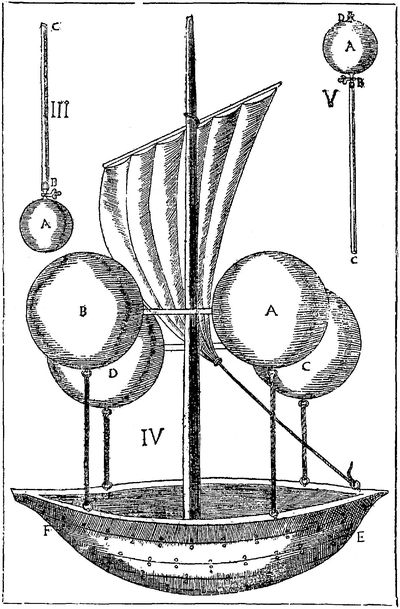
 (Note the optimism of the engraving above: with reference to the defensive kites, the balloons are moving *against* the wind; indeed our engineers are working hard to make this possible.)

.
Limitations of the previous design are the natural cooling of the enclosed air and the very restricted mobility. Our Project 20, currently halfway from completion, is an airboat with total autonomy for several days and some control of its movement.
Concerning the first point, the simplest solution would be to devise a light brazier to keep the enclosed air as hot as desired to permanently control the height. The airboad wil ‘sail’ a favorable wind like a ship on the sea. But promising recent discoveries are currently integrated in this Project: the power of thunderbolt decomposes water in two gases, the one obtained in higher yield being far less dense than air!
Concerning the second point, manhandled wings (following Da Vinci pioneer designs) and large screws are under comparative trials on scale models and nacelles hanging from a wooden scaffolding.

Long distance communication between the airboats and the ground could be soometimes a problem, so the technical description of a "heliograph" is inserted in the Patent: this ingenious device uses a mirror to reflect sunlight to a distant observer. By moving the mirror, flashes of light can be used to send messages (a simple but efficient code using short and long flashes is provided free). The heliograph is a simple but highly effective instrument for instantaneous optical communication over 20 leagues or more.
While the visionary drawings attached mainly show such airboats as part of an amphibious (and even 'triphibious', with a tunnel digged by our chtonian Taupe-Behemoth) invasion, they obviously will be of general use, from carrying dispatchs and Generals to reconnoitring, resupplying a besieged place, supporting land troops with direct fire, and long distance bombing.
This Patent using the innovations protected by Patent 19, their simultaneous acquisition is compulsory.

Our engineers devised a parachute to ensure the perfect safety of the crew.
As for the armement of such aircrafts, delayed rockets shot by some kind of springal / crossbow would be far lighter than guns. Against ground targets, the crew would drop (profiled and feathered?) grenades and bombs, but a simple weapon, efficient if dropped en masse, would be mere leaded darts with a 'howling banshee' whistle attached. Specially useful to 'soften' enemy troops just before the impact of a ground charge. Whether the addition of huge ribbons would make them even more frightening to horses without allowing infantrymen to dodge them more easily, is debated. To carry out real-scale experiments, the team in charge of this subproject had a protruding platform built at the highest point of a cliff overlooking a quiet calanque.
Addendum: Monte-Cristan engineers never cease to work!
-Progess in the development of a screw propeller for Project 20:

The device was tested as depicted to assess its power by the measure of the decrease of weight obtained. But, the main concern being with the control of direction, it will be used with its axis horizontal. The current idea is to have a pair of such airscrews (called 'helices' by Monte-Cristan engineers), one on either side of the airboat, to act as differential rudders.
-Development, from the simple 'parachute' project, of an advanced system transforming a man into a bat:

Actually such a «batman» would not take-off from the ground, but would perfectly control his flight down from a balloon. This device not only brings an increased safety for the ballooners, but introduces the real possibility of dropping troops (or spies) from the air - if necessary from quite a distance from their objective.

Futuristic models on display:

 (Bogdanwaz developing the 17th C. concept of Father Francesco Lana, C.J. )

The mysterious ascending power of hot air is used since the Middle Ages to rotate spits connected by rods and cogwheels to fans in the shaft. Our innovative concept is to enclose enough hot air in an airtight membrane to raise a light nacelle with a few passengers. A crucial point is the nature of the airproof material; waxed paper, waxed silk and pig bladder, among other, were tested: the final choice is currently finalized. For stability the airskiff will be fastened to the ground (or to some heavy wagon, allowing limited mobility) by a length of very light but hard-wearing rope. Spider silk is most suited, and indeed growing spider webs, harvesting, treating and spinning the silk are parts of a separate project of the Departement de Zoologie, Bureau de la Recherche Appliquee. The screening of spider species for the most appropriate to profitable domestication is under way.
The location, deployment and movements of the enemy will be discovered from above and afar, no longer concealed by distance, relief or front rank.
Patent 20: le Bateau Aerien Ameliore Libre (BAAL)

.

 (Note the optimism of the engraving above: with reference to the defensive kites, the balloons are moving *against* the wind; indeed our engineers are working hard to make this possible.)
.
Limitations of the previous design are the natural cooling of the enclosed air and the very restricted mobility. Our Project 20, currently halfway from completion, is an airboat with total autonomy for several days and some control of its movement.
Concerning the first point, the simplest solution would be to devise a light brazier to keep the enclosed air as hot as desired to permanently control the height. The airboad wil ‘sail’ a favorable wind like a ship on the sea. But promising recent discoveries are currently integrated in this Project: the power of thunderbolt decomposes water in two gases, the one obtained in higher yield being far less dense than air!
Concerning the second point, manhandled wings (following Da Vinci pioneer designs) and large screws are under comparative trials on scale models and nacelles hanging from a wooden scaffolding.

Long distance communication between the airboats and the ground could be soometimes a problem, so the technical description of a "heliograph" is inserted in the Patent: this ingenious device uses a mirror to reflect sunlight to a distant observer. By moving the mirror, flashes of light can be used to send messages (a simple but efficient code using short and long flashes is provided free). The heliograph is a simple but highly effective instrument for instantaneous optical communication over 20 leagues or more.
While the visionary drawings attached mainly show such airboats as part of an amphibious (and even 'triphibious', with a tunnel digged by our chtonian Taupe-Behemoth) invasion, they obviously will be of general use, from carrying dispatchs and Generals to reconnoitring, resupplying a besieged place, supporting land troops with direct fire, and long distance bombing.
This Patent using the innovations protected by Patent 19, their simultaneous acquisition is compulsory.

Our engineers devised a parachute to ensure the perfect safety of the crew.
As for the armement of such aircrafts, delayed rockets shot by some kind of springal / crossbow would be far lighter than guns. Against ground targets, the crew would drop (profiled and feathered?) grenades and bombs, but a simple weapon, efficient if dropped en masse, would be mere leaded darts with a 'howling banshee' whistle attached. Specially useful to 'soften' enemy troops just before the impact of a ground charge. Whether the addition of huge ribbons would make them even more frightening to horses without allowing infantrymen to dodge them more easily, is debated. To carry out real-scale experiments, the team in charge of this subproject had a protruding platform built at the highest point of a cliff overlooking a quiet calanque.
Addendum: Monte-Cristan engineers never cease to work!
-Progess in the development of a screw propeller for Project 20:

The device was tested as depicted to assess its power by the measure of the decrease of weight obtained. But, the main concern being with the control of direction, it will be used with its axis horizontal. The current idea is to have a pair of such airscrews (called 'helices' by Monte-Cristan engineers), one on either side of the airboat, to act as differential rudders.
-Development, from the simple 'parachute' project, of an advanced system transforming a man into a bat:

Actually such a «batman» would not take-off from the ground, but would perfectly control his flight down from a balloon. This device not only brings an increased safety for the ballooners, but introduces the real possibility of dropping troops (or spies) from the air - if necessary from quite a distance from their objective.
Such man-powered hang glider would be precious for State agents in 'delicate' missions.

Futuristic models on display:

 (Bogdanwaz developing the 17th C. concept of Father Francesco Lana, C.J. )
(from)
.^-^.
Warning: don't buy such tickets, they are a fraud!

.

Updated: this artist's rendition of a heavy airborne troop carrier appeared on a broadsheet published in a foreign country; the Monte-Cristan Service de documentation Exterieure is investigating, so much the more as the article referred to a very intriguing military use of steampower.

Without keel, sails are unfortunately useless...
^-^
Objets Volants Non Identifiés

(Monte-Cristan cartoon published after the first public trials of our flying contraptions)

Various very optimistic designs:


1 comment:
Discussion of "MUNCHAUSENIAN EXECUTIONS OF DA VINCI'S FLYING MACHINES"posted as comments on dec.28."10 to the 'Lace Wars SCi-Fi?' post.
.
Post a Comment