
(Last update -main text or comments: O3.26."14)
 Perhaps taking inspiration from C. Grant’s «Vereinigte Freie Städte» (in 'The War Game', left) and P. Young’s «Electorate of Teutoberg-Althaufen» ('Charge!', right) you lovingly designed an original army for your own fictitious Lace Wars country. Then you wish your brainchild to ‘look right’ on the tabletop, to your own eyes (you probably have at least some general knowledge of what historical armies of the period looked like) and also to the eyes of other wargamers, including the –perhaps a priori prejudiced– hard-boiled ‘historical’ ones. What are the requirements for the army you built for your own ‘Tricorne’ imaginary country to «look right» on the tabletop, even to the eyes of a purely (and purist) historical wargamer? First of all remember that: "Rule 1: It's MY army, d***it! Rule 2: In case of doubt, see Rule 1!". Of course it’s YOUR creation, ‘locally’ you are the Ruler and your word is the Law. And indeed you can quote some odd (and short-lived) historical precedents: Potemkin Russians, late 18°C. Swedishs… Nevertheless most of you Imagi-Nation rulers wish to obtain a ‘credible’ result. Here I’ll try to review some critical factors, and develop arguments to rationally justify differences from major historical armies of the period. This text aims to be a synthesis of the debate initiated on the Old_School_Wargaming Yahoo group by Robert Piepenbrink’s very erudite post (message #17997). I’ll successively treat 7 topics :
- The color(s) of the ‘basic’ line infantry coat
(credible diversity in inverse proportion with the *size* of your country)
- Other Arms
- About Colors and Colours
- Fictitious uniforms from later periods and the SYW templates
- Web resources
- N. American troops in fictitious Lace Wars Europe?
- 'Logically'designing the appearance of an imaginary army (edited O1.01."13)

I- THE MOST CRITICAL (CRITICIZED) POINT: THE COLOR(S) of YOUR ‘BASIC’ LINE INFANTRY COAT
 Historical H&M wargamers are mainly familiar with armies of the major powers. The bulk, the most visible, conspicuous part of such forces was the infantry, mainly the ‘basic’ line regiments of national recruitment. Now in most historical cases all these units wore a coat (the most obvious part of the dress) of the very same color –chosen from a very limited range of hues. Thus the main visual feature of historical H&M armies was the homogenous, almost monochromatic mass of identically uniformed infantry –and, roughly, only either in off-white, blue, red or green. I’ll try to bring forward several rational, historically based arguments to justify a departure from this so-called ‘universal rule’. This, at two levels: the diversity of infantry coats colors within a given army; the use of ‘unorthodox’ coat colors.
As for DIVERSITY, the decisive factor is the supposed SIZE of your mythical COUNTRY (and thus the supposed overall strenght of your mythical army).
Let's start with a typical –already respectable– LaceWars tabletop army as fielded by each of C. (& C.S.) Grant's mythical countries. °Infantry: 12-14 regular battalions/ regiments (half of them with battalion gun, if your rules allow); of them 9-12 will be of the ‘basic’ type of national recruitement, the balance national units with elite / veteran status (Guard, ‘Old’ regiments, converged grenadiers, fusiliers in the British sense, marines…) and foreign infantry. One, at most two unit(s) of light/ irregular infantry; one or two units of pioneers / militia.
°Cavalry: up to 2 units of light/ irregular cavalry, 5-6 regiments of `Heavy Horse', half (rounded down) of them Cuirassiers / Gendarmes/ Carabiniers / `Horse'/ Dragoon Guards… often wearing at least a breastplate, traditionally deployed in the 1st line, one of them perhaps of Guard/ Elite status; remainder (ordinary) Dragoons (2nd line, 2nd rate, expendable), one of their units possibly promoted to Horse Grenadiers.
°Artillery: 6-7 (1-model –specially if you already fielded battalion guns– or 2-models) batteries of artillery, mainly 12 pders if infantry has its own guns, half 3-4 pders otherwise. Perhaps one battery can be heavier (16 - 24 pders) as Guard/ Elite artillery, one of howitzer(s) to field 'bombardiers' with their special uniform; while rather progressive for the time, a single galloper piece with mounted crew would allow you to enjoy colorful horse artillery uniforms.
BTW, as for the nature of the minis, my rule of thumb is that, for the army to ‘look right’ as a normal, ‘classical’ western European one, at least 2/3 of the minis have to be in totally ‘normal’ (western European) uniform: tricorn, justaucorps (except perhaps HC with full cuirass), no pointed ('Polish') cuffs (except for a few units related to Poland and actually wearing them before 1750), full (front & back) turnbacks, even if 'unhistorical' for the considered country by 1745, waistcoat, breeches, gaiters or high boots. Only a few elite, or on the opposite militia or light troops (or a few 'experimental' bodies such as de Saxe's 'daydreamed legion'), would wear another headgear or /and some ‘exotic’ dress. This 'rule' comes from decades(!) of observation of contempory paintings and OOB of historical battles, and from the armies fielded by Charles Grant to refight some of them.

Now, as a ruler, you can fit if one of the 2 following cases:
I-A Your tabletop force actually represents the actual strenght of your army, you are ruling some *SMALL* (even if entitled 'Great') Duchy/ Magraviate/ Principality/ Bishopric/ League of mercantile towns. Then no problemo, your orders of uniform cloth are too small to warrant a significative discount, so let every colonel dress his unit as he likes. Historical precedent, such as Spanish foot before its grey-bourbonization, fully allows you to field an infantry line displaying all the colors of the rainbow and some more (some dyes being nevertheless more expensive and thus less frequently used –purple, bright durable yellow; other uncommon because out of the traditional range of heraldic colors, e.g. brown). The Emigres regiments of French revolution provide another historical precedent: except for a few units in British uniform, each colonel freely chose the uniform of the regiment he raised, and several were quite coloful.
BUT then, in order to have an army looking like the force of a Nation, not like a patchwork, a random/ ramshackle collection of heterogeneous bodies of troops, take care to have several FEATURES at least COMMON to all your ‘basic, national’ line infantry, some UNIFYING details.
1°In the Spanish exemple quoted above the common uniform part of all Spanish tercios is the combination of red stockings with yellow breeches –in Lace Wars times, with gaiters concealing the stockings and the waistcoat now visible, it would translate as ‘red breeches and yellow waistcoat’.
2°Another element of homogeneity is the way you dress your drummers, again at least to all your ‘basic, national’ line infantry units. Either all with coat in ‘reversed colors’ and not much lace, OR all with coat with same colors pattern as the troops and a lot of livery lace. Of course in any case the equivalent of ‘royal’ regiments will have their drummers in the ruler’s livery.
3°Keep constant the pattern of your infantry FLAGS: the French white cross, the Prussian black ‘iron cross’, the Spanish crossed red knotted staffs….
I-B Your tabletop force corresponds only to a (small) part of your paperstrength, and/or when playing 'campaign' battles you use the additional representational scale «1 tabletop bton = a whole brigade», as C. Grant when wargaming large historical battles. Then you rule a *LARGE* country. {If this country is a League, a (con)federation, each province, canton, diocese, town… providing a contingent in a distinctive uniform, -or if you field a mixed force of troops from several allies- the army will probably be even more variegated as in the case above, a rainbow assemblage with uniforms of different cuts and flags of different patterns}. But if you rule a large unified, centralized country–Hungland, Hyspania, Gallia, GrossGermania… then your Chancellor of the Exchequer is adamant: at the very least for the most numerous & less prestigious part of the Army, the native line infantry, you *have* to buy military cloth by the shipload, at wholesale bulk price –and it must be both cheap and durable. Thus your infantry will be rather uniform (gloomy ?) at least in its coat, and your lines of infantry will look almost monochromatic when seen ‘en masse' on the tabletop.
 To expand a little, one can observe that the choice of either a dyed or undyed coat for the bulk of the infantry is somehow related to religion: with some oversimplification one can observe the tritomy : coat dyed red or dark blue (and grenadiers with mitres) = Protestant countries, green coat (and grenadiers with helmet-mitres)= Orthodox, grey to off white undyed coats (and grenadiers with bearskins)= roman Catholics (but then several Reformed countries adopted the bearskin later, at least for the Guard, so your imaginary one can be merely in advance («progressive protestantism» ?… ). In western Europe dyed infantry coats were more frequent northward, undyed ones southwards: a mere side-effect of the religious geography? Did dyed coats fade more quickly under a southern sun? Was the contrast between off-white cloth and bright facing colors more in harmony with southern exuberance than with northern austerity?

NATURE of the infantry coat colors in 'uniform' ('large') armies
IB-1 Dyed (great)coat :
IB1-a Basic line infantry: differences between regiments varied with Country. In British service variation of facing color was complemented by individual regimental lace, and ‘royal’ units wore blue small cloth; in Prussia details of lapels, lace and facing color individualized each regiment; while in Russia the whole line infantry had a single uniform. Remember that cloth and dye quality varied with rank (private /sergeant // officers) giving in most armies a perceptible gradient of shades (darker-dull to brighter).
IB1-b Elite and foreign units:
 IB1b-1: Elite/Guard units of Foot: generally same color as 'line' but 'Guard' flags & drummers livery. Cloth and dye quality varied often also with the seniority / status of the unit, so a mere guardman can wear an uniform of 'line' sergeant quality if infantry (of 'line officer' if cavalry): thus possibly Elite/Guard units wore a coat of a slightly brighter/ lighter shade [indeed at some time the 'green' of the Russian Guard was different from the line's].
IB1b-2: Foreign infantry: I have to confess my ignorance. For some reason foreign troops seem to have been far less frequently used by countries with infantry in dyed coat. AFAIK Lace Wars Sweden and Russia used none; the best British approximation would be Hanovrian foot; the Netherland used some: according to these very well illustrated Dutch uniforms plates, infantry of the United Provinces displayed so diverse uniforms by the Lace Wars times that it’s not really possible to draw a general conclusion.

IB-2 (Un)bleached, grey to off-white (great)coat
IB2-a: Basic line infantry: historically allows nonetheless a surprising amount of variation even for native ‘line’ units:
IB2a-1: grey came 1st, so some traditionalist 'old' regiments kept it while junior units were already in off-white (Picardie in France): veteran status?
IB2a-2: waistcoat of the facing color: initially common, but expensive (waistcoats the same color as (great)coats were made from reformed such; you could not really do the same & obtain a colored waistcoat merely by reversing the coat (like the traditional turncoat changing sides) since the lining material was generally lighter). Soon out of fashion & discarded in France (together with a lot of lace) but kept (as was the lace) by some regiments with special status (Regiment du Roi).
IB2a-3: dyed breeches: (often, but not always, of the facing color): rather common in Spain & Italy; also Hungarian infantry.
IB2a-4: lacing was rarely worn on off-white coat for want of contrast (being as a rule either yellow or white according to the metal of the regimental button). But brightly colored buttonloops had been known before, specially in eastern Europe: thus you are perfecly allowed to decree that at least some of your infantry will wear coats adorned with buttonhole lace in the facing color (then you’ll have to do the additional painting!).
IB2-b: Elite and foreign units: often quite different from the native ‘line': with dyed coat (even Austria with the ‘Staff' regiment). Waistcoat & breeches often dyed also. Often a lot of lace – it shows well against a colored background, expense was not a problem for Guard units, ‘national' tradition could play a part (Irish regiments in French service were ± part of an English army in exile).
IB2b-1: Elite/Guard units of Foot: again it would be practical for easy identification on the tabletop (this time to distinguish them from foreign regiments), to give then ‘gold’ button & lace, ‘ordinary' regiments being restricted to ‘silver'.
IB2b-2: Foreign infantry: in France the color of the coat generally indicated the nationality: red for Irishs and Swiss (was it exactly the same red?), (dark) blue for Germans, brown for Italo-corsicans. Sometimes kept a few pecularities from their native country, in the lacing, the lapels or cuffs, the small pompoms in the corners of the tricorne.
With ‘uniformed infantry’, the main color of the coat worn at least by the majority of the foot regiments provides your army with an already homogeneous, ‘individualzed’ character. Thus you can relax somewhat the regulation about drummer coats and allow a few colonels to dress them in their own livery. But keeping an homogeneous pattern for the flags remains essential.
IB-3 Your «uniformely clothed foot» army & its historical prototype:
 IB3-a: with such an army you can chose to design a force corresponding to a well-identified historical large & powerful prototype: Gallia= France, GrossGermania= Prussia, Hungland= Great Britain… Then KEEP THE COLORS PATTERN OF YOUR HISTORICAL PROTOTYPE, it will make the correspondance obvious & give your Imagi-Nation its character. Actually this requirement applies at least / merely to the masses of *line infantry*, and only to the color of the *coat*, which is what strikes first when the army is deployed on the tabletop. Additionally your mythical army will then more easily moonlight as an historical one when refighting a battle. C. Grant used his French white-clad Lorraine foot as Austrians for Mollwitz and, had ‘The Wargame’ be illustrated in full colors, he would have been glad to own some red-coated Hunglish or Brittonian or Danelawyer infantry to play the part of the British at Bunker Hill (and Fontenoy).
Then as surely as, in Conan's hyborian world, Stygia 'is' ancient Egypt and Aquilonia 'is' medieval France,
- infantry in uniform red coat will look 'British' & will fit with your Britannia / Brythunia / Anglishopry and –same king– Hangover..
- infantry in uniform dark blue coat will cry 'Lutherian' (Prussian or Swedish), thus will be suitable for °Germania/ Prussland/ Grossdeutchland/ Alemany/ Branleburg but also °Ikeaway, (Prince Valiant's) Scandia, Northeim, Suede (but only the Palace Inner Guard will wear blue suede shoes)…
- infantry in uniform dark green will be suitable for any variant of Russia, either °'southern' (some well & alive Eastern Roman Empire: Orthodox –unless converted to the monotheist cult of Mithra or Isis some 1400 years ago, anyway using an alphabet derived from Ancient Greek, submitted to a lot of eastern influence (even if more from Anatolia than from the Steppes), or °'northern' (if you care to remember that Santa Claus wore green before Coca-cola seized him), or even °'far western' (that russo-mongolo-chinese-native american country in north-western America),
- infantry mainly in light grey to off-white will point to some (large) Roman Catholic country: ° with more frequent colored waistcoats & /or breeches: Hispania, Antiglia (oversea), Castanettas y Calecon, Mantillia, Hysteria (merely because it sounds 'latin' & thus ‘roman’), Castapiana, Tilea, Tagliattella, The Serenissime Mercantile Oligarchic Republic of Zennice, Pizzamargueritta… ; °with white more proeminent: Gallia, Francia, Bourbonnia, Burgundy (with burgundy as the Grand-ducal color), Camembert-et-Roquefort, Grenouillere, Ostrichery, Oysteria {but the Blue Oyster forces (a ‘cult' army) will of course be in cornflower}….
IB3-b: BUT DEPART SOMEHOW FROM YOUR HISTORICAL MODEL :
IB3b-1: Distinguish clearly the ‘universal’ –the main color of the infantry coat and the general pattern of the flags– you respect from the ‘parochial’, ‘temporary’, the ‘historical accidents’ you can largely temper with: e.g. British & Russians at some time replaced their red breeches by white ones, it could have happened earlier in ‘your' country (or they could have used cheap buckskin or unbleached wool for the ‘line’ infantry); non-elite foot can wear instead pale neutral grey, buff or pale ‘confederate chesnut’ smallclothes (or just breeches, waistcoat being assorted to the coat): all these would not hinder, make ambiguous, the identification of your ‘historical reference’. ‘Prussia’ could have used light blue for the smallclothes of its regular infantry, with dull grey, buff (memories of buckskin breeches), chesnut or maroon for thoses of the Frei Korps (who will raise a ‘Frei Corpse’, btw?)….
IB3b-2: A given ‘major color’ corresponds actually to a range of shades, so you may depart somewhat from the ‘authentic’ hue used by your historical prototype. Anyway, whatever red you’ll paint your British foot, you’ll be told its not exactly of the accurate hue, so… There is a whole palette of medium to dark greens. Modern (chemists’) ‘Bleu de Prusse’ tends *slightly* to emerald, so could provide an alternative to ‘historical’ dark blue; on the opposite you can add a few drops of violet to your dark blue to obtain a dark indigo.
IB3b-3: Paint the colors pattern of (the coat of) infantry of your historical model (the feature that is immediatly ‘seen' & ‘identifies' your nation) on minis intended to represent another nationality: dark blue on Russians, red on Prussians, russian green or off-white on Britishs… With headswaps you can permutate grenadiers headgears (religious alignement or time-switch), and obtain light infantry left flank companies by substituting a {mirliton, busby, cap, bonnet /beret, spanish & italian chechia-like traditional headgear or helmet} to a tricorn; or obtain a traditionalist quasi-russian Guard by giving a more modern mini the odd headgear of Peter the Great’s guard (Strelets*R - The Guard of Peter I)…. Modern highlanders feathered bonnet would make an interesting variant to bearskins. By combining the head of a Napoleonic French dragoon (cuirassier for the elite companies) with the body of a WAS Austrian infantryman (Prussian for the 'velites' light infantry) or French dragoon you'll obtain a ‘soft' version of de Saxe's «daydreamed» mixed Legion (the ‘hardcore' version would require plug bayonets, boiled leather pavisas and half-pikes for the close-order infantry, and a lot of 1/2 pders ‘amusettes'! –and corresponding rules amendments)…. And what if the same de Saxe had chosen some form of pickelhaube (spelling ?)/spiked helmet instead of an ‘ancient roman' model?
IB3-c: AND keep the characteristic general FLAG PATTERN of your model, changing some details: give an imperial roman or napoleonic black eagle to semi-Prussia (carefully keeping the ‘ironcross’ background), a Paratrooper, Judas Priest or GW Imperial Guard eagle to Ostria, a purple double-headed eagle to quasi-Russia…
II- OTHER ARMS
II-A: Cavalry and Light Troops: Even in a large ‘uniformed’ army cavalry and light troops are almost always more colorful than the infantry, even for red-addicted British (not only with the `Blues', but also the Chasseurs Britanniques, and were not the North British Dragoons initially in grey?). For a mythical Britannia you could add Hanovrian cavalry & light troops -same King- &/or ‘borderline’ British types: Jacobites ‘hussars’ of the '45 (tartan tight trousers?), light lancers in blue bonnet (rather ECW, but in your world some mounted militia/yeomanry of Border Horse/ Border Reivers ascent may have survived); and what about Eirin Loyal Dragoons wholly in traditional saffron with 'irish green' facings –not orange, don’t ask for too much (with a mounted bagpiper)?

IIA-1: ‘True’ (heavy) cavalry was the most prestigious (& expensive) component of the army, so generally alloted good quality cloth & dyes and often a lot of lace; always gaudy and Elite/Guard types could be quite glamorous. ‘Royal' red or blue, but also very often the white-to-yellow range as a memory of the buff coat of late Renaissance armored cavalry (in Piedmont-Savoy ‘true' cavalry for sometime wore blue in peacetime, buff in the field: from ’Uniforms & Colours of the Army of Savoy from the late 17°- to the late-18° cent.’: in italian, but so abundantly illustrated that it's really not a problem; extremely rich, highly recommended; similarly red cloth or buff for the Cuirassiers of Saxony). In France the foreign regiments followed the same color pattern as their foot counterparts. Two national pecularities: in France ‘light cavalry’ actually designed (as late as the WAS at least) all the ‘heavies’, including the Cuirassiers du Roi and Carabiniers, by opposition to the ‘Gendarmerie’ (Household cavalry & Gendarmerie des Provinces), proud heirs of the Gendarmes (men-at-arms) of the late medieval Compagnies d’Ordonnance. The British ‘Dragoon Guards’ were not dragoons at all, but ‘Horse’ declassed to be less expensive. As a compensation they were granted the ‘Guards’ title and kept rectangular standards; they were always seen and used as true heavy cavalry. And while dealing with heavy cavalry, since WAS kings and marshalls still wore 3/4 armour on official paintings, what about a traditionalist regiment still using it on the battlefield? Just a tricorne by headswapping, some minor conversions (green stuff?) of saddlery and the higher part of the boots and, yep, here you have your Alten Reitres regiment (on black horses, obligatorily:«Der Tod rei’t auf einem kohlschwarzen Rappen» [‘Der Tod in Flandern’,WWI (1917) anonymous poem, later put on a traditional melody by Elsa Lauravon Wolzogen. Quite impressive, beautiful and almost gothic text].
Reiters of Princess Trixie’s Army:

A striking exemple of Extra-Heavy Cuirassiers in 3/4 armor, by ‘Otto’, the owner of the SOCDAISY Yahoo group (with his kind permission). He describes his conversion :
«The Reiters of the Purple Sage are quite unique: I chose them for the 3/4 armor that you see in so many pictures of the leaders of this time and I figured why not use a whole unit of them.
They are old 30mm Willie Cuirassiers from the Renaissance-30 Years War Range and were quite chewed up over the years. I did some radical conversions of them by carving off the saddlcloths, lopping off the full helmets and replacing the heads with Russian 7 Years War figure heads that I chopped off some FrontRank figures I bought at a convention. Too heavy and fat for me, the figures had heads though that were just the right size! The saddle cloths are those I PRINTED out from my Corel Draw Artwork program on a regular printer on glossy photo paper. This was glued on and it makes a very nice presentation and you can do some nice detail work with it so long as you don't need undercutsor curvs. All the flags by the way are done that way. The swords are all Styrene from Evergreen Industries, a supplier of model Railroad styrene.They are quite flexible and last a lot longer than metal sword and- when they do break, are much easier to replace. I simply push out the broken butt from the hand and glue a new one in.»
A *lot* of other photos of Princess Trixie’s Army are on display on the SOCDAISY Yahoo group.

IIA-2: Dragoons: their similarity with ‘true Horse’ increased as their ‘mounted infantry’ origin was forgotten, until eventually they substituted trumpets to their drums. Their constant distinction was the use of a ‘bilobate’ flag (guidon) rather than a rectangular standard, as a mark of lower status. This goes back to feudal times, when the «chevalier banneret», allowed to command other knights, was allowed a quadrangular ‘banner’, while the «bachelier» (bas-chevalier, ordinary knight) was only allowed a ‘pennon’, pointed & often divided (thus in some armies, hussars of even lower status had a ‘swallowtail’ flag). Otherwise, in those armies where dragoons were just cheap, second-rate cavalry, they differed from ‘Horses’ mainly by the coat (in British service, with almost everybody and his brother in red, you need to be a specialist to recognize them on the tabletop). Perhaps dragoons *at first* rarely received coats in the white-to-yellow range (or were soon deprived of) because, as mentioned above, it was a mark of the prestigious heirs of armored cavalry? They received cavalry-like uniforms, including white coats in some countries, later, when accepted as true heavy cavalry: as some kind of unarmoured cuirassiers. WAS French dragoons provide an interesting case: their ‘mounted infantry’ role was not forgotten, each carried an entrenching or woodcutting tool to act as a pioneer clearing the way to the army; they still wore leather gaiters instead of boots, were often associated with grenadiers in ‘special ops', &c… The abundant lacing (and the very cut) of the coat & waistcoat put them apart from ‘true’ cavalry (which already had lapels instead) and was now obsolete for ‘French’ infantry. Their (generally red) dyed uniform dated from their creation in the 17° cent: by then the infantry was not yet fully ‘uniformed', and additionally they appear to have been initially perceived as what would later be called ‘light troops’, specialized in scouting and extorting ‘contributions’ from enemy towns (a song from the time reports with a naive bluntness that «At the sound of their fifes and drums, Mr de Turenne's fierce dragoons crossed the Rhine, burned down Koblenz and looted the whole Palatinate»). Light, quasi-irregular troops always had more freedom of clothing, so initially there were green, yellow, brown, blue (various shades) and red regiments of French dragoons! Calmed down by the 18° cent., but other hues than red & blue may have been selected in some 'alternative' France –Sea green, Condé’s ‘ventre de biche’, monk-brown… .
 The mounted part of mixed legions of light troops, when not designed as hussars, were generally called ‘Dragons’. Actually they represent another type of mounted troops, light cavalry, forerunners of the ‘light squadrons’ and then ‘light dragoons’ regiments (chasseurs à cheval or chevau-legers elsewhere). Early ‘Jägers zu pferde’ were actually staff personal, couriers, just like the French ‘staff guides’.
IIA-3: Hussars. If you feel your infantry monotonous («Boredom was born one day from uniformity»), make up for it / recoup yourself with a vengeance with your hussars & run freewheeling. Here you can use all your flashy/ fluo paints. You can even try some unorthodox painting techniques to obtain an ‘exotic’ effect, such as the ‘fresco’: on a still wet water-based (ans a little thicker than usual) white undercoat or paint, sofltly (but as many times as you feel required) pass a bright, intensely colored artist’s ink. Using a pale-colored basis instead of a white one gives increased effect: no special difficulty if the undercoat is of the same general color as the ink, but to obtain a fully shimmering/ silky/ ‘pigeon’s throat’ effect you can use e.g. green or red on a yellow background, or green or magenta to violet on a pale blue one.
IIA-4: Light troops (on foot and mounted): here we must distinguish the fully regular and uniformed jägers and later light dragoons, from the semi-irregular types which in France were e.g. not allowed to benefit from the army’s logistics and (even more doubtful) medical facilities. For this later type colonels kept up to the WAS at least, specially in French service, total freedom to design the uniform of their (often mixed) legion or Frei Korp –the cost was for their own purse- and in France at least used largely of this freedom. Several French hussars regiments received for a time a contingent of foot chasseurs -uniform of the most classical cut: tricorne, justaucorps, waistcoat, white gaiters… but faithfully reflecting the unorthodox colors patterns of the hussars; an historical precedent to exploit more widely (wildly?). The Condé-Clermont Prince family dressed its unit in the familial livery, one Britton noble dresssed his locally-recruited Volontaires –including the foot fusiliers– as hussars with a rather original combination of unusual colors… The first ‘modern’ helmets appeared on such light troops.
The cut of the uniform was often ‘original’ (e.g. the Grassins, Miquelets, Grenzers and Pandours):
-which suggest to use 18th C. minis already in 'exotic' uniforms, such as *French Marines in campaign dress in Canada or in Florida, ‘Milice’, and French in India (= ?), but painting them as 'light foot' of the European theatre (forester green, burgundy facings, deerskin gaiters; or...); * of course, Anglo-Saxon FIW and even AWI rangers, riflemen, frontiersmen, English light infantry, Anglo-Americans in short coats, Provincials, militia in summer dress … are of use, provided they are not obviously in fringed hunting shirt (erase any peak on the caps / helmets, they'll less look 'late 18th C.') - not restricted to quasi-British armies, btw: even those in blue bonnet can be exiled Jacobites; * id° for minis of Half-breed, Indian and Black (Pardos, Morenos, Negros) units from Mexico, the Caribbean and South America, even AWI Black troops and Jamaicans;
 * Marines and American FIW - AWI militia, if in short coat, (and specially with some kind of cap for the privates- then, if available, with tricorn for sergents) also make good light infantry in Europe; * The same for GNW Russians and Swedes in cap;
* Spanish militia with head scarf makes credible light foot in other countries;
* Culloden Lowlanders, by some paint conversion (adding a *lot* of braiding dolman-fashion on the upper garnments, low boots at the feet; blue bonnet and tartan trousers, of course), can be turned into "Scot-Grenzer ‘hybrids’";
* perhaps after an headswap or a greenstuff alteration of their hat (to modern ‘picador’ one), Mexican 'Dragones de Cuera / Cuereros' become Jinetes; after receiving the same tricorn, would make a great mixed Legion with the historical Fusileros de Montaña;
* a mixture of Bosnian, Croat Serb and Moldovian frontiermen from any 'Ottoman' range, with 'janissaries' as officers, become a Frei Korps of Eastern recruitment;
* a mixture of swashbucklers, pirates, Sailors (even some unarmoured Late Renaissance ones in short breeches), sea dogs, Marbleheaders, smugglers, seamen, highwaymen and rogues (basically same *numerous* manufacturers as for female minis –yes, including Shadowforge ‘Laughing Monk’– + Artizan, Crusader, Dixon, Foundry, Privateer Press, Redoubt, TLWR, Warrior...), perhaps with a few (Royal?) marines and FIW or even AWI militia minis with tricorn (# as sergeants) and one or two officers in old-fashioned dress, all with tricorn (headswap) and painted in uniform colors (with -paint conversion- shoes and, at least in Europe, stocks), would provide a ('rabbid' harbour) militia or landing party unit, 'light' here as unfit to hold its place in a regular line of pitched battle ('Charging Irregular Infantry in WRG parlance);
* Russians in waistcoat with cape, worn or rolled, if suitably painted ('checked', Gallic-Briton pattern, cape of greens on a brown-orange 'dead leaf' background, silver birch grey uniform with moss green facings, buckskin gaiters?) become 'chasseurs à pied'; (also fitting for *any* regular line infantry in oversea service, btw);
* the same with the cape on (e.g. SYWR18), with dark red cape, deep crimsom waist, checked breeches, deerskin gaiters -natural leather boots if of 'Observation Corps' type-, can be used as 'Welsh in America', or at least their sergeants;
* some Eastern European rulers raised 'Turkish-fashion' guards, and de Bussy had an unit of such 'Cafres' in India. Giant enturbanned Blacks with 2-hand scimitar (from some Fantasy range), with the addition of a blunderbuss or, better, jezzail for privates, provide an imitation of the 'Calife's Black Guard'; for the silk of such costumes, iridescent / opalescent nail varnishes -either of suitable color, or transparent and almost colorless above a bright color- give very good effects.
* And, more for their fashionable exoticism than any military consideration, you can 'import' as light troops Red Indians or Black Africans.
-But this historical precedent also allows to use minis intended to other periods as Lace Wars light troops:
** Late Renaissance *light* Croat, Hungarian or Polish cavalry types (as painted by Velimir Vuksic) would provide you with the wildest type of Pandours. Late Renaissance Cossaks light horse are also colorful.
* Late Renaissance Foot Transylvanians, Poles, Cossacks and Strelzi can be used as ± irregular ‘charging’ infantry.
* Unfortunately not illustrated on the respective sites, Minifigs and OldGlory TYW Croats enjoy a favourable reputation as 'Maria-Theresa's Wild Men'.
*Extra-European types, such as light Turk Sipahis, can also be used: 'Turkeries' were fashionable.
*Even wilder choices can be endvisaged, such as (±converted) * 19°C-early 20°C Tatars, Mongols & Tibetan horsemen, * or on the opposite {not too amoured, shieldless types of} Attila’s Huns and Gengis Khan’s Mongols, to provide the equivalent of Baskirs, Kalmuks or Lithuanian Tatars auxiliary light cavalry. Don't feel 'shocked' by the suggestion: think of Napoleonic Circassians in Russian service (were identical in the 18th C.), and de Saxe's Uhlans were initially intended to wear a mailshirt and to wield a mace! Too bad no contemporary drawing of this planned uniform survived, afaik, this already 'exotic looking' unit would have been even more spectacular.
 *Western European types of the 17th C., if in 'local' costume, can also be used, e.g. * ECW Irish foot (with musket; green west, checked trousers: Irish rangers in North-America?) or * Scot lancers (with blue bonnet). * Symmetrically Irish of the '98 (with musket, sergeants with the historical 'half-pike') can receive the colors pattern of Fenian zouaves (again some 'wild' type of Irish foot in North-America?).*Troops in old-fashioned uniforms with karpus / kabuds/ pokalems look quite like de Bussy's Frenchs.*Old-fashioned Dragoons, still trained and willing to fight on foot, could be part of the Light Troops by the mid-18th C.
*at the cost of some conversion of the lower body, Bonaparte's camel riders (with turban) on Mamelucks' horses become Turcopoles...
*Late 18th C. (Dane) Bosniaks and Napoleonic (French) Lithuanians would look good in a Lace Wars army [yet in the mid-18th C. plumes were shorter and worn on the side, not on the front].
*Napoleonic Mamelucks (with the plume drastically shortened) can be used as 'pseudo-oriental' Guard: use your most flashy / fluo paints; drybrushing with scintillating / satiny eye shadows and lipsticks can greatly enhance the appearance.
*Anti-Napoleonic Spanish guerilleros in very short coat, breeches and alpargatas, after receiving a tricorn by headswapping to 'date' them, become alternative Chasseurs de Montagne and Mignones. Even without modification, Spanish Guerillas in 'soft caps' and breeches look quite similar to types that fought during Austrian Insurrectio and against Turks for 300 years in the Balkans: you can thus use them as ± irregular light foot in a variety of settings; would make a great mixed Legion with Mexican Cueras lancers after the last have received the same cap by headswap.*Anti-Napoleonic Andreas Hofer's Tyroleans in lederhosen would make great Gebirgsjaeger; reciprocally those in 'short breeches and stocks could provide 'alternate' Fusilieros de Montana; though in both cases I'd bother to sand down the '19th C. looking' flat-topped hats to round-topped ones, more 'Lace Wars compatible imho.
* Napoleonic Black fighters from the West Indies are rather generic, provided they are moulded with short breeches (would look more ‘18th C.’ with the top of the hat rounded by filing out): given shoes and stocks by ‘paint conversion’ they can appear on an European theatre; applies also to 'Black' pirates, Maroons....* More generally, once you allow 'Native' troops from the Colonies to be used in direct defense of the 'Mother Country', remember:-that the local costumes changed less than in Europe, thus Zouaves with turban (can be painted as 'Senegaleses'), Algerian Spahis, Berbers, Tuaregs cavalry, Arabs and pseudo-such, Bashi-Bazouks, Nizam~Cedit, mounted and foot ‘Balkanics’, Borderers and Albanian Turks (with turban), pseudo-Janissaries, Azabs, Tufecis, various Levantines, Abyssinians, Somalis, Zanzibaris, Ansars, Turkomans, Circassians, Turcomen, Bokharans, Pathans, W/India Reg't (w. turban), Pathans, North-West Mountaineers, Hillmen and Tribesmen, Moghul foot, 19th C. Sikhs, various Indian Sepoys, warriors & cavalrymen and Indochinese -even regular or irregular Chinese- fighters, Tirailleurs Annamites, Boxers with musket and Chinese militia and even (why not?) Tibetan nomad horsemen and matchlockmen, Filipinos, Apaches (with headband), Seminoles and Maori scouts -perhaps painted as other ethnical groups, can be used as Tirailleurs.- possibly painted as 'another' ethnical group;
-that Europeans can 'slide' an ’exotic’ dress they like to other 'Natives': in the late 19th C. Natives of the West Indies in British service, Indian Sepoys and Senegalese 'Tirailleurs' in French service all received a 'Zuave' uniform: thus, some of the above can actually come from a quite different ethnical group from what the dress their European employer gave them would suggest;-that, in the same way as 'Turkeries' were extremely fashionable, (so Black pages and musicians were 'enturbaned' in pseudo-Turkish to Indian costumes), Eastern European dress had its partizans (who raised imitation Haiduks, e.g.): so you can add without scruple, as recruited 'en route' then dressed 'exotically' rather than 'accurately, Evzones (as ‘Balkanics’), Ukrainians, Slavonians, Croats, Cossacks (even 20th C. ones, if mounted e.g. on 18th C. Hussar horses), Drabants, Haiduks, Moloitsy, Streltzi, Wallachians and even Tatars and Siberian_rifles….-that Natives can also be dressed European-fashion with short coats.
Thus the color of the skin is the main indication (occasionally reinforced by a 'typical' mustache / beard) of the real area of recruitment.Troops from 'different' ethnical groups are propitious to the use of minis of slightly different scale (25 or 30 mm vs your 'normal 28 mm, e.g.);
.To highlight the 'exoticism' of the troops in 'extra-European' costume (and possibly make less immediatly identifiable as minis 'from another century'), you can clothe them in light, even pastel, colors and / or of 'unconventional' hues: mauve, violet, lavander, lilac, indigo, turquoise, cyan, sea green, 'fluo' / acid yellow, apricot, orange, pumpkin, salmon, murrey, purple...
'European’ minis with short coat and tricorn can be used as 'White cadre', dressed European-fashion but with the peculiar colors pattern of the 'Native' unit (ever dreamed of painting a Marine pink and 'fluo' lemon yellow?).All this within the restricted allowance of light troops in a standard Army List for the European theatre, of course; this restriction would not apply in an oversea 'colonization' campaign.
* Many (1st half of) 19°th C. South American uniforms are inspirational (helmeted -yes, helmeted- Hussars and the like…): look e.g. at the 2 Spanish-speaking sites quoted at the end of V-B below.*19°th C. Greeks and Bashi-Bazouks minis can be used directly in a Lace Wars setting, as Albanians - Bosniaks- Kosovars.* Some late 18°C – early 19°C types can easily be converted into Lace Wars light troops by filling out the peak from the shako or kasket (amazing how removing the peak changes the ‘chronological look’!) to turn them into some kind of mirliton or cap; also shorten drastically any oversized plume typical of early 19°C and unseen in Lace Wars times -and, by then, plumes were worn on the side rather than on the front. This latest point excepted, all this applies also to helmets, BTW.* They are horribly expensive, probably too large and would require new weapons, but GW Imperial Guard Vostroyans (and the Attila Roughriders) could provide ‘savage’ auxiliaries (with a screen of Evil Cossacks skirmishers?). * In a similar (far-fetched) vein, what about Warmachine Cygnar Long-gunners (command) and Rangers (possible command?), Khador Widowmakers (command) and Woodsmen, Menoth Idrian Skirmishers? Rackham’s style is certainly not suiting everybody's taste, but is not dissimilar: some of their minis with gunpowder weapons (e.g. Misericord, also Garell & Saphon -with tricorns instead of their silly hats; also the Griffin Fusiliers with tricorns -& without spectacles) would probably complement well the Warmachine ones. A few Warmachine (Captain Kraye…) and Iron Kingdoms (monster hunter, rifleman, gunmage…) characters could probably be added. The same for some Dark Age Games Forsaken Haniel. More fitting for volunteers recruited among European settlers under other skies? So what? If some European rulers 'import' the 'ranger' skills of their oversea subjects, then...
Silly as it may sound, Chiltren's 'Galactic Highlanders' could also fit here (very disturbed Jacobite exiles?).
Berbers (for 'Hell Dorado') are of the same style.
*You can even use minis intended for an other species!
 (* Alternative Armies 'Flintloque' Dark Elves light infantry)
 Variations on a multicolored uniform
I wanted to toy with the ‘colors modifications’ utilities of the GraphicConverted shareware. The basic Grassin dress is ‘exotic’ enough to bear such parrot-like polychromatism! The original is the 4th from the right, the 16 other were obtained by various ‘symmetries’ (axial chromatic, central, hot/cold, isothermal, red/green), rotations of diverse angles on the chromatic circle, color-blind vision (protan and deutan)…
Variations on a multicolored uniform
I wanted to toy with the ‘colors modifications’ utilities of the GraphicConverted shareware. The basic Grassin dress is ‘exotic’ enough to bear such parrot-like polychromatism! The original is the 4th from the right, the 16 other were obtained by various ‘symmetries’ (axial chromatic, central, hot/cold, isothermal, red/green), rotations of diverse angles on the chromatic circle, color-blind vision (protan and deutan)…

‘Exotic’ Empires fielded ‘exotic’ armies, but if (as supposed here) your Imagi-Nation is of European culture, to look 'right' your army can include only one or two units in such dress (either as irregular auxiliaries or, chiefly if 'imitation', as Elite Guard). This applies as well to ‘historical’ types from Turkey as to ‘mythical’ outfits from e.g. Neo-Byzantium. Similarly for the very ‘odd’ but still 18th C. looking uniforms described in Sci-Fi books such as "L'an 2440" (Mercier, 1770!) and the "Monster Blood Tattoo" series.


 II-B: Artillery: One single rule: black powder *is* dirty, so artillery crew dressed in dark: Swiss being wise & pratical people, Geneva had its artillerymen in dark blue coat (discarded in action) and black smallclothes.
II-C: Not really a separated Arm, but...: Women soldiers?
;.While in my wargaming days I had no scruple to build, paint and field a huge ‘Amazons’ army in an ‘AncMed’ setting, I feel the very idea of «jeopardizing the Charms of Aphrodite on the Fields of Ares» totally alien to the European mid-18th C. ethos. To the point that I posted the proposal between ‘Cosmos 1745?’ and ‘Castle Falkenstein 1745?’. Yet, as the fancy creation of some Queen or Princess (a French Queen, following her husband to the Crusade, raised a body of female followers dressed ‘like Amazons’ and ‘ready to fight as such’)? Or, in the ‘Age of Enlightenment and Liberation’, some form of ‘Women’s Lib’ mercenary warband?
III- ABOUT COLORS AND COLOURS
If you really want to be a purist you *may* bother to remember that in the mid-18°C they did not have the bright / flashy/ fluo/ metallic/ psychedelic colors we can use to-day. Perhaps restrict their use to elites of the most prestigious status (cavalry first, only as facings for Foot Guard with a possible exception for a special ‘Leib’ company), or preferably to those ‘exotic’ types already seen as ‘abnormally colorful’ by their contemporaries: hussars of course and the whole range of ‘Croats’, ‘Pandours’ and ‘imitation Janissaries’, or fictitious predecessors of napoleonic Mameluks and Lithuanian Tatars, French Spahis and Turcos, Bengal lancers….
III-A: Dyed cloth colors
IIIA-1: Main uniform colors:
*RED and (generally dark) *BLUE were the most often used, at least for the infantry.*GREEN had the repute of being either expensive, unstable or both: nonetheless the whole Russian infantry wore a green coat, so feel quite free to use it. Two remarks about green-coated infantry: °first, forget that Russian foot looked ‘wearing blue’ with their cloak on, or ‘wholly in red’ when fighting in waistcoat. Our quasi-Russians (Kasikievans or Russinovgorodians) are supposed to fight mainly decent Western European foes under a decent climate, not to be hunting (been hunted by) some Finns, Lapps, Samoyeds, Koryaks, Nanais or Chukchis in a snow-covered taiga, nor battling against Turks or Turkomans under a hellishly burning sky. °Then I have to repeat Jeff ‘Bluebear’ Hudelson’s important advice: when clothing your infantry in green, be sure that the hue is quite different from the green you’ll use to paint or flock the bases. To merge in the landscape is OK for 21°C forces, but by Lace wars times, while tolerable for those cowardy jägers, it would be ignominious for honorable and proud regular infantry. Of couse, white gaiters and white or pale breeches will help to set your infantrymen clearly apart from the grass.*YELLOWwas more rarely used by infantry than by mounted troops. Yellows suffers from a bad repute among anglo-saxon wargamers, being somehow associated with cowardise (in France it is one of the two symbols traditionally associated with cuckolds, the other being stag antlers). Yet it can provide pleasant-looking infantry (see e.g. the Bandera de la Reina). ‘True’ saffron is stable but expensive (then, an uniform ‘wholly saffron, faced ancient purple’ would reverse the cloaks presented by Alexander to his Companions, so could fit well for some Household Cavalry).
*BROWN was known since worn by the monks, and was easily available and cheap in deeply catholic countries as the napoleonic French discovered in Spain. Yet is was rarely used (both non-heraldic and uninspirational?). Yet it was the first uniform color of the young US Army, thus cannot be neglected. As such I see it as the basic uniform color for some League/ (Con)Federacy of republican city-states.*VIOLET (Austrian Staff Regiment…) and PURPLE were known but rarely used (expensive). As main color uniform they are more likely to be worn by Guard troops.*OTHER COLORS were known and occasionally worn, but since they historically existed no unbiased objection can be raised against a more widespread use in your fictitious army: SKY BLUE, CORNFLOWER BLUE, BLUEISH IRON GREY (probably similar to WWI French ‘Bleu Horizon’), SILVER GREY, VENTRE DE BICHE (chamsy deep yellow-orange of the Clermont-Prince/ Conde livery), SEA GREEN (breeches of French coastal artillery and customs), POLISH CRIMSOM…. I’m quite sure some early form of PALE ‘Confederate’ CHESNUT was available. If you cloth your Guard in your dynastic livery, you can use the full range of heraldic colors, including BLACK and the less common (but historical) ORANGE, MURREY (between dark red & purple) and TENNE (a tawny orange).
 *BLACK historically was only rarely used, and mainly by a few light troops; yet several Imagi-Nations field very good-looking infantry units with striking black coats (depicted here thanks to David’s precious SYW templates).Remember that the English & French scarlet/ecarlate, carmine/carmin, crimsom/cramoisi, purple/pourpre and even violet/violet actually refer to perceptibly different colors, which widens your choice!
Remind your ‘historical’ critic that some color choices were actually ‘historical accidents’, so another color would have been chosen in an alternative timeline / country. For instance (and the exemple can be generalized even to infantry) de Saxe dressed his Hulans in green; consequently the dragoons (Pacolets) attached to them received a green coat which (together with the crested helmet) became later the distinctive uniform of all French dragoons for more than a century. But why did de Saxe choose green in the first place? Because his Lithuanian Tatars were musilm? Or merely because of a personal fancy for green? In the later case other characters would have chosen another color, with the same wide and long-term consequences. Now, Bonaparte at some time favored sky blue, while Berthier liked canary yellow and Murat was extremely fond of amaranth… So don't be shy about your source of-inspiration! IIIA-2: Facing colors: Here the choice is considerably wider, even historically. To the limited range generally used by the WAS (including buff, rarely used on grey/offwhite coats: you can be original here) a *lot* were added in the late 18°-early 19° C.: 'ox blood', 'dried blood', garance, ‘lie de vin’ (wine), violet, amaranth, pink, aurore (‘dawn’, a coppery orange), jonquil, nasturtium, gillyflower, lime green, light ‘pea’ green, moss green, fir green, verdigris, sky blue, dark blue, barbel (or pike) grey (or blue), lead grey, chesnut/chocolate brown… Additionally, all the dyes used earlier or in Eastern Europe were still technically available: in any study of Streltsi you’ll find quoted among other: deep orange, raspberry, strawberry, cranberry, cherry and cinnamon. With such precedents you can enlarge further, on one side to chartreuse, parma, lilac, lavander, fushia, magenta, on the other to duck blue, salmon, peach, abricot, grapefruit (pink or not), lemon (green or not) and any spice you care to name: curry, paprika, powdered red chili pepper, ketchup…. From historical emerald, what about cinnabre, garnet, turquoise, malachite and lapis-lazuli? Then nothing really prevents you from using Confederate chesnut, RAF or USAF blue or Lufwaffe grey-blue. IIIA-3: ‘Royal’, ‘national’ and livery colors:
IIIA3-a : ‘Royal’ colors were used for the whole coat or at least as distinguishing facing by troops specially attached to the sovereign, raised by a special royal decree or granted the title ‘Royal-’. The notion is relevant mainly in France and England, with heraldic arms unaltered over centuries regardless of dynastic changes. In both cases the two royal colors are blue and red, in France from the early medieval blue ‘Banniere’ and red ‘Oriflamme’, in England since the English King posed as a pretender of the French throne and adopted biparted ‘arms’, half French (blue field) half English (red field). In both cases blue became the real ‘royal’ color, as the field of the ‘arms’ in France, since red was already worn by the whole soldiery in England. In France (disregarding foreign troops) red uniforms were often given to prestigious units (Red Household, Gendarmerie). When the whole uniform was blue, ‘royal’ units had red facings (e.g. in England the Royal Horse Guards and Royal Artillery).
.
Elsewhere? Each country had its coat of arms, but they did not seem to have given birth to specific ‘royal’ color(s). Indeed in most cases the King’s/ Leib/ Lif flag
Now, of course, YOU can choose one color from your national coat-of-arms and grant it ‘royal’ status, using it as the ‘field’ for your ruler’s/ Leib/ Lif flag and for the uniform of your equivalent to ‘royal’ units (not all of you are actually ‘Kings’!). You can even use (bavarian fashion ?) some heraldic displayed some national device (a black eagle, an icon of Virgin Mary…) on a WHITE field: rather unspecific and AFAIK never used as a ‘royal’ color (white is too hard to keep clean, and no ruler wanted these units with a peculiar link to HIS August Person to look specially unkept and dirty). You can even choose a ‘fur’–vair, ermine and all their variants– which shall give you the two main colors of your Guard’s uniform, one of them possibly promoted to ‘royal’ color. But think of the time and work it’ll take to paint your ruler’s flags –unless of course you print them directly from Paintshop or Appleworks. IIIA3-b : ‘National’ colors and dynastic livery colors.
While ‘jacks’ were used at sea as marks of national identification, there were no ‘national’ flags then (with the British exception): the notion appeared later, with the American and French Revolutions. Without national flag, no national color(s). Instead, the colors of the ruling line ‘arms’, as displayed in the household livery, were sometimes used for the uniform of at least the Guard units (Saxony red and yellow?). At a lower level, drummers and trumpeters of ‘royal’ regiments wore the royal livery. Thus if you find on an authentic blazon a combination of colors, even rarely used, that pleases you, you havean irrefutable precedent to justify the oddly colorful uniform of your Guard.
A possible source of fictitious Lace Wars uniforms?
III-B: Some minor notes on uniforms
IIIB-1: Cheap and rustic uniforms:
IIIB1-a: Waistcoats: the cheapest way to obtain them was from to cut them from overworn coats. I doubt they could have been reversed in the process (as the classic ‘turncoat’), the lining material being of quite different texture and durability. So if your country is poor, your ruler avaricious or you are designing 2nd rate units, the waistcoat will be of the same color as the coat (faded if you are a perfectionist). IIIB1-b: Buckskin small clothes: some rustic infantry, specially in northern Europe, can still wear buckskin smallclothes, or at least breeches. IIIB-2: White gaiters: while black gaiters were more and more often worn by the SYW, for me I greatly prefer foot troops in white gaiters. I feel black gaiters of an infantry unit seen ‘en masse’ from some distance tends to ‘dim’, darken, render dull the uniform of the regiment. I remember that Phil Olley when preparing the refight of Sittanbag, having painted ‘German’ infantry with black gaiters, took the time and pain to re-paint them with white ones and largely prefered their new look. If really you want gaiters less conspicuous, e.g. for your jägers, what about buckskin? IIIB-3: Tricorn lace. When designing uniforms that ‘look right’ one has to respect the ‘universals’ of the time, while he can play havoc with parochial, ‘accidental’, variable details. Now one such ‘universal’ was the lace rimming the military tricorn (the noble and wealthy wore lace or embrodery on their hat, but the practice was unknown of the ordinary civilians: a tricorn with a lace rim was a mark of military status). Now tricorn lace was universally (almost: a very few exceptions by malburian times) white/ silver or yellow/ gold according (generally) to the metal (pewter or brass) of the regimental button. Lace rims of different colors (red for grenadiers, yellow or green for light foot..) appeared later, in the early 19°C, with the various shakos and kaskets, where the regimental ‘metal’ was in evidence as a plate....
A few ‘mythical’ wargamers use ‘colored’ tricorn lace for specific units -e.g. green for jägers- prefering to keep the pompom (if any) to display the company’s color. Of course it’s totally their right ("Rule 1: It's MY f***g army!") and the detail can seem minor (though quite obvious), but they are breaking an universal rule… And, in some countries, military tricorns had small pompoms in the corners that could be used instead... IIIB-4: Tricorn cockade. Designers of fictitious uniforms sometimes give it the facing color of the regiment; actually it was constant for a given army, the (almost) only sign of what side you were on! III-C: Two notes on Flags
IIIC-1: Visibility/ lisibility: Having designed and lovingly painted the flags of your fictitious regiments, you wish your efforts to be rewarded. Then don’t forget that your flags are not designed to be submitted to close scrutiny in isolation, but to be viewed from some distance amid a tabletop battle. Fantasy wargamers who lenghty & painfully painted the famous 'red lion on a black field' banner described in the Fantasy litterature (quizz?) soon discovered with dismay that the beast has to be heavily outlined with gold to be picked out & recognized from any distance.
.
The rules of western heraldry were not arbitrary, they provided the contrast needed for v/lisibility in battlefield conditions, & thus were applied to banners/flags as well as to familial 'arms'. Western heraldry opposes 'metals' (gold=yellow, silver=white) to all others hues: 'enamels' = all other colors *including black*. Then the rule is excessively simple :-no metal on metal (the only noteworthy exception being the banner of the Christian Kingdom of Jerusalem -yellow crosses on a white field, and it is very old, antedating the fixation of the rules),
-no enamel on enamel (that's why the red cross of St George is outlined with white in the Union Jack)..
How does this apply to flags of fictitious armies? Those created for Lace Wars armies often display 2 distinctive components :
-a central circle bearing the Imagi-Nation's animal totem (that is what it is, even if no longer recognized as such in Christian times),..
-a large cross of some kind baring the general field.
Both are historically OK, validated e.g. by the French and Prussian flags ; but when it comes to the colors used....
-If your device (eagle -parachutists insigna offer good models-, owl, bear, wolf, lion, unicorn, pegasus, sagittarius, or that so decent vine-leaf) is of any 'color' including BLACK, the background circle has to be WHITE or YELLOW for contrast. Though by no means mandatory, it would probably be a good idea to associate it with the metal of the button, a so important part of the regimental uniform by H&M times (& later)..
-Similarly for the contrast between cross & field (though some historical secondary/battalion colours show exception, I know)..
Indeed here if you *really* need a blue or green or black cross on a red field or whatever similar combination, you can always copy the British (& Irish in French service): line it with a 'metal'. But if the aim is to display on the flag both the regimental coat's major & facing colors, it would probably turn out better to have the regimental facing color in the 'indents' of a maltese white or yellow cross, with the coat's color as general field?..
Black is gorgeous against yellow, and of course is contrasted enough against white. As for other colors they generally show well against white, but against yellow be cautious and make sure your color is saturated/ dense/ dark enough (and the yellow adequately pale) to give a good contrast: otherwise your carefully designed and painted device will appear on the tabletop only as some amiboid blotch of color. A simple test is to vizualise your flag in black and white (photocopy or screen setting): the loss of constrast due to the lack of color is roughly equivalent to the effect of distance.

For a discussion of 'designing' the coats-of-arms and flags (& uniforms) of an Imagi-Nation according to its likely history and cultural roots as suggested by its geographical location, re threads of comments on 'Emperor vs Elector' about the 'Catalan' Imagi-Nations of Poictesme and Trypheme . IIIC-2: Number of flags/ unit: In most armies, you had the compulsory King’s/ Leib/ Lif (or Colonel's in France) on a standardized background field, white generally, in addition to the ‘regimental’ or ‘battalion’ one. So regiments, at least of foot, had generally 2 flags..
How to translate it in a table-top army? The most 'historically accurate' would be to have your infantry regiment/ battalion displaying 2 flags, as some of you do. 'Accurate' indeed, and 'colourful', but that makes *a lot* of flags & flagbearers even in a 48-60 figs unit looks more like a colours party than like a fighting unit. On the other hand the 'founding fathers', Grant & Young, had only 1 ensign/ infantry regiment, but then you lose, litterally, half of the colour: and the visual aspect is, for most of us, essential..
So here's my suggestion (illustrated firstly by the possible 'synthetic flag' of a Zolms-Rottenwald foot regiment): why not fielding a single ‘colour’, but with the National/ King's/ Lieb theme on 1 side, and the regiment/ battalion's on the other? Since the King's &c.. Colour 'took the right' and the flag was more often than not carried slightly inclined backwards (because of the weight of a 3m x 3m piece of embroderied heavy silk on a 4m staff for the infantry, because of the 'wind' for the moving
 cavalry) [the ‘navel-set, inclined forward’ pose came with the 19°C smaller flags], this would place the "King's" side on the side that in this position is to the right of the ensign, i.e. with the staff to the right of the banner, from the viewer’s viewpoint (that is, I believe, it's traditionally the 'reverse' of a flag?). This quasi-'Santa Claus' Regiment Standard' ‘historical exemple’ above combines the Liffana (left) with a Kompanifana (right) of the Swedish Vasterbotten IR, according to the marvelous Royalfig site. Historically the practice was rather common for the standards and guidons of mounted troops: I propose to extend it to wargame infantry.

As a possible source of inspiration most of the Flags devised for the 1938 VBCW are not only 'credible' but beautiful and inspirational; many have 2 very different sides.
 [Though I feel the 3 vertical stripes on some of the reverses look a little too 'modern' for the 18th C.-and red on black is not recommended; besides I'd prefer this sides to be identical as the 'national' one. I'd suggest a white cross of St Andrew under the Burgundian staves with black triangles above & below and gold ones on the sides would look less 'post Revolutionary times'. For the obverse the 3 horizontal stripes are less embarrassing, but what about a white cross with black in 1 & 3 and gold in 2 & 4?]
IV FICTITIOUS UNIFORMS OF LATER PERIODS AND THE SYW TEMPLATES
 Later periods –from ca. 1780 to 1898 (Fachoda)– offer plenty of ‘Alternative History’ potentialities, from actual incidents that just did NOT started a real war to many types of ‘what if’; this both in Europe and N. America (in Latin America no need to turn mythical!).
Translation of uniforms from the mid-17th C. to 1914 (for n°1 dress ones) is generally straightforward. Before the introduction of the great coat with its cuffs uniforms generally included a sash that could be used to provide the facing color. When stockings were visible the waistcoat generally was not so 'move up' the colors when the stockings are hidden by gaiters (for infantry officers still in stockings keep the original pattern for the oldest uniforms, use stockings of the breeches color for those after, say, 1672). When the waistcoat was no longer visible give it the color of the coat, though if this last had a large plastron front use its color for the waistcoat. Colored stripes along the trousers were absent from typical 'Western European' 18th C. breeches, their color can be used instead for the waistcoat -at least for a pipping on it or buttonhole narrow lacing, or as a facing color if the original uniform showed none -specially for the *cuffs*; if indicating rank, have them on all seams of the coat but enriched with gorgeous metallic embroideries.....As for shoulder straps / épaulettes 'metallic' ones as mark of ranks were not yet in use during the Lace Wars, and colored ones distinguishing soldier types (grenadiers, chasseurs, voltigeurs...) or unit (French Foreign Legion and Africa Light Infantry e.g.) were extremely uncommon at least in the infantry. Thus those marking officers can be 'translated' as 'metal' lace on the coat (and possibly waistcoat), those distinguishing a 'specialty' or unit as cuff straps, possibly pipped e.g. green pipped red for the Légion Etrangère, red pipped green for the Infanterie Légère d'Afrique.
°If you prefer to resist the temptation to rewrite history -to refrain from putting a sacrilegious / blasphemous hand on History- then you have to create fictitious principalities / mini-republics fighting as proxies of the 'historical' major powers. (While countries -& casualties- were real, some 40 years of Cold War were fought in that way, from one side at least). Then of course you'll have to design flags & uniforms similar enough to those of the 'real' belligerents to make identification unambiguous, but somehow original nonetheless..°Or you created a Pike & Shot or Lace Wars fictitious country, and then extended its history (and uniformology) deep in the 19°C, perhaps down to the Crimean War, ACW, FPW times.
Then why do I suggest strongly to ‘translate’ your uniform designs using the marvelous free SYW templates? Three reasons:-It’s the most convenient way to try & test your designs, your combinations of colors without having to actually paint a single mini (as done e.g. for Anthro-Paphburg -actually the template used there is not David's: his are far better- and for me I disagree with the red tricorn lace). If eventually you hesitate between two equally pleasant uniforms you can submit them to a poll (but beware the wargamer syndrome: anyway you’ll wish to paint a full regiment of each!).-Your fictitious country did not appear on a snap ‘at the instant of use’. In N. America its original settlement can well date from the first real FIW –the local echo of the WAS. In Europe it’s more likely to be centuries old: e.g. read in the ‘Files’ of the Old_School_Wargaming Yahoo group a really stunning ‘History of Ruritania from the Dark Ages’, exceptionally well documented and constructed and worthy of an academic journal. Now, while the CUT of the uniforms changed constantly following the current fashion, the COLORS PATTERN often remained basically unchanged for most than a century (unless tradition had been broken by a deep political change, e.g. the French infantry translation white -> blue by the Revolution, temporarily reversed with the ‘Legions Departementales’ of the early Restauration). Then you’ll have a fairly good representation of what the ancestors of your 19°C troops looked like by the Lace Wars times.-A perhaps less respectable reason: this would allow to include them in the compilation / compendium (not a selective anthology but, hopefully, an exhaustive encyclopedy) which, as a common project, may some day become the ‘Funcken of Mythical Lace Wars Armies’.

VI ANNEX: NORTH AMERICAN TROOPS IN FICTITIOUS LACE WARS EUROPE?
VI-A: Regular infantry recruited from European settlers
Historically impossible –colonies were unable to defend themselves, troops had to be sent from Europe. One can nevertheless endvisage (toy with) ‘what if’ drastic events that would make such a ‘reversed’ transfer of troops (on a very limited basis) possible. Actually the cooccurence of both these Imagi-Nations would probably had been required to free spare troops.
VIA-1: Jacobites in exile. France ceded some of her canadian territories (Acadia / Placentia) to England by the Treaty of Utrecht. If the French settlers have not yet been expelled (from 1749 on, historically), there you have a British territory with a Catholic population. After Culloden the Pretender could have flown here to establish with French support a «Legitimate British Kingdom in Exile».
Likely uniforms (see comment to the ‘Oversea Colonies’ post)? Probably trying to keep to the full English tradition (all red, typical lapels and regimental lace), within the limits of local resources (very same red as in the Mother Country?) and perhaps some French influences (large cuffs, gaiters–is that me or did the ‘English’ gaiters actually raised higher on the thighs than ‘continental ones?); English mitre displaying the red lion of the Stuarts instead of the hanovrian horse; see Light Troops above for a possible Welsh contingent.
VIA-2: Irish independantists. OK, no potatoes and no blight yet in Ireland, but Irish already had reasons enough to cross the Atlantic in search for a better life. Possibly they could have progressively infiltrated a sparsely populated Protestant territory, and taken the power and claimed their independance once numerous enough, as the WASP did later in Texas. Again with French support.
Likely uniforms and flag (see comment to the ‘Oversea Colonies’ post)? Perhaps similar to the fantastic vision of the ‘Wild Geese’ at Fontenoy on http://www.thewildgeese.com/pages/dkiram2.html
(image http://www.thewildgeese.com/pages/images/fontenoy.jpg )
 though the gaiters should be white (exchange with the waistcoat).
Grenadiers certainly NOT with mitre; perhaps Austrian bearskin with ‘bag’ (also worn by French light troops grenadiers, e.g. in Fischer’s Chasseurs foot battalion). Also see Light Troops above for 'skirmishing' and 'charging' types of foot.
VIA-3: Common features and actions. Given the terrain, resources and historical precedent, cavalry would be too rare and precious to be parted with; ‘line’ infantry battalions have a ‘left flank’ light company in addition to the traditional ‘right flank’ grenadiers (use some suitable FIW minis, e.g. French in fatigue cap: Redoubt, 1st Corps?).
.
With the British pinned by the French and these two new threats, both independant Catholic statelets can loan (at a high price) a contingent to any anti-Hanovrian European coalition. A contingent small in strenght but potentially with some political weight.
VI-B: The Oumpah-Pah case

In 'Oumpah-Pah vs. Sick Liver' (by Goscinny & Uderzo, better known for their Asterix character), a ‘German' state’ (stereotypical Germans -WWI light felgrau coat, white small clothes, grenadier mitre of the Prussian guard 1st regt. up to 1894 -but, 'accurately', officers in tricorn) tries to recruit Mohawks-like allies.
Perhaps, rather than a single individual coming to Europe as in Oumpah-Pah vol.4 (and in the 'Pact of the Wolves/ Brotherhood of the Wolves' movie), a whole battalion could have been raised from the Flat Foot tribe to be used as skillful (and exotic) equivalents of Grenzers / Jagers in the European theatre? It would make sense that, at a time when recruiting 'exotic' troops -imitation janissaries, Bosniaks with turban- was so fashionable, a German Person In Power would have push the search for exotism as far as the West Indies: Mohawks being more conforable in the Central Germany weather than sepoys from the East Indies!
Their dress would be interesting: after some time in Europe it would be a mixture of Native American and European clothes, so the body could be that of FIW/ AWI coureurs des bois, rangers/ insurgents in hunting shirt and even Davy Crockett-type trappers; a mere headswap with a true Mohawk and here you have your FlatFoot Auxiliaries. Tomahawks, sheathed knives, scalps can be cutted from the beheaded Indians and glued to the belt of the final mini. Very small real feathers (from any edible poultry) can be glued where required before undercoating. It would be appropriate for a warband integrated in a regular european army to be at least partly uniformed, so paint all shirts, ‘capots’, jackets, coats of any design and hunting shirts in an uniform color. Avoid green, already used by European jägers: were not some hunting shirts dyed violet? A *transparent* paint (as to paint imitation stained-glass) somewhere in the burgundy / puce/ red beet range, over a buckskin / buff undercoat would give an adequatly subdued, yet original and interesting, final result. Pick up the ‘fringes’ with buckskin/buff, perhaps red for subchiefs. °Subchiefs can wear some kind of fur bonnet (Davy Crockett-fashion without the racoon tail) with feathers added, mostly hanging down.
 As for a ‘command group’… usually light troops did not carry a flag on the field, and wargame light infantry units are generally deprived of any musician and standard. Yet the Grassins *had* a full set of flags, and a command group is always interesting to convert and paint, so…
.
°For the musician/ signaller, Indian drummers minis are generally seated, or stand upright playing a *huge* tomtom. If you cannot find or convert an ‘Indian dancer playing his bellydrum’, an european drum would be too cumbersome and out of character: then what about some kind of hornist?
°As for the flag it would be far smaller than contemporary European infantry types, having to be carried across dense woods: their Fanion would rather of the dimensions of a French late Napoleonic infantry flag. Carried on a perfectly functional 'demi-pique' with a crossbar below the pike head to protect the flag. Its main colors are unavoidable: as for the US Army Indian Scouts, red and white. Their badge (two crossed arrows) is far too simple for Lace Wars times; what about Primo de Rivera's design for his Phalange Espanola, with a bow instead of a yoke above the five arrows? In blood red on a white field. If you are talented and patient enough (or if you print the flag), you can add a small figuration of the typical Native American ‘thunderbird’ diagonally in each corner.
°The Chief: a very interesting conversion. Chiefs liked to copy the dress of European officers, so some archetypal ‘Pirate Captain of the Caribbean’ could provide the body. If you can substitute a large typical indian mace or a musket to the boarding sabre, so much the better. If your chief wishes to wear a tricorn (as they often did) some headswap is unavoidable (pirate captains are always bearded): exchange with some Insurgent or better give him the head of some Household cavalry officer or brigadier-general. Add feathers, not as much on the hat than hanging on the temples. Rim the hat with a *large* golden lace, and generously enlarge the lace / braiding initially scupted on the mini: the coats specially tailored to be presented to chiefs had more lace than a French Gardes du Corps captain’s! On Xmas/ New Year time one can buy colorless nail varnishes with minute glittering metallic flakes (gold, silver or even ‘fire copper’): very convenient to easily highlight the rim of the tricorn and the (raised) lace / braiding moulded on the coat. If you use a matt or satiny protective varnish, a final local coat of glossy varnish will fully restore the sparkling effect.

.
(A solo wargaming fellow, having created the Direktorat of Herrschaden, needed an 'arch-enemy': here is a synthesis of my proposals, slightly edited).
For an imaginary army to exhibit a well-marked identity, the sets of fictitious uniforms and colours have to be self-consistent: thus the
 - Hyper-religious - and Roman Catholic, since the GDR was basically Prussian, i.e. of Lutheran background: under the spiritual rule of fundamentalist 'Papists' (whatever the commoners may actually feel - some may even be secretly pagans still). Actually the old nobility remains in power only because the various components of the 'Ecclesiarchy' -the local church, various monastic orders, jesuits of the Opus Dei- compete for supremacy.This would be reflected on the flags -white with emphatically non-Reformed religious motives -Virgins, warrior saints- of rather archaic style; and on the uniforms, specially those of 'line' infantry -most major Catholic powers at that time dressed their infantry in (off)white (Austria, France, largely Spain) or very light colors (cornflower blue for Bavaria): dragoons and, even more, noble cavalry should be more colorful, artillery in some practical rather dark shade.
 ±For infantry I'd keep the idea of a white field with a large yellow cross, in remembrance of the Crusader Kingdom; the 'Holy Heart' (as worn by the royalists of Vendee) in each corner, oriented along the diagonals -in the facing color (the characteristic coat color, and with flames emerging from the heart at the foot of the cross, for the Guard?). A large religious image / icon in a golden wreath or baroque / rococo frame covering the center of the cross / flag.
 ±For the bilobbed guidons of the Dragoons simple heraldic devices of a single color (corresponding to the metal of the button, hence white?) on a solid (facing color) field; subject of religious nature nonetheless, e.g. the silhouette of a warrior saint with inner details simply outlined in black? Perhaps also the 'Holy Hearth' (vertical, in this case) in button color in the upper corner close to the pole, as an unifying device?
 Here a -very rough- partial draft of a possible flag background design. I only have 'GraphicConverter' -NOT intended as a drawing / 'painting' programm- and I use it by trials & errors in the most awkward and unskilled manner. Searched for the arms of the Kingdom of Jerusalem, found them as shield, erased the shield outline. Searched for 'Sacred Heart', the best I found was an advert, hence the 'mutilation'. Then it was scale up / down images to get approximatively the right relative sizes, 'rotate 45°', 'horizontal mirror', 'vertical mirror', copy and paste... all done in an abysmally clumsy way. A very crude sketch, yet carries the basic idea. Maybe the yellow crosses should be outlined, not with a thin black line, but with a *thick* -specially for the large, main one- blood red line: would add some 'originality' to the flag (and make him conform to the rules of heraldry: no metal on metal: better li/visibility).
ORDER OF BATTLE
- Imagi-Nations tend to field armies too 'heavy' in cavalry (glamorous) and light troops ('exotic' uniforms?).
_As for regular troops, from French OOB of the WAS I'd require at least 2 battalions of infantry for each regiment of cavalry, and the later of inferior numerical strenght (attrition weighted more heavily on horses than on men): with 'Old School' infantry battalions of 48 (8 companies of 6, one possibly of grenadiers) I'd use cavalry regiments of 32 (8 companies of 4, one possibly of horse grenadiers for some units of dragoons); a ratio of 3 infantrymen / 1 rider, overall.
_Light troops were not abundant and used out of 'pitched' battlefields (they were often not mentioned at all in contemporary OOB for major battles) to scout, screen the army and on enemy land to raise 'contributions' from the civilians. Useful in a campaign, but not numerous.
-Then the OOB must not be too different from that of Herrschadent, to ensure a balanced campaign.
_Nonetheless to reflect the difference between the 'advanced' / 'technology minded' Direktorat and its 'reactionary' / 'knightly minded' opponent, this later could have a little less artillery and a little more cavalry - a 'good' point value system could be used as a guideline for a balanced exchange between these 2 troop types. . 'Fluff-wise' in Herrschadent's best enemy 'true', noble cavalry the colonels would not 'own' their regiments, neither the captains their companies: under such a system the troopers are the employees of their officer, and a noble man is nobody's employee -except some lip service to the Prince.
_At least as many Dragoons as 'Horses': nobility is not numerous.
_While the Direktorat would have no difficulty to converge grenadiers from several regiment in some 'ad hoc' shock force, no converged grenadiers for its opponents: colonels would jealously keep their elite companies under their control.
[Historical background: Fitz-Badger excellently suggested an ex-Crusader Successor State (such could well be located in Europe: historically the Orders retreated from the Holy Land to Rhodes, Malta and then the mainland). It ideally fulfils the 3 'requirements' of an archaic, overconservative social structure, an intense religious fervor as an essential element of 'national identity' and a messy, chaotic political situation with bickering nobles barely acknowledging the central authority. As light troops such a country would field exotic, colorful Turcopoles (descendants of Maronites and Copts who followed the 'Franks' away from the Holy Land): late Renaissance 'oriental Turks' types could be used, but I'd rather suggest *Napoleonic Mameluks* (amputated of any tall plume, which too clearly labels the trooper 'early 19th C.); to 'divert' minis is one of the enjoyable possibilities allowed by Imagi-Nations. Such historical roots suggest new uniform details, specially regarding colors patterns. Crusader knights are traditionally depicted wearing a white surcoat with a red cross (reversed for Hospitaliers) over a full suite of mail armour: in remembrance, the Most Elite Noble Cavalry can have a white coat with red facings (or the reverse, to be more colorful?) over blueish light grey smallclothes (re. the 'blueish iron grey' of French Napoleonic artillery train? GW Space Wolves used a suitable color, a WH40K edition ago). 'Sergeants' (professional soldiers of common birth) of the Military Orders wore grey, but for some reason (the Revolutionary Union of Bittburg ?) line troops in grey can be redolent of a 'socialist' State, quite inappropriate here, thus good, senior but non-noble units could rather be in some ('Space 1999'?) beige / very light buff. Turcopoles of Lebanese Maronite ascent (the Harkis of the time) would be more colorful, e.g. in some 'flashy' ice blue and dazzling white, the colors of Virgin Mary -and preferably mustached.
As for a *name* (and thus tongue and culture) for Herrschaden's arch-enemy I suggested a German-sounding one, Heiligekirche: with reference to the GDR I 'saw' Herrschaden in Eastern Germany and unconsciously I refused to envisage tongues (Czech, Polish, Slovak...) from Eastern-European Catholic countries; later I realized that I've been 'blocked' by my 'rule of thumb: at least 2/3 of the army in classical Western European uniform and tricorn', assuming that a country with such a cultural background would field *lots* of troops in 'local' costume.
With reference to the 'Crusader Successor State' hypothesis, given that the King of Jerusalem was French but a more 'Latin sounding' tongue would fit with a fundamentalist Catholic culture, I suggested to use Occitan or any other member of the French Langues d'Oc family. Rumanian is indeed a 'local' evolution of Latin, but too easily recognized and hard to come by.]
P.S.1: Some (totally unsolicited) musings about HERRSCHADENER FLAGS

A few (tentatively) supportive arguments compiled in the 'Fictitious Lace Wars Countries' post, comparisons of the so-called 'historical' and 'fictional' wargame campaigns, countries and armies and demonstration of a continuous 'gradient of unhistoricity' in the 'Historical wargames' one: in both cases, according to local practice, more to read in the attached comments (latest: O8.17."09) than in the original -yet edited and 'improved' afterwards- post.

 Perhaps taking inspiration from C. Grant’s «Vereinigte Freie Städte» (in 'The War Game', left) and P. Young’s «Electorate of Teutoberg-Althaufen» ('Charge!', right) you lovingly designed an original army for your own fictitious Lace Wars country. Then you wish your brainchild to ‘look right’ on the tabletop, to your own eyes (you probably have at least some general knowledge of what historical armies of the period looked like) and also to the eyes of other wargamers, including the –perhaps a priori prejudiced– hard-boiled ‘historical’ ones. What are the requirements for the army you built for your own ‘Tricorne’ imaginary country to «look right» on the tabletop, even to the eyes of a purely (and purist) historical wargamer? First of all remember that: "Rule 1: It's MY army, d***it! Rule 2: In case of doubt, see Rule 1!". Of course it’s YOUR creation, ‘locally’ you are the Ruler and your word is the Law. And indeed you can quote some odd (and short-lived) historical precedents: Potemkin Russians, late 18°C. Swedishs… Nevertheless most of you Imagi-Nation rulers wish to obtain a ‘credible’ result. Here I’ll try to review some critical factors, and develop arguments to rationally justify differences from major historical armies of the period. This text aims to be a synthesis of the debate initiated on the Old_School_Wargaming Yahoo group by Robert Piepenbrink’s very erudite post (message #17997). I’ll successively treat 7 topics :
- The color(s) of the ‘basic’ line infantry coat
(credible diversity in inverse proportion with the *size* of your country)
- Other Arms
- About Colors and Colours
- Fictitious uniforms from later periods and the SYW templates
- Web resources
- N. American troops in fictitious Lace Wars Europe?
- 'Logically'
(Note: several imaginary units and armies are described in the comments to this post and to the 'Oversea' one; the limited military potential of tiny and peaceful Monte-Cristo is described here, its potential allies there.
Suggestions for the armies of Poictesme and Trypheme were posted on the 'Emperor vs Elector' collective blog, the armies of Langdouc were detailed on the Royaume de l'Imagination forum.
Suggestions for the armies of Poictesme and Trypheme were posted on the 'Emperor vs Elector' collective blog, the armies of Langdouc were detailed on the Royaume de l'Imagination forum.
The 'Fict' links on the left and (after O1."12) there lead to 18th C. Imagi-Nations, the descriptions of which generally cover their armies)

(My life-long interest with 'unhistorical' Lace Wars uniforms is for a good part rooted in old movies:
Fanfan la Tulipe (1952) -also the 2003 remake,
Rob Roy, the Highland Rogue (1953), La Tempête (1958), Cartouche (1962), Par le fer et par le feu (1963), Les Fêtes Galantes (1965), Le Chevalier de Maupin (1966)...)
I- THE MOST CRITICAL (CRITICIZED) POINT: THE COLOR(S) of YOUR ‘BASIC’ LINE INFANTRY COAT

As for DIVERSITY, the decisive factor is the supposed SIZE of your mythical COUNTRY (and thus the supposed overall strenght of your mythical army).
Let's start with a typical –already respectable– LaceWars tabletop army as fielded by each of C. (& C.S.) Grant's mythical countries. °Infantry: 12-14 regular battalions/ regiments (half of them with battalion gun, if your rules allow); of them 9-12 will be of the ‘basic’ type of national recruitement, the balance national units with elite / veteran status (Guard, ‘Old’ regiments, converged grenadiers, fusiliers in the British sense, marines…) and foreign infantry. One, at most two unit(s) of light/ irregular infantry; one or two units of pioneers / militia.
°Cavalry: up to 2 units of light/ irregular cavalry, 5-6 regiments of `Heavy Horse', half (rounded down) of them Cuirassiers / Gendarmes/ Carabiniers / `Horse'/ Dragoon Guards… often wearing at least a breastplate, traditionally deployed in the 1st line, one of them perhaps of Guard/ Elite status; remainder (ordinary) Dragoons (2nd line, 2nd rate, expendable), one of their units possibly promoted to Horse Grenadiers.
°Artillery: 6-7 (1-model –specially if you already fielded battalion guns– or 2-models) batteries of artillery, mainly 12 pders if infantry has its own guns, half 3-4 pders otherwise. Perhaps one battery can be heavier (16 - 24 pders) as Guard/ Elite artillery, one of howitzer(s) to field 'bombardiers' with their special uniform; while rather progressive for the time, a single galloper piece with mounted crew would allow you to enjoy colorful horse artillery uniforms.
BTW, as for the nature of the minis, my rule of thumb is that, for the army to ‘look right’ as a normal, ‘classical’ western European one, at least 2/3 of the minis have to be in totally ‘normal’ (western European) uniform: tricorn, justaucorps (except perhaps HC with full cuirass), no pointed ('Polish') cuffs (except for a few units related to Poland and actually wearing them before 1750), full (front & back) turnbacks, even if 'unhistorical' for the considered country by 1745, waistcoat, breeches, gaiters or high boots. Only a few elite, or on the opposite militia or light troops (or a few 'experimental' bodies such as de Saxe's 'daydreamed legion'), would wear another headgear or /and some ‘exotic’ dress. This 'rule' comes from decades(!) of observation of contempory paintings and OOB of historical battles, and from the armies fielded by Charles Grant to refight some of them.

Now, as a ruler, you can fit if one of the 2 following cases:
I-A Your tabletop force actually represents the actual strenght of your army, you are ruling some *SMALL* (even if entitled 'Great') Duchy/ Magraviate/ Principality/ Bishopric/ League of mercantile towns. Then no problemo, your orders of uniform cloth are too small to warrant a significative discount, so let every colonel dress his unit as he likes. Historical precedent, such as Spanish foot before its grey-bourbonization, fully allows you to field an infantry line displaying all the colors of the rainbow and some more (some dyes being nevertheless more expensive and thus less frequently used –purple, bright durable yellow; other uncommon because out of the traditional range of heraldic colors, e.g. brown). The Emigres regiments of French revolution provide another historical precedent: except for a few units in British uniform, each colonel freely chose the uniform of the regiment he raised, and several were quite coloful.
BUT then, in order to have an army looking like the force of a Nation, not like a patchwork, a random/ ramshackle collection of heterogeneous bodies of troops, take care to have several FEATURES at least COMMON to all your ‘basic, national’ line infantry, some UNIFYING details.
1°In the Spanish exemple quoted above the common uniform part of all Spanish tercios is the combination of red stockings with yellow breeches –in Lace Wars times, with gaiters concealing the stockings and the waistcoat now visible, it would translate as ‘red breeches and yellow waistcoat’.
2°Another element of homogeneity is the way you dress your drummers, again at least to all your ‘basic, national’ line infantry units. Either all with coat in ‘reversed colors’ and not much lace, OR all with coat with same colors pattern as the troops and a lot of livery lace. Of course in any case the equivalent of ‘royal’ regiments will have their drummers in the ruler’s livery.
3°Keep constant the pattern of your infantry FLAGS: the French white cross, the Prussian black ‘iron cross’, the Spanish crossed red knotted staffs….
I-B Your tabletop force corresponds only to a (small) part of your paperstrength, and/or when playing 'campaign' battles you use the additional representational scale «1 tabletop bton = a whole brigade», as C. Grant when wargaming large historical battles. Then you rule a *LARGE* country. {If this country is a League, a (con)federation, each province, canton, diocese, town… providing a contingent in a distinctive uniform, -or if you field a mixed force of troops from several allies- the army will probably be even more variegated as in the case above, a rainbow assemblage with uniforms of different cuts and flags of different patterns}. But if you rule a large unified, centralized country–Hungland, Hyspania, Gallia, GrossGermania… then your Chancellor of the Exchequer is adamant: at the very least for the most numerous & less prestigious part of the Army, the native line infantry, you *have* to buy military cloth by the shipload, at wholesale bulk price –and it must be both cheap and durable. Thus your infantry will be rather uniform (gloomy ?) at least in its coat, and your lines of infantry will look almost monochromatic when seen ‘en masse' on the tabletop.
 To expand a little, one can observe that the choice of either a dyed or undyed coat for the bulk of the infantry is somehow related to religion: with some oversimplification one can observe the tritomy : coat dyed red or dark blue (and grenadiers with mitres) = Protestant countries, green coat (and grenadiers with helmet-mitres)= Orthodox, grey to off white undyed coats (and grenadiers with bearskins)= roman Catholics (but then several Reformed countries adopted the bearskin later, at least for the Guard, so your imaginary one can be merely in advance («progressive protestantism» ?… ). In western Europe dyed infantry coats were more frequent northward, undyed ones southwards: a mere side-effect of the religious geography? Did dyed coats fade more quickly under a southern sun? Was the contrast between off-white cloth and bright facing colors more in harmony with southern exuberance than with northern austerity?
NATURE of the infantry coat colors in 'uniform' ('large') armies
IB-1 Dyed (great)coat :
IB1-a Basic line infantry: differences between regiments varied with Country. In British service variation of facing color was complemented by individual regimental lace, and ‘royal’ units wore blue small cloth; in Prussia details of lapels, lace and facing color individualized each regiment; while in Russia the whole line infantry had a single uniform. Remember that cloth and dye quality varied with rank (private /sergeant // officers) giving in most armies a perceptible gradient of shades (darker-dull to brighter).
IB1-b Elite and foreign units:

IB1b-2: Foreign infantry: I have to confess my ignorance. For some reason foreign troops seem to have been far less frequently used by countries with infantry in dyed coat. AFAIK Lace Wars Sweden and Russia used none; the best British approximation would be Hanovrian foot; the Netherland used some: according to these very well illustrated Dutch uniforms plates, infantry of the United Provinces displayed so diverse uniforms by the Lace Wars times that it’s not really possible to draw a general conclusion.

IB-2 (Un)bleached, grey to off-white (great)coat
IB2-a: Basic line infantry: historically allows nonetheless a surprising amount of variation even for native ‘line’ units:
IB2a-1: grey came 1st, so some traditionalist 'old' regiments kept it while junior units were already in off-white (Picardie in France): veteran status?
IB2a-2: waistcoat of the facing color: initially common, but expensive (waistcoats the same color as (great)coats were made from reformed such; you could not really do the same & obtain a colored waistcoat merely by reversing the coat (like the traditional turncoat changing sides) since the lining material was generally lighter). Soon out of fashion & discarded in France (together with a lot of lace) but kept (as was the lace) by some regiments with special status (Regiment du Roi).
IB2a-3: dyed breeches: (often, but not always, of the facing color): rather common in Spain & Italy; also Hungarian infantry.
IB2a-4: lacing was rarely worn on off-white coat for want of contrast (being as a rule either yellow or white according to the metal of the regimental button). But brightly colored buttonloops had been known before, specially in eastern Europe: thus you are perfecly allowed to decree that at least some of your infantry will wear coats adorned with buttonhole lace in the facing color (then you’ll have to do the additional painting!).
IB2-b: Elite and foreign units: often quite different from the native ‘line': with dyed coat
 (even Austria with the ‘Staff' regiment). Waistcoat & breeches often dyed also. Often a lot of lace – it shows well against a colored background, expense was not a problem for Guard units, ‘national' tradition could play a part (Irish regiments in French service were ± part of an English army in exile).
IB2b-1: Elite/Guard units of Foot: again it would be practical for easy identification on the tabletop (this time to distinguish them from foreign regiments), to give then ‘gold’ button & lace, ‘ordinary' regiments being restricted to ‘silver'.
IB2b-2: Foreign infantry: in France the color of the coat generally indicated the nationality: red for Irishs and Swiss (was it exactly the same red?), (dark) blue for Germans, brown for Italo-corsicans. Sometimes kept a few pecularities from their native country, in the lacing, the lapels or cuffs, the small pompoms in the corners of the tricorne.
With ‘uniformed infantry’, the main color of the coat worn at least by the majority of the foot regiments provides your army with an already homogeneous, ‘individualzed’ character. Thus you can relax somewhat the regulation about drummer coats and allow a few colonels to dress them in their own livery. But keeping an homogeneous pattern for the flags remains essential.
IB-3 Your «uniformely clothed foot» army & its historical prototype:

Then as surely as, in Conan's hyborian world, Stygia 'is' ancient Egypt and Aquilonia 'is' medieval France,
- infantry in uniform red coat will look 'British' & will fit with your Britannia / Brythunia / Anglishopry and –same king– Hangover..
- infantry in uniform dark blue coat will cry 'Lutherian' (Prussian or Swedish), thus will be suitable for °Germania/ Prussland/ Grossdeutchland/ Alemany/ Branleburg but also °Ikeaway, (Prince Valiant's) Scandia, Northeim, Suede (but only the Palace Inner Guard will wear blue suede shoes)…
- infantry in uniform dark green will be suitable for any variant of Russia, either °'southern' (some well & alive Eastern Roman Empire: Orthodox –unless converted to the monotheist cult of Mithra or Isis some 1400 years ago, anyway using an alphabet derived from Ancient Greek, submitted to a lot of eastern influence (even if more from Anatolia than from the Steppes), or °'northern' (if you care to remember that Santa Claus wore green before Coca-cola seized him), or even °'far western' (that russo-mongolo-chinese-native american country in north-western America),
- infantry mainly in light grey to off-white will point to some (large) Roman Catholic country: ° with more frequent colored waistcoats & /or breeches: Hispania, Antiglia (oversea), Castanettas y Calecon, Mantillia, Hysteria (merely because it sounds 'latin' & thus ‘roman’), Castapiana, Tilea, Tagliattella, The Serenissime Mercantile Oligarchic Republic of Zennice, Pizzamargueritta… ; °with white more proeminent: Gallia, Francia, Bourbonnia, Burgundy (with burgundy as the Grand-ducal color), Camembert-et-Roquefort, Grenouillere, Ostrichery, Oysteria {but the Blue Oyster forces (a ‘cult' army) will of course be in cornflower}….
IB3-b: BUT DEPART SOMEHOW FROM YOUR HISTORICAL MODEL :
IB3b-1: Distinguish clearly the ‘universal’ –the main color of the infantry coat and the general pattern of the flags– you respect from the ‘parochial’, ‘temporary’, the ‘historical accidents’ you can largely temper with: e.g. British & Russians at some time replaced their red breeches by white ones, it could have happened earlier in ‘your' country (or they could have used cheap buckskin or unbleached wool for the ‘line’ infantry); non-elite foot can wear instead pale neutral grey, buff or pale ‘confederate chesnut’ smallclothes (or just breeches, waistcoat being assorted to the coat): all these would not hinder, make ambiguous, the identification of your ‘historical reference’. ‘Prussia’ could have used light blue for the smallclothes of its regular infantry, with dull grey, buff (memories of buckskin breeches), chesnut or maroon for thoses of the Frei Korps (who will raise a ‘Frei Corpse’, btw?)….
IB3b-2: A given ‘major color’ corresponds actually to a range of shades, so you may
depart somewhat from the ‘authentic’ hue used by your historical prototype. Anyway, whatever red you’ll paint your British foot, you’ll be told its not exactly of the accurate hue, so… There is a whole palette of medium to dark greens. Modern (chemists’) ‘Bleu de Prusse’ tends *slightly* to emerald, so could provide an alternative to ‘historical’ dark blue; on the opposite you can add a few drops of violet to your dark blue to obtain a dark indigo.IB3b-3: Paint the colors pattern of (the coat of) infantry of your historical model (the feature that is immediatly ‘seen' & ‘identifies' your nation) on minis intended to represent another nationality: dark blue on Russians, red on Prussians, russian green or off-white on Britishs… With headswaps you can permutate grenadiers headgears (religious alignement or time-switch), and obtain light infantry left flank companies by substituting a {mirliton, busby, cap, bonnet /beret, spanish & italian chechia-like traditional headgear or helmet} to a tricorn; or obtain a traditionalist quasi-russian Guard by giving a more modern mini the odd headgear of Peter the Great’s guard (Strelets*R - The Guard of Peter I)…. Modern highlanders feathered bonnet would make an interesting variant to bearskins. By combining the head of a Napoleonic French dragoon (cuirassier for the elite companies) with the body of a WAS Austrian infantryman (Prussian for the 'velites' light infantry) or French dragoon you'll obtain a ‘soft' version of de Saxe's «daydreamed» mixed Legion (the ‘hardcore' version would require plug bayonets, boiled leather pavisas and half-pikes for the close-order infantry, and a lot of 1/2 pders ‘amusettes'! –and corresponding rules amendments)…. And what if the same de Saxe had chosen some form of pickelhaube (spelling ?)/spiked helmet instead of an ‘ancient roman' model?
IB3-c: AND keep the characteristic general FLAG PATTERN of your model, changing some details: give an imperial roman or napoleonic black eagle to semi-Prussia (carefully keeping the ‘ironcross’ background), a Paratrooper, Judas Priest or GW Imperial Guard eagle to Ostria, a purple double-headed eagle to quasi-Russia…
II- OTHER ARMS
II-A: Cavalry and Light Troops: Even in a large ‘uniformed’ army cavalry and light troops are almost always more colorful than the infantry, even for red-addicted British (not only with the `Blues', but also the Chasseurs Britanniques, and were not the North British Dragoons initially in grey?). For a mythical Britannia you could add Hanovrian cavalry & light troops -same King- &/or ‘borderline’ British types: Jacobites ‘hussars’ of the '45 (tartan tight trousers?), light lancers in blue bonnet (rather ECW, but in your world some mounted militia/yeomanry of Border Horse/ Border Reivers ascent may have survived); and what about Eirin Loyal Dragoons wholly in traditional saffron with 'irish green' facings –not orange, don’t ask for too much (with a mounted bagpiper)?

IIA-1: ‘True’ (heavy) cavalry was the most prestigious (& expensive) component of
 the army, so generally alloted good quality cloth & dyes and often a lot of lace; always gaudy and Elite/Guard types could be quite glamorous. ‘Royal' red or blue, but also very often the white-to-yellow range as a memory of the buff coat of late Renaissance armored cavalry (in Piedmont-Savoy ‘true' cavalry for sometime wore blue in peacetime, buff in the field: from ’Uniforms & Colours of the Army of Savoy from the late 17°- to the late-18° cent.’: in italian, but so abundantly illustrated that it's really not a problem; extremely rich, highly recommended; similarly red cloth or buff for the Cuirassiers of Saxony). In France the foreign regiments followed the same color pattern as their foot counterparts. Two national pecularities: in France ‘light cavalry’ actually designed (as late as the WAS at least) all the ‘heavies’, including the Cuirassiers du Roi and Carabiniers, by opposition to the ‘Gendarmerie’ (Household cavalry & Gendarmerie des Provinces), proud heirs of the Gendarmes (men-at-arms) of the late medieval Compagnies d’Ordonnance. The British ‘Dragoon Guards’ were not dragoons at all, but ‘Horse’ declassed to be less expensive. As a compensation they were granted the ‘Guards’ title and kept rectangular standards; they were always seen and used as true heavy cavalry. And while dealing with heavy cavalry, since WAS kings and marshalls still wore 3/4 armour on official paintings, what about a traditionalist regiment still using it on the battlefield? Just a tricorne by headswapping, some minor conversions (green stuff?) of saddlery and the higher part of the boots and, yep, here you have your Alten Reitres regiment (on black horses, obligatorily:«Der Tod rei’t auf einem kohlschwarzen Rappen» [‘Der Tod in Flandern’,WWI (1917) anonymous poem, later put on a traditional melody by Elsa Lauravon Wolzogen. Quite impressive, beautiful and almost gothic text].
Reiters of Princess Trixie’s Army:

A striking exemple of Extra-Heavy Cuirassiers in 3/4 armor, by ‘Otto’, the owner of the SOCDAISY Yahoo group (with his kind permission). He describes his conversion :
«The Reiters of the Purple Sage are quite unique: I chose them for the 3/4 armor that you see in so many pictures of the leaders of this time and I figured why not use a whole unit of them.
They are old 30mm Willie Cuirassiers from the Renaissance-30 Years War Range and were quite chewed up over the years. I did some radical conversions of them by carving off the saddlcloths, lopping off the full helmets and replacing the heads with Russian 7 Years War figure heads that I chopped off some FrontRank figures I bought at a convention. Too heavy and fat for me, the figures had heads though that were just the right size! The saddle cloths are those I PRINTED out from my Corel Draw Artwork program on a regular printer on glossy photo paper. This was glued on and it makes a very nice presentation and you can do some nice detail work with it so long as you don't need undercutsor curvs. All the flags by the way are done that way. The swords are all Styrene from Evergreen Industries, a supplier of model Railroad styrene.They are quite flexible and last a lot longer than metal sword and- when they do break, are much easier to replace. I simply push out the broken butt from the hand and glue a new one in.»
A *lot* of other photos of Princess Trixie’s Army are on display on the SOCDAISY Yahoo group.

IIA-2: Dragoons: their similarity with ‘true Horse’ increased as their ‘mounted infantry’ origin was forgotten, until eventually they substituted trumpets to their drums. Their constant distinction was the use of a ‘bilobate’ flag (guidon) rather than a rectangular standard, as a mark of lower status. This goes back to feudal times, when the «chevalier banneret», allowed to command other knights, was allowed a quadrangular ‘banner’, while the «bachelier» (bas-chevalier, ordinary knight) was only allowed a ‘pennon’, pointed & often divided (thus in some armies, hussars of even lower status had a ‘swallowtail’ flag). Otherwise, in those armies where dragoons were just cheap, second-rate cavalry, they differed from ‘Horses’ mainly by the coat (in British service, with almost everybody and his brother in red, you need to be a specialist to recognize them on the tabletop). Perhaps dragoons *at first* rarely received coats in the white-to-yellow range (or were soon deprived of) because, as mentioned above, it was a mark of the prestigious heirs of armored cavalry? They received cavalry-like uniforms, including white coats in some countries, later, when accepted as true heavy cavalry: as some kind of unarmoured cuirassiers. WAS French dragoons provide an interesting case: their ‘mounted infantry’ role was not forgotten, each carried an entrenching or woodcutting tool to act as a pioneer clearing the way to the army; they still wore leather gaiters instead of boots, were often associated with grenadiers in ‘special ops', &c… The abundant lacing (and the very cut) of the coat & waistcoat put them apart from ‘true’ cavalry (which already had lapels instead) and was now obsolete for ‘French’ infantry. Their (generally red) dyed uniform dated from their creation in the 17° cent: by then the infantry was not yet fully ‘uniformed', and additionally they appear to have been initially perceived as what would later be called ‘light troops’, specialized in scouting and extorting ‘contributions’ from enemy towns (a song from the time reports with a naive bluntness that «At the sound of their fifes and drums, Mr de Turenne's
 fierce dragoons crossed the Rhine, burned down Koblenz and looted the whole Palatinate»). Light, quasi-irregular troops always had more freedom of clothing, so initially there were green, yellow, brown, blue (various shades) and red regiments of French dragoons! Calmed down by the 18° cent., but other hues than red & blue may have been selected in some 'alternative' France –Sea green, Condé’s ‘ventre de biche’, monk-brown… .
 The mounted part of mixed legions of light troops, when not designed as hussars, were generally called ‘Dragons’. Actually they represent another type of mounted troops, light cavalry, forerunners of the ‘light squadrons’ and then ‘light dragoons’ regiments (chasseurs à cheval or chevau-legers elsewhere). Early ‘Jägers zu pferde’ were actually staff personal, couriers, just like the French ‘staff guides’.
IIA-3: Hussars. If you feel your infantry monotonous («Boredom was born one day from uniformity»), make up for it / recoup yourself with a vengeance with your hussars & run freewheeling. Here you can use all your flashy/ fluo paints. You can even try some unorthodox painting techniques to obtain an ‘exotic’ effect, such as the ‘fresco’: on a still wet water-based (ans a little thicker than usual) white undercoat or paint, sofltly (but as many times as you feel required) pass a bright, intensely colored artist’s ink. Using a pale-colored basis instead of a white one gives increased effect: no special difficulty if the undercoat is of the same general color as the ink, but to obtain a fully shimmering/ silky/ ‘pigeon’s throat’ effect you can use e.g. green or red on a yellow background, or green or magenta to violet on a pale blue one.
IIA-4: Light troops (on foot and mounted): here we must distinguish the fully regular and
 uniformed jägers and later light dragoons, from the semi-irregular types which in France were e.g. not allowed to benefit from the army’s logistics and (even more doubtful) medical facilities. For this later type colonels kept up to the WAS at least, specially in French service, total freedom to design the uniform of their (often mixed) legion or Frei Korp –the cost was for their own purse- and in France at least used largely of this freedom. Several French hussars regiments received for a time a contingent of foot chasseurs -uniform of the most classical cut: tricorne, justaucorps, waistcoat, white gaiters… but faithfully reflecting the unorthodox colors patterns of the hussars; an historical precedent to exploit more widely (wildly?). The Condé-Clermont Prince family dressed its unit in the familial livery, one Britton noble dresssed his locally-recruited Volontaires –including the foot fusiliers– as hussars with a rather original combination of unusual colors… The first ‘modern’ helmets appeared on such light troops.
The cut of the uniform was often ‘original’
 (e.g. the Grassins, Miquelets, Grenzers and Pandours):
-which suggest to use 18th C. minis already in 'exotic' uniforms, such as *French Marines in campaign dress in Canada or in Florida, ‘Milice’, and French in India (= ?), but painting them as 'light foot' of the European theatre (forester green, burgundy facings, deerskin gaiters; or...); * of course, Anglo-Saxon FIW and even AWI rangers, riflemen, frontiersmen, English light infantry, Anglo-Americans in short coats, Provincials, militia in summer dress … are of use, provided they are not obviously in fringed hunting shirt (erase any peak on the caps / helmets, they'll less look 'late 18th C.') - not restricted to quasi-British armies, btw: even those in blue bonnet can be exiled Jacobites; * id° for minis of Half-breed, Indian and Black (Pardos, Morenos, Negros) units from Mexico, the Caribbean and South America, even AWI Black troops and Jamaicans;

* Spanish militia with head scarf makes credible light foot in other countries;
* Culloden Lowlanders, by some paint conversion (adding a *lot* of braiding dolman-fashion on the upper garnments, low boots at the feet; blue bonnet and tartan trousers, of course), can be turned into "Scot-Grenzer ‘hybrids’";
* perhaps after an headswap or a greenstuff alteration of their hat (to modern ‘picador’ one), Mexican 'Dragones de Cuera / Cuereros' become Jinetes; after receiving the same tricorn, would make a great mixed Legion with the historical Fusileros de Montaña;
* a mixture of Bosnian, Croat Serb and Moldovian frontiermen from any 'Ottoman' range, with 'janissaries' as officers, become a Frei Korps of Eastern recruitment;
* a mixture of swashbucklers, pirates, Sailors (even some unarmoured Late Renaissance ones in short breeches), sea dogs, Marbleheaders, smugglers, seamen, highwaymen and rogues (basically same *numerous* manufacturers as for female minis –yes, including Shadowforge ‘Laughing Monk’– + Artizan, Crusader, Dixon, Foundry, Privateer Press, Redoubt, TLWR, Warrior...), perhaps with a few (Royal?) marines and FIW or even AWI militia minis with tricorn (# as sergeants) and one or two officers in old-fashioned dress, all with tricorn (headswap) and painted in uniform colors (with -paint conversion- shoes and, at least in Europe, stocks), would provide a ('rabbid' harbour) militia or landing party unit, 'light' here as unfit to hold its place in a regular line of pitched battle ('Charging Irregular Infantry in WRG parlance);
* Russians in waistcoat with cape, worn or rolled, if suitably painted ('checked', Gallic-Briton pattern, cape of greens on a brown-orange 'dead leaf' background, silver birch grey uniform with moss green facings, buckskin gaiters?) become 'chasseurs à pied'; (also fitting for *any* regular line infantry in oversea service, btw);
* the same with the cape on (e.g. SYWR18), with dark red cape, deep crimsom waist, checked breeches, deerskin gaiters -natural leather boots if of 'Observation Corps' type-, can be used as 'Welsh in America', or at least their sergeants;
* some Eastern European rulers raised 'Turkish-fashion' guards, and de Bussy had an unit of such 'Cafres' in India. Giant enturbanned Blacks with 2-hand scimitar (from some Fantasy range), with the addition of a blunderbuss or, better, jezzail for privates, provide an imitation of the 'Calife's Black Guard'; for the silk of such costumes, iridescent / opalescent nail varnishes -either of suitable color, or transparent and almost colorless above a bright color- give very good effects.
* And, more for their fashionable exoticism than any military consideration, you can 'import' as light troops Red Indians or Black Africans.
-But this historical precedent also allows to use minis intended to other periods as Lace Wars light troops:

** Late Renaissance *light* Croat, Hungarian or Polish cavalry
 types (as painted by Velimir Vuksic) would provide you with the wildest type of Pandours. Late Renaissance Cossaks light horse are also colorful.
* Late Renaissance Foot Transylvanians, Poles, Cossacks and Strelzi can be used as ± irregular ‘charging’ infantry.
* Unfortunately not illustrated on the respective sites, Minifigs and OldGlory TYW Croats enjoy a favourable reputation as 'Maria-Theresa's Wild Men'.
*Extra-European types, such as light Turk Sipahis, can also be used: 'Turkeries' were fashionable.
*Even wilder choices can be endvisaged, such as (±converted) * 19°C-early 20°C Tatars, Mongols & Tibetan horsemen, * or on the opposite {not too amoured, shieldless types of} Attila’s Huns and Gengis Khan’s Mongols, to provide the equivalent of Baskirs, Kalmuks or Lithuanian Tatars auxiliary light cavalry. Don't feel 'shocked' by the suggestion: think of Napoleonic Circassians in Russian service (were identical in the 18th C.), and de Saxe's Uhlans were initially intended to wear a mailshirt and to wield a mace! Too bad no contemporary drawing of this planned uniform survived, afaik, this already 'exotic looking' unit would have been even more spectacular.

*at the cost of some conversion of the lower body, Bonaparte's camel riders (with turban) on Mamelucks' horses become Turcopoles...
*Late 18th C. (Dane) Bosniaks and Napoleonic (French) Lithuanians would look good in a Lace Wars army [yet in the mid-18th C. plumes were shorter and worn on the side, not on the front].
*Napoleonic Mamelucks (with the plume drastically shortened) can be used as 'pseudo-oriental' Guard: use your most flashy / fluo paints; drybrushing with scintillating / satiny eye shadows and lipsticks can greatly enhance the appearance.
*Anti-Napoleonic Spanish guerilleros in very short coat, breeches and alpargatas, after receiving a tricorn by headswapping to 'date' them, become alternative Chasseurs de Montagne and Mignones. Even without modification, Spanish Guerillas in 'soft caps' and breeches look quite similar to types that fought during Austrian Insurrectio and against Turks for 300 years in the Balkans: you can thus use them as ± irregular light foot in a variety of settings; would make a great mixed Legion with Mexican Cueras lancers after the last have received the same cap by headswap.*Anti-Napoleonic Andreas Hofer's Tyroleans in lederhosen would make great Gebirgsjaeger; reciprocally those in 'short breeches and stocks could provide 'alternate' Fusilieros de Montana; though in both cases I'd bother to sand down the '19th C. looking' flat-topped hats to round-topped ones, more 'Lace Wars compatible imho.
* Napoleonic Black fighters from the West Indies are rather generic, provided they are moulded with short breeches (would look more ‘18th C.’ with the top of the hat rounded by filing out): given shoes and stocks by ‘paint conversion’ they can appear on an European theatre; applies also to 'Black' pirates, Maroons....* More generally, once you allow 'Native' troops from the Colonies to be used in direct defense of the 'Mother Country', remember:-that the local costumes changed less than in Europe, thus Zouaves with turban (can be painted as 'Senegaleses'), Algerian Spahis, Berbers, Tuaregs cavalry, Arabs and pseudo-such, Bashi-Bazouks, Nizam~Cedit, mounted and foot ‘Balkanics’, Borderers and Albanian Turks (with turban), pseudo-Janissaries, Azabs, Tufecis, various Levantines, Abyssinians, Somalis, Zanzibaris, Ansars, Turkomans, Circassians, Turcomen, Bokharans, Pathans, W/India Reg't (w. turban), Pathans, North-West Mountaineers, Hillmen and Tribesmen, Moghul foot, 19th C. Sikhs, various Indian Sepoys, warriors & cavalrymen and Indochinese -even regular or irregular Chinese- fighters, Tirailleurs Annamites, Boxers with musket and Chinese militia and even (why not?) Tibetan nomad horsemen and matchlockmen, Filipinos, Apaches (with headband), Seminoles and Maori scouts -perhaps painted as other ethnical groups, can be used as Tirailleurs.- possibly painted as 'another' ethnical group;
-that Europeans can 'slide' an ’exotic’ dress they like to other 'Natives': in the late 19th C. Natives of the West Indies in British service, Indian Sepoys and Senegalese 'Tirailleurs' in French service all received a 'Zuave' uniform: thus, some of the above can actually come from a quite different ethnical group from what the dress their European employer gave them would suggest;-that, in the same way as 'Turkeries' were extremely fashionable, (so Black pages and musicians were 'enturbaned' in pseudo-Turkish to Indian costumes), Eastern European dress had its partizans (who raised imitation Haiduks, e.g.): so you can add without scruple, as recruited 'en route' then dressed 'exotically' rather than 'accurately, Evzones (as ‘Balkanics’), Ukrainians, Slavonians, Croats, Cossacks (even 20th C. ones, if mounted e.g. on 18th C. Hussar horses), Drabants, Haiduks, Moloitsy, Streltzi, Wallachians and even Tatars and Siberian_rifles….-that Natives can also be dressed European-fashion with short coats.
Thus the color of the skin is the main indication (occasionally reinforced by a 'typical' mustache / beard) of the real area of recruitment.Troops from 'different' ethnical groups are propitious to the use of minis of slightly different scale (25 or 30 mm vs your 'normal 28 mm, e.g.);
.To highlight the 'exoticism' of the troops in 'extra-European' costume (and possibly make less immediatly identifiable as minis 'from another century'), you can clothe them in light, even pastel, colors and / or of 'unconventional' hues: mauve, violet, lavander, lilac, indigo, turquoise, cyan, sea green, 'fluo' / acid yellow, apricot, orange, pumpkin, salmon, murrey, purple...
'European’ minis with short coat and tricorn can be used as 'White cadre', dressed European-fashion but with the peculiar colors pattern of the 'Native' unit (ever dreamed of painting a Marine pink and 'fluo' lemon yellow?).All this within the restricted allowance of light troops in a standard Army List for the European theatre, of course; this restriction would not apply in an oversea 'colonization' campaign.
* Many (1st half of) 19°th C. South American uniforms are inspirational (helmeted -yes, helmeted- Hussars and the like…): look e.g. at the 2 Spanish-speaking sites quoted at the end of V-B below.*19°th C. Greeks and Bashi-Bazouks minis can be used directly in a Lace Wars setting, as Albanians - Bosniaks- Kosovars.* Some late 18°C – early 19°C types can easily be converted into Lace Wars light troops by filling out the peak from the shako or kasket (amazing how removing the peak changes the ‘chronological look’!) to turn them into some kind of mirliton or cap; also shorten drastically any oversized plume typical of early 19°C and unseen in Lace Wars times -and, by then, plumes were worn on the side rather than on the front. This latest point excepted, all this applies also to helmets, BTW.* They are horribly expensive, probably too large and would require new weapons, but GW Imperial Guard Vostroyans (and the Attila Roughriders) could provide ‘savage’ auxiliaries (with a screen of Evil Cossacks skirmishers?). * In a similar (far-fetched) vein, what about Warmachine Cygnar Long-gunners (command) and Rangers (possible command?), Khador Widowmakers (command) and Woodsmen, Menoth Idrian Skirmishers? Rackham’s style is certainly not suiting everybody's taste, but is not dissimilar: some of their minis with gunpowder weapons (e.g. Misericord, also Garell & Saphon -with tricorns instead of their silly hats; also the Griffin Fusiliers with tricorns -& without spectacles) would probably complement well the Warmachine ones. A few Warmachine (Captain Kraye…) and Iron Kingdoms (monster hunter, rifleman, gunmage…) characters could probably be added. The same for some Dark Age Games Forsaken Haniel. More fitting for volunteers recruited among European settlers under other skies? So what? If some European rulers 'import' the 'ranger' skills of their oversea subjects, then...
Silly as it may sound, Chiltren's 'Galactic Highlanders' could also fit here (very disturbed Jacobite exiles?).
Berbers (for 'Hell Dorado') are of the same style.
*You can even use minis intended for an other species!
 (* Alternative Armies 'Flintloque' Dark Elves light infantry)
.
(* Then, if your setting allows and provided that on the tabletop they "count as" any *normal* 'skirmishing Croat' or 'charging Highlander', you can even field a few Martian Sepoys!) Furthermore, as Parroom Sepoys, being helmeted, are 'humanoid' enough to be used, with a suitable (‘Indonesian’) skin color, as *human* Sepoys from some Spices Island [though I'd give them, by 'paint conversion', shoes and some form of very short stocks / puttees to fight in the European theatre; perhaps even close-fitting trousers, Hungarian-fashion, using thick *wall* paint]: in both cases, 'acknowledged' or ex-Martians, as a colorful alternative to Pandours they would outdo, in matter of exoticism, Bosniaks or imitation Janissaries. Now, a few VSF minis can also be fielded directly as light troops in a 'normal' Lace Wars army. Variations on a multicolored uniform
.
Anyway I can call upon a *worse* historical precedent, with even more psychedelic chromatic chaos within a single unit: for the uniforms of the French Revolutionary ‘Ecole de Mars’ cloths of at least 6 different colors were used, both for the ‘Spartiat tunic’ and the trousers, and combined in all possible way when distributed to the pupils! David’s design (not David Linienblatt, but the French painter) is potentially a very nice pattern for Lace Wars light troops, btw (with a 'true' mirliton - or a very low early shapska? May vary with rank, or between Mounted / Foot?).
Anyway I can call upon a *worse* historical precedent, with even more
 psychedelic chromatic chaos within a single unit: for the uniforms of the French Revolutionary ‘Ecole de Mars’ cloths of at least 6 different colors were used, both for the ‘Spartiat tunic’ and the trousers, and combined in all possible way when distributed to the pupils! David’s design (not David Linienblatt, but the French painter) is potentially a very nice pattern for Lace Wars light troops, btw (with a 'true' mirliton - or a very low early shapska? May vary with rank, or between Mounted / Foot?).
‘Exotic’ Empires fielded ‘exotic’ armies, but if (as supposed here) your Imagi-Nation is of European culture, to look 'right' your army can include only one or two units in such dress (either as irregular auxiliaries or, chiefly if 'imitation', as Elite Guard). This applies as well to ‘historical’ types from Turkey as to ‘mythical’ outfits from e.g. Neo-Byzantium. Similarly for the very ‘odd’ but still 18th C. looking uniforms described in Sci-Fi books such as "L'an 2440" (Mercier, 1770!) and the "Monster Blood Tattoo" series.
A possible type of very irregular light infantry

(Semi-) uniformed Landjaeger

II-C: Not really a separated Arm, but...:
 Women soldiers?
;.While in my wargaming days I had no scruple to build, paint and field a huge ‘Amazons’ army in an ‘AncMed’ setting, I feel the very idea of «jeopardizing the Charms of Aphrodite on the Fields of Ares» totally alien to the European mid-18th C. ethos. To the point that I posted the proposal between ‘Cosmos 1745?’ and ‘Castle Falkenstein 1745?’. Yet, as the fancy creation of some Queen or Princess (a French Queen, following her husband to the Crusade, raised a body of female followers dressed ‘like Amazons’ and ‘ready to fight as such’)? Or, in the ‘Age of Enlightenment and Liberation’, some form of ‘Women’s Lib’ mercenary warband?
If you really want to be a purist you *may* bother to remember that in the mid-18°C they did not have the bright / flashy/ fluo/ metallic/ psychedelic colors we can use to-day. Perhaps restrict their use to elites of the most prestigious status (cavalry first, only as facings for Foot Guard with a possible exception for a special ‘Leib’ company), or preferably to those ‘exotic’ types already seen as ‘abnormally colorful’ by their contemporaries: hussars of course and the whole range of ‘Croats’, ‘Pandours’ and ‘imitation Janissaries’, or fictitious predecessors of napoleonic Mameluks and Lithuanian Tatars, French Spahis and Turcos, Bengal lancers….
III-A: Dyed cloth colors
IIIA-1: Main uniform colors:

*RED and (generally dark) *BLUE were the most often used, at least for the infantry.*GREEN had the repute of being either expensive, unstable or both: nonetheless the whole Russian infantry wore a green coat, so feel quite free to use it. Two remarks about green-coated infantry: °first, forget that Russian foot looked ‘wearing blue’ with their cloak on, or ‘wholly in red’ when fighting in waistcoat. Our quasi-Russians (Kasikievans or Russinovgorodians) are supposed to fight mainly decent Western European foes under a decent climate, not to be hunting (been hunted by) some Finns, Lapps, Samoyeds, Koryaks, Nanais or Chukchis in a snow-covered taiga, nor battling against Turks or Turkomans under a hellishly burning sky. °Then I have to repeat Jeff ‘Bluebear’ Hudelson’s important advice: when clothing your infantry in green, be sure that the hue is quite different from the green you’ll use to paint or flock the bases. To merge in the landscape is OK for 21°C forces, but by Lace wars times, while tolerable for those cowardy jägers, it would be ignominious for honorable and proud regular infantry. Of couse, white gaiters and white or pale breeches will help to set your infantrymen clearly apart from the grass.*YELLOWwas more rarely used by infantry than by mounted troops. Yellows suffers from a bad repute among anglo-saxon wargamers, being somehow associated with cowardise (in France it is one of the two symbols traditionally associated with cuckolds, the other being stag antlers). Yet it can provide pleasant-looking infantry (see e.g. the Bandera de la Reina). ‘True’ saffron is stable but expensive (then, an uniform ‘wholly saffron, faced ancient purple’ would reverse the cloaks presented by Alexander to his Companions, so could fit well for some Household Cavalry).
*BROWN was known since worn by the monks, and was easily available and cheap in deeply catholic countries as the napoleonic French discovered in Spain. Yet is was rarely used (both non-heraldic and uninspirational?). Yet it was the first uniform color of the young US Army, thus cannot be neglected. As such I see it as the basic uniform color for some League/ (Con)Federacy of republican city-states.*VIOLET (Austrian Staff Regiment…) and PURPLE were known but rarely used (expensive). As main color uniform they are more likely to be worn by Guard troops.*OTHER COLORS were known and occasionally worn, but since
 they historically existed no unbiased objection can be raised against a more widespread use in your fictitious army: SKY BLUE, CORNFLOWER BLUE, BLUEISH IRON GREY (probably similar to WWI French ‘Bleu Horizon’), SILVER GREY, VENTRE DE BICHE (chamsy deep yellow-orange of the Clermont-Prince/ Conde livery), SEA GREEN (breeches of French coastal artillery and customs), POLISH CRIMSOM…. I’m quite sure some early form of PALE ‘Confederate’ CHESNUT was available. If you cloth your Guard in your dynastic livery, you can use the full range of heraldic colors, including BLACK and the less common (but historical) ORANGE, MURREY (between dark red & purple) and TENNE (a tawny orange).
 *BLACK historically was only rarely used, and mainly by a few light troops; yet several Imagi-Nations field very good-looking infantry units with striking black coats (depicted here thanks to David’s precious SYW templates).Remember that the English & French scarlet/ecarlate, carmine/carmin, crimsom/cramoisi, purple/pourpre and even violet/violet actually refer to perceptibly different colors, which widens your choice!
Remind your ‘historical’ critic that some color choices were actually ‘historical accidents’, so another color would have been chosen in an alternative timeline / country. For instance (and the exemple can be generalized even to infantry) de Saxe dressed his Hulans in green; consequently the dragoons (Pacolets) attached to them received a green coat which (together with the crested helmet) became later the distinctive uniform of all French dragoons for more than a century. But why did de Saxe choose green in the first place? Because his Lithuanian Tatars were musilm? Or merely because of a personal fancy for green? In the later case other characters would have chosen another color, with the same wide and long-term consequences. Now, Bonaparte at some time favored sky blue, while Berthier liked canary yellow and Murat was extremely fond of amaranth… So don't be shy about your source of-inspiration! IIIA-2: Facing colors:
 Here the choice is considerably wider, even historically. To the limited range generally used by the WAS (including buff, rarely used on grey/offwhite coats: you can be original here) a *lot* were added in the late 18°-early 19° C.: 'ox blood', 'dried blood', garance, ‘lie de vin’ (wine), violet, amaranth, pink, aurore (‘dawn’, a coppery orange), jonquil, nasturtium, gillyflower, lime green, light ‘pea’ green, moss green, fir green, verdigris, sky blue, dark blue, barbel (or pike) grey (or blue), lead grey, chesnut/chocolate brown… Additionally, all the dyes used earlier or in Eastern Europe were still technically available: in any study of Streltsi you’ll find quoted among other: deep orange, raspberry, strawberry, cranberry, cherry and cinnamon. With such precedents you can enlarge further, on one side to chartreuse, parma, lilac, lavander, fushia, magenta, on the other to duck blue, salmon, peach, abricot, grapefruit (pink or not), lemon (green or not) and any spice you care to name: curry, paprika, powdered red chili pepper, ketchup…. From historical emerald, what about cinnabre, garnet, turquoise, malachite and lapis-lazuli? Then nothing really prevents you from using Confederate chesnut, RAF or USAF blue or Lufwaffe grey-blue. IIIA-3: ‘Royal’, ‘national’ and livery colors:
IIIA3-a : ‘Royal’ colors were used for the whole coat or at least as distinguishing facing by troops specially attached to the sovereign, raised by a special royal decree or granted the title ‘Royal-’. The notion is relevant mainly in France and England, with heraldic arms unaltered over centuries regardless of dynastic changes. In both cases the two royal colors are blue and red, in France from the early medieval blue ‘Banniere’ and red ‘Oriflamme’, in England since the English King posed as a pretender of the French throne and adopted biparted ‘arms’, half French (blue field) half English (red field). In both cases blue became the real ‘royal’ color, as the field of the ‘arms’ in France, since red was already worn by the whole soldiery in England. In France (disregarding foreign troops) red uniforms were often given to prestigious units (Red Household, Gendarmerie). When the whole uniform was blue, ‘royal’ units had red facings (e.g. in England the Royal Horse Guards and Royal Artillery).
.
Elsewhere? Each country had its coat of arms, but they did not seem to have given birth to specific ‘royal’ color(s). Indeed in most cases the King’s/ Leib/ Lif flag
Now, of course, YOU can choose one color from your national coat-of-arms and grant it ‘royal’ status, using it as the ‘field’ for your ruler’s/ Leib/ Lif flag and for the uniform of your equivalent to ‘royal’ units (not all of you are actually ‘Kings’!). You can even use (bavarian fashion ?) some heraldic displayed some national device (a black eagle, an icon of Virgin Mary…) on a WHITE field: rather unspecific and AFAIK never used as a ‘royal’ color (white is too hard to keep clean, and no ruler wanted these units with a peculiar link to HIS August Person to look specially unkept and dirty). You can even choose a ‘fur’–vair, ermine and all their variants– which shall give you the two main colors of your Guard’s uniform, one of them possibly promoted to ‘royal’ color. But think of the time and work it’ll take to paint your ruler’s flags –unless of course you print them directly from Paintshop or Appleworks. IIIA3-b : ‘National’ colors and dynastic livery colors.
While ‘jacks’ were used at sea as marks of national identification, there were no ‘national’ flags then (with the British exception): the notion appeared later, with the American and French Revolutions. Without national flag, no national color(s). Instead, the colors of the ruling line ‘arms’, as displayed in the household livery, were sometimes used for the uniform of at least the Guard units (Saxony red and yellow?). At a lower level, drummers and trumpeters of ‘royal’ regiments wore the royal livery. Thus if you find on an authentic blazon a combination of colors, even rarely used, that pleases you, you havean irrefutable precedent to justify the oddly colorful uniform of your Guard.

III-B: Some minor notes on uniforms
IIIB-1: Cheap and rustic uniforms:
IIIB1-a: Waistcoats: the cheapest way to obtain them was from to cut them from overworn coats. I doubt they could have been reversed in the process (as the classic ‘turncoat’), the lining material being of quite different texture and durability. So if your country is poor, your ruler avaricious or you are designing 2nd rate units, the waistcoat will be of the same color as the coat (faded if you are a perfectionist). IIIB1-b: Buckskin small clothes: some rustic infantry, specially in northern Europe, can still wear buckskin smallclothes, or at least breeches. IIIB-2: White gaiters: while black gaiters were more and more often worn by the SYW, for me I greatly prefer foot troops in white gaiters. I feel black gaiters of an infantry unit seen ‘en masse’ from some distance tends to ‘dim’, darken, render dull the uniform of the regiment. I remember that Phil Olley when preparing the refight of Sittanbag, having painted ‘German’ infantry with black gaiters, took the time and pain to re-paint them with white ones and largely prefered their new look. If really you want gaiters less conspicuous, e.g. for your jägers, what about buckskin? IIIB-3: Tricorn lace. When designing uniforms that ‘look right’ one has to respect the ‘universals’ of the time, while he can play havoc with parochial, ‘accidental’, variable details. Now one such ‘universal’ was the lace rimming the military tricorn (the noble and wealthy wore lace or embrodery on their hat, but the practice was unknown of the ordinary civilians: a tricorn with a lace rim was a mark of military status). Now tricorn lace was universally (almost: a very few exceptions by malburian times) white/ silver or yellow/ gold according (generally) to the metal (pewter or brass) of the regimental button. Lace rims of different colors (red for grenadiers, yellow or green for light foot..) appeared later, in the early 19°C, with the various shakos and kaskets, where the regimental ‘metal’ was in evidence as a plate....
A few ‘mythical’ wargamers use ‘colored’ tricorn lace for specific units -e.g. green for jägers- prefering to keep the pompom (if any) to display the company’s color. Of course it’s totally their right ("Rule 1: It's MY f***g army!") and the detail can seem minor (though quite obvious), but they are breaking an universal rule… And, in some countries, military tricorns had small pompoms in the corners that could be used instead... IIIB-4: Tricorn cockade. Designers of fictitious uniforms sometimes give it the facing color of the regiment; actually it was constant for a given army, the (almost) only sign of what side you were on! III-C: Two notes on Flags
IIIC-1: Visibility/ lisibility: Having designed and lovingly painted the flags of your fictitious regiments, you wish your efforts to be rewarded. Then don’t forget that your flags are not designed to be submitted to close scrutiny in isolation, but to be viewed from some distance amid a tabletop battle. Fantasy wargamers who lenghty & painfully painted the famous 'red lion on a black field' banner described in the Fantasy litterature (quizz?) soon discovered with dismay that the beast has to be heavily outlined with gold to be picked out & recognized from any distance.
.
The rules of western heraldry were not arbitrary, they provided the contrast needed for v/lisibility in battlefield conditions, & thus were applied to banners/flags as well as to familial 'arms'. Western heraldry opposes 'metals' (gold=yellow, silver=white) to all others hues: 'enamels' = all other colors *including black*. Then the rule is excessively simple :-no metal on metal (the only noteworthy exception being the banner of the Christian Kingdom of Jerusalem -yellow crosses on a white field, and it is very old, antedating the fixation of the rules),
-no enamel on enamel (that's why the red cross of St George is outlined with white in the Union Jack)..
How does this apply to flags of fictitious armies? Those created for Lace Wars armies often display 2 distinctive components :
-a central circle bearing the Imagi-Nation's animal totem (that is what it is, even if no longer recognized as such in Christian times),..
-a large cross of some kind baring the general field.
Both are historically OK, validated e.g. by the French and Prussian flags ; but when it comes to the colors used....
-If your device (eagle -parachutists insigna offer good models-, owl, bear, wolf, lion, unicorn, pegasus, sagittarius, or that so decent vine-leaf) is of any 'color' including BLACK, the background circle has to be WHITE or YELLOW for contrast. Though by no means mandatory, it would probably be a good idea to associate it with the metal of the button, a so important part of the regimental uniform by H&M times (& later)..
-Similarly for the contrast between cross & field (though some historical secondary/battalion colours show exception, I know)..
Indeed here if you *really* need a blue or green or black cross on a red field or whatever similar combination, you can always copy the British (& Irish in French service): line it with a 'metal'. But if the aim is to display on the flag both the regimental coat's major & facing colors, it would probably turn out better to have the regimental facing color in the 'indents' of a maltese white or yellow cross, with the coat's color as general field?..
Black is gorgeous against yellow, and of course is contrasted enough against white. As for other colors they generally show well against white, but against yellow be cautious and make sure your color is saturated/ dense/ dark enough (and the yellow adequately pale) to give a good contrast: otherwise your carefully designed and painted device will appear on the tabletop only as some amiboid blotch of color. A simple test is to vizualise your flag in black and white (photocopy or screen setting): the loss of constrast due to the lack of color is roughly equivalent to the effect of distance.
The images below can be taken as sources of inspiration for fictitious Lace Wars flags

For a discussion of 'designing' the coats-of-arms and flags (& uniforms) of an Imagi-Nation according to its likely history and cultural roots as suggested by its geographical location, re threads of comments on 'Emperor vs Elector' about the 'Catalan' Imagi-Nations of Poictesme and Trypheme . IIIC-2: Number of flags/ unit: In most armies, you had the compulsory King’s/ Leib/ Lif (or Colonel's in France) on a standardized background field, white generally, in addition to the ‘regimental’ or ‘battalion’ one. So regiments, at least of foot, had generally 2 flags..
How to translate it in a table-top army? The most 'historically accurate' would be to have your infantry regiment/ battalion displaying 2 flags, as some of you do. 'Accurate' indeed, and 'colourful', but that makes *a lot* of flags & flagbearers even in a 48-60 figs unit looks more like a colours party than like a fighting unit. On the other hand the 'founding fathers', Grant & Young, had only 1 ensign/ infantry regiment, but then you lose, litterally, half of the colour: and the visual aspect is, for most of us, essential..
So here's my suggestion (illustrated firstly by the possible 'synthetic flag' of a Zolms-Rottenwald foot regiment): why not fielding a single ‘colour’, but with the National/ King's/ Lieb theme on 1 side, and the regiment/ battalion's on the other?
 Since the King's &c.. Colour 'took the right' and the flag was more often than not carried slightly inclined backwards (because of the weight of a 3m x 3m piece of embroderied heavy silk on a 4m staff for the infantry, because of the 'wind' for the moving
 cavalry) [the ‘navel-set, inclined forward’ pose came with the 19°C smaller flags], this would place the "King's" side on the side that in this position is to the right of the ensign, i.e. with the staff to the right of the banner, from the viewer’s viewpoint (that is, I believe, it's traditionally the 'reverse' of a flag?). This quasi-'Santa Claus' Regiment Standard' ‘historical exemple’ above combines the Liffana (left) with a Kompanifana (right) of the Swedish Vasterbotten IR, according to the marvelous Royalfig site. Historically the practice was rather common for the standards and guidons of mounted troops: I propose to extend it to wargame infantry.
As a possible source of inspiration most of the Flags devised for the 1938 VBCW are not only 'credible' but beautiful and inspirational; many have 2 very different sides.
A series of very interesting imaginary regimental flags (for an independent Habsburg Burgundy) posted on the Alternate History Forum (complement there)
 [Though I feel the 3 vertical stripes on some of the reverses look a little too 'modern' for the 18th C.-and red on black is not recommended; besides I'd prefer this sides to be identical as the 'national' one. I'd suggest a white cross of St Andrew under the Burgundian staves with black triangles above & below and gold ones on the sides would look less 'post Revolutionary times'. For the obverse the 3 horizontal stripes are less embarrassing, but what about a white cross with black in 1 & 3 and gold in 2 & 4?]
 IV FICTITIOUS UNIFORMS OF LATER PERIODS AND THE SYW TEMPLATES
 Later periods –from ca. 1780 to 1898 (Fachoda)– offer plenty of ‘Alternative History’ potentialities, from actual incidents that just did NOT started a real war to many types of ‘what if’; this both in Europe and N. America (in Latin America no need to turn mythical!).
Translation of uniforms from the mid-17th C. to 1914 (for n°1 dress ones) is generally straightforward. Before the introduction of the great coat with its cuffs uniforms generally included a sash that could be used to provide the facing color. When stockings were visible the waistcoat generally was not so 'move up' the colors when the stockings are hidden by gaiters (for infantry officers still in stockings keep the original pattern for the oldest uniforms, use stockings of the breeches color for those after, say, 1672). When the waistcoat was no longer visible give it the color of the coat, though if this last had a large plastron front use its color for the waistcoat. Colored stripes along the trousers were absent from typical 'Western European' 18th C. breeches, their color can be used instead for the waistcoat -at least for a pipping on it or buttonhole narrow lacing, or as a facing color if the original uniform showed none -specially for the *cuffs*; if indicating rank, have them on all seams of the coat but enriched with gorgeous metallic embroideries.....As for shoulder straps / épaulettes 'metallic' ones as mark of ranks were not yet in use during the Lace Wars, and colored ones distinguishing soldier types (grenadiers, chasseurs, voltigeurs...) or unit (French Foreign Legion and Africa Light Infantry e.g.) were extremely uncommon at least in the infantry. Thus those marking officers can be 'translated' as 'metal' lace on the coat (and possibly waistcoat), those distinguishing a 'specialty' or unit as cuff straps, possibly pipped e.g. green pipped red for the Légion Etrangère, red pipped green for the Infanterie Légère d'Afrique.
°If you prefer to resist the temptation to rewrite history -to refrain from putting a sacrilegious / blasphemous hand on History- then you have to create fictitious principalities / mini-republics fighting as proxies of the 'historical' major powers. (While countries -& casualties- were real, some 40 years of Cold War were fought in that way, from one side at least). Then of course you'll have to design flags & uniforms similar enough to those of the 'real' belligerents to make identification unambiguous, but somehow original nonetheless..°Or you created a Pike & Shot or Lace Wars fictitious country, and then extended its history (and uniformology) deep in the 19°C, perhaps down to the Crimean War, ACW, FPW times.
Then why do I suggest strongly to ‘translate’ your uniform designs using the marvelous free SYW templates? Three reasons:-It’s the most convenient way to try & test your designs, your combinations of colors without having to actually paint a single mini (as done e.g. for Anthro-Paphburg -actually the template used there is not David's: his are far better- and for me I disagree with the red tricorn lace). If eventually you hesitate between two equally pleasant uniforms you can submit them to a poll (but beware the wargamer syndrome: anyway you’ll wish to paint a full regiment of each!).-Your fictitious country did not appear on a snap ‘at the instant of use’. In N. America its original settlement can well date from the first real FIW –the local echo of the WAS. In Europe it’s more likely to be centuries old: e.g. read in the ‘Files’ of the Old_School_Wargaming Yahoo group a really stunning ‘History of Ruritania from the Dark Ages’, exceptionally well documented and constructed and worthy of an academic journal. Now, while the CUT of the uniforms changed constantly following the current fashion, the COLORS PATTERN often remained basically unchanged for most than a century (unless tradition had been broken by a deep political change, e.g. the French infantry translation white -> blue by the Revolution, temporarily reversed with the ‘Legions Departementales’ of the early Restauration). Then you’ll have a fairly good representation of what the ancestors of your 19°C troops looked like by the Lace Wars times.-A perhaps less respectable reason: this would allow to include them in the compilation / compendium (not a selective anthology but, hopefully, an exhaustive encyclopedy) which, as a common project, may some day become the ‘Funcken of Mythical Lace Wars Armies’.

V- WEB RESOURCES
V-A Interested, or merely intrigued, by the concept of fictitious Lace Wars countries, armies and campaigns?
- On the Battlegames site, under ‘Old School Games’ you’ll discover awesome photo reports of battles between fictitious Lace Wars armies, in the full tradition of C. Grant’s «The Wargame» and P. Young’s «Charge!». Henry Hyde initiated (2008) a series of posts devoted to his famous Wars of the Faltenian Succession: enjoy! And remember to peruse on his Battlegames site his ‘Old School’ fictitious Lace Wars battle reports, regiments, forteress…
- The Emperor vs Elector blog is devoted to a diplomatic and wargaming campaign between fictitious Lace Wars countries. Here you’ll find links to the 22+ (currently) blogs each devoted to one or several ImagiNations. Some are just emerging, other already offer the map, history and descriptions of the armed forces of the blogger’s country. On some of them you’ll also find links to similar blogs not (yet) integrated in the campaign.
To quote Jeff Hudelson, owner of the ‘EvE’ blog: "Here is the URL of Emperor vs Elector. Read through back posts and see if you'd like to join us:
-Ifyou'd like to join the group blog, "Emperor vs Elector", please email meat . . . bluebear@uniserve.com . .. (ISP is . . . uniserve.com . . . sinceYahoo cuts them off addresses) and I'll see that you get an invitation."
To these I add two relevant web sites:
° War Cabinet for the Pils-Holstein Campaign, 1755. Phil’s troops are marvelously painted; all units are fictional (even the Auvergne infanterie regt., since depicted in the uniform colors of Royal-Auvergne after Yorktown; in pure ‘Old School’ tradition, the name and flag of both cavalry units conceal a discreet pun. Other similar units on the "Classic Wargaming"page of the "Showcase", and a lot more in the "Miniatures Museum". On the same site, John Ray's awesome historical minis -and look at the flags!- and SYW reports,
° Miniature Wars for the ‘Fictional Countries’ pages.
- An important proportion of the initial membership of both the Old_School_Wargaming and SOCDAISY Yahoo groups was ‘hooked’ to the hobby by C. Grant’s «The Wargame» and P. Young’s «Charge!» and thus was familiar with the Vereinigte Freie Städte and the Electorate of Teutoberg-Althaufen. As such, while being just one among other topics (rules, minis, painting…) dealed with there, fictitious countries and armies are part and parcel of the original ethos of both groups. Beside the archived messages, you’ll find mythistorical and fictitiuniformal studies in the ‘Files’ and several really eye-candy fictitious armies (some really *huge*) in the ‘Photos’ section .
V-B As for a general knowledge of what Lace Wars armies looked like, the classic books are the Funcken(s) ' "Lace Wars", and Mollo & McGregor' "Uniforms of the SYW" (Blandford Colour Series -1977!). Out of print and horrendeously overpriced as 2nd hand; not easy to find in public libraries, I'm afraid. The Osprey are generally hyperspecialized.
Then, the Web resources are scattered but free:
General:
- The Vinkhuijzen collection of military uniforms : select a country & browse.
- In german, but a classic, with among other partial collections of "Deutsche Uniformen v. H. Knötel d.J. u. M. Lezius", "Knötels Uniformkunde", and "Les Uniformes de l'Armée française 1690 - 1900" .
Specially devoted to the Lace Wars:
- Wargames-etc: a *lot* of uniform plates, pleasantly illustrated battle reports and under 'links' a list of links to sites displaying other SYW Uniform Plates; currently transfered to a blog.
- To discover some Lace Wars armies in the form of wargame units of (historical but nicely painted miniatures) one can go to Roly’s, Eric’s and Der Alte Fritz's sites.
- The Seven Years War Website: SYW (articles, some illos), links.
- Kronoskaf’s Seven Years' War Project: "A comprehensive structure for the knowledge base. The members of our community have already published more than 600 detailed articles".
- O’Hara’s SYW pages have not been updated for long, but their content is interestingly original (Spain, e.g.).
- A site for SYW players: the links lead to ‘national’ uniformology pages illustrated by drawings or painted units.
- The Mouillard plates ('planches') of the French army (Louis XV's whole army: flags & uniforms).
- In french but richely illustrated Royalfig: go to Uniformes et Drapeaux (you'll even find a totally historical flag suitable for Santa Claus! Remember he was dressed in green before Coca-Cola enslaved him).
- In french but illustrated (British & Hanovrian light troops).
- The Baccus6mm site offers several uniformology pages, devoted among other to the SYW and the wars that occured just before and after the Lace Wars: the WSS and the AWI.
- A 'young' (nov. 2007) French blog devoted to wargaming the SYW. French wargamers daring to adventure out of Napoleonics or AncMed deserve loud encouragings!
- In italian but richely illustrated, the Uniforms & flags of Savoy during the 18°C.: perhaps the most inspirational & rich site devoted to Lace wars armies.
- In french, pages by country, illustrated: NPI.
- The War of Polish Succession: Russia 1730-1740, Poland, Saxony.
A little before or after the Lace Wars s.s.:
- In french, early 18°C. French Army.
- Earlier 18°C.: the Great Northern War; an interesting blog devoted to the same conflict.
- Late 17°C. - early 18°C: the Wars of Louis Quatorze.
- Late 17° C. Spain, but a lot of colorful infantry uniforms, when they were chosen by the colonel rather than regulated nation-wide.
- In catalan, but so much more interesting as devoted to the WSS from the Peninsular pov.
- In russian (often transcribed only by series of ‘S’) and a little later for the Lace Wars, a site about Potemkin’s army. Numerous and rare illustrations, not only under ‘Uniforms’ (with a Swedish page) but also under ‘Galleries’ (with an Austrian page). Some of Potemkin’s very ‘unusual’ uniforms would be great for light troops (or Elite Eastern Guard).
- Very late 18°C Swedish army: out the ‘Lace Wars’ period, but original uniforms designs;
- Swedish uniforms 1788-1808, with some inspirational uniforms from earlier dates;
- Sweden again, but more general.
- 2 links to Spanish forces in the New World by the late 18th C., and one in english.
- Post-Lace Wars actually, in Spanish, 2 sites devoted to Armies of Spain and South America: mainly post-Napoleonic 19th C., but many inspirational uniforms; some ‘exotic’ ones ask to be worn, almost unchanged, by fictitious 18th C. light troops (2nd site under reconstruction here: look specially at the Carabinero-lancero Husar, Guardia del Virrey del Peru, 1815; will an Imagi-Nation creator dare to field a regiment in such extraordinary uniform? A mere headswapping would give the appropriate helmet to a hussar standard-bearer).
- Covers a wider span of time, but the British Battles web site has several well-illustrated pages devoted to major 'tricorned British' encounters.
V-C Now, you are ready to design your own imaginary uniforms and flags. Two types of sites are of great help then:
.
- The SYW uniforms templates: before painting any mini you can design, visualize and judge your original uniforms via colored drawings. David of Tippelbruder's excellent SYW uniform templates are of great help, and you can use them even if as computer-illiterate as myself: The Bishop of Uber Gruntshuffen printed one (enlarged), hand-colored or painted it and had the image numerized back to post it on his blog; so did more recently the ruler of (one of the) Freedonia(s): the result is striking! And of course, before coloring it, you can modify the printed template to reflect exactly the cut of your imaginary uniform. You can even do 'cut & paste' with scissors and glue: outdated, but flexible and reliable. And then, if you have a blog (it's so easy, believe me) or are member of a Yahoo group, you can post your 'brainchild' to share your designs with us!
.
- The Flag Generator, and also Warflag, to design your original flags.You can print them in mini scale; some do it and then overpaint them, for a better, more consistent with that of the miniature soldiers, 'look'.
.
- *Advanced*!: for those who do not find on the market suitable minis for their fictitious troops, but enterprising and confident enough, this blog is specially devoted to sculpting and moulding your own minis; on the «FU!UK » site, a page and links devoted to this topic; this TMP thread is also relevant, and ‘Bloggerator’ took the plunge.
.
- Interested in *amphibious actions*? On these two ‘generalist’ sites, a thread is devoted to converting toys into small good-looking 25 / 28mm armed ships; great inspirational conversions of Playmobil and Lego toys to seafaring ships and riverine boats -and a *lot* of other goodies- on the Wittenberg blog; these two url are also relevant, if dealing with a more classical approach of modelism. Check periodically the TMP Pirates board for very interesting and inspirational posts, with links to photos on sites or photoalbums. Now, if you are content with just painting your flottilla, the Merrimack Old Glory Shipyard may provide you with a good choice of suitable boats and ships from their Gunboats and Buccaneer ranges; while smaller boats are available e.g. from Redoubt FIW range: their ‘Quebec’ landing barge looks specially full of potential; ‘THE LONDON WAR ROOM’ also offers a resin boat, rowers, naval pieces (down on febr. "09: will their excellent products reappear?); Stronghold Miniatures offer in their Village Green range, boats, large ships, crews and rowers, ‘tricorned’ rowers and infantry passengers - and even a coastal fort! Shifting Lands models are probably expensive but great. This ‘artisanal / garage’ production looks quite promising. Take also a look at the Flagship models, intended for (17th C.) pirates games: most are 'generic' (simple, not to say crude) enough to appear in a 18th C. setting, and their oared ones can be used as xebecs. Small 'pirate' boats and, hopefully, riverine crafts soon at FoxholeTerrain. Here a frigate and a step-by-step tutorial to built a very good-looking coastal fort. Following the publication of the Legends of the High Seas ‘WH Historicals’ rules Games of War produces an impressive resin pirate ship and boats of various sizes. Sailpower, long time specialist of 15mm models, is going to 28mm. Britannia offers mainly spectacular large (and certainly expensive) ships. Several other manufacturers of FIW and / or pirates minis (listed under Light Infantry) sell also boats or ships…
V-D Various useful sites :
- The Miniature Page (TMP) is a generalist wargaming webzine, but you can 'filter' by period, and several discussion boards are specially devoted to the 18th C.
- To search for cheap plastic soldiers, check the Plastic Soldier Review.
- In want of updates, but still extremely useful, an encyclopedic ‘Atlas of Wargaming Miniatures’.
- An useful table crossing manufacturer by nation for mid-18th C. military miniatures.
- To provide you with a scenario for your first battles (specially if you are isolated and play solo; anyway you’ll start with simple ‘stand alone’ encounters, and insert your battles in the framework of a campaign only later), C.S. Grant’s Table Top Teasers (published long ago in ‘Battle’) have been compiled by ‘Steve the Wargamer’. Some are ‘illustrated’ by an actual game reported elsewhere in Steve’s main site (search for WSS and AWI labels) and other blogs - not all set in Lace Wars times, not displaying spectacular ‘Old School’ Big Battalions, but demonstrative and inspirational nevertheless.
- A (merry) example of fictitious Lace Wars campaign rules and play (using 54mm minis for the battles).
- To easily design and draw the map of your country, later of your wargame campaign theatre of operations, Snickering Corpses of Hesse-Engelburg offers a free Map Generator Online.
- As a source of inspirational terrain, go and peruse this great German site (partly translated into English): their battlefields look like gigantic dioramas, their building models are awesome. While ‘napoleonic’, their game in Spanish Ávila is a ‘must see’ specially for the Vauban fortifications. By their setting, the Isla Perdita (Pirates in the Caribbean) and Treasure Island games are closer to the Lace Wars.- Inspirational home-made fortress, bridge, palace and scenery -and a *lot* of other goodies- on the Wittenberg blog.
- Don’t be deterred by the reference to (Fantasy Napoleonic) ‘Flintloque’: there you’ll find great step-by-step descriptions of how to build marvelous model houses! .
- Very well painted minis and marvelous flags, SYW but also colorful Renaissance Russians.
- A series of excellent ‘historical’ battles presentations and eye-candy as inspirational After Action Reports on Olicanalad’s Games.
- On this generalist site, the labels Uniforms and Wars for Acadian Glory will lead you to fictitious Lace Wars wargame units and battle reports, respectively: go and enjoy!- Similarly, on this general wargaming site, posts labelled WSS and Malburian are devoted to early 18th C. historical wars - very inspirational units and battle reports. Here, straight in the tradition of C. Grant and perfectly illustrating his reference to «the pleasing 'visual effect' of wargames», a spectacular re-fight of the battle of Mollwitz.
- Here, a great ‘generalist’ wargaming site, with conveniently ‘labelled’ posts.- "Make Ready" is a site devoted to H&M battle in a DBx format: *small* units, then, but often large, enjoyable battles.- Impressive SYW battle reports here.- Then, check periodically the TMP 18th Century Battle Reports Message Board for new, often well illustrated, After Action Reports.
- A new blog aiming to cover the History of a fictitious mini-continent from the legendary quasi Hyborian-times almost to the present: Ornria. Also check the 'brother' blog devoted to the 'Despotate of Floopy' (?)... (both 'dead' now?).
- A little miracle: a blog devoted to a Napoleonic Imagi-Nation! Such an unique endeavour (‘Napoleonics’ as a rule being fanatically 'historicals') deserves to be lauded.- Forthcoming here, a fictitious 19th C. campaign: the War of Ruritanian Succession, ca. 1837.
- A 'modern' exemple of fictitious country developed 'in depth' -inspirational, many parts can easily be 'translated back' to the mid-18th C.
- Alliance is a federation of 'Imaginary Country' web sites. Most players describe the armed forces of their country, as a rule (crudely) illustrated. Most of the uniforms look 19th C., but are often interesting. Imho, the armies of the 120 ‘Peaceful Confederate States of Phenixia’ (!), Mauretanie (could be translated in a mid-18th C. setting as a ‘Principality of Illyria-Carthage’), Empire des Loups and Imperium Galavorum are specially inspirational. Besides, many flags, and even more coats-of-arms, are very pleasant.
- Set (currently) only in the time of the 3 Musketeers, but inspirational for 18th C. equivalent scenarios (skirmishes, RPG) –and also for the terrain pieces models.
V-E A few relevant short videos (Lace Wars battles scenes) steaming on the Web:
V-F For a (general, non specially military) vision of the ‘tricorn era’ background and dress :
- An excellent blog (but in French, be warned) devoted to (mainly civilian) life in the 18th C. and its modern renditions in movies, TV series, comics, novels… with a lot of links (to ‘civilian’ reenactors, e.g.)..
- Two sites devoted to the re-enactment of festive life and to fashion in the 18th C..
- Four different links to reviews of movies in 18th C. dress, and two more in French,
.
- a little before the Lace Wars (ends with the WSS) but original and enjoyable.
- Peruse the links on the left to blogs specialized in the 18th C. -fashion, movies....
- Links to 30+ videos (movies trailers and short excerpts, even a few musicals) with a 'civilian' 18th C. setting are scattered among the various posts, specially the 'presentation' onet; one more here.

V-A Interested, or merely intrigued, by the concept of fictitious Lace Wars countries, armies and campaigns?
- On the Battlegames site, under ‘Old School Games’ you’ll discover awesome photo reports of battles between fictitious Lace Wars armies, in the full tradition of C. Grant’s «The Wargame» and P. Young’s «Charge!». Henry Hyde initiated (2008) a series of posts devoted to his famous Wars of the Faltenian Succession: enjoy! And remember to peruse on his Battlegames site his ‘Old School’ fictitious Lace Wars battle reports, regiments, forteress…
- The Emperor vs Elector blog is devoted to a diplomatic and wargaming campaign between fictitious Lace Wars countries. Here you’ll find links to the 22+ (currently) blogs each devoted to one or several ImagiNations. Some are just emerging, other already offer the map, history and descriptions of the armed forces of the blogger’s country. On some of them you’ll also find links to similar blogs not (yet) integrated in the campaign.
To quote Jeff Hudelson, owner of the ‘EvE’ blog: "Here is the URL of Emperor vs Elector. Read through back posts and see if you'd like to join us:
-Ifyou'd like to join the group blog, "Emperor vs Elector", please email meat . . . bluebear@uniserve.com . .. (ISP is . . . uniserve.com . . . sinceYahoo cuts them off addresses) and I'll see that you get an invitation."
To these I add two relevant web sites:
° War Cabinet for the Pils-Holstein Campaign, 1755. Phil’s troops are marvelously painted; all units are fictional (even the Auvergne infanterie regt., since depicted in the uniform colors of Royal-Auvergne after Yorktown; in pure ‘Old School’ tradition, the name and flag of both cavalry units conceal a discreet pun. Other similar units on the "Classic Wargaming"page of the "Showcase", and a lot more in the "Miniatures Museum". On the same site, John Ray's awesome historical minis -and look at the flags!- and SYW reports,
° Miniature Wars for the ‘Fictional Countries’ pages.
- An important proportion of the initial membership of both the Old_School_Wargaming and SOCDAISY Yahoo groups was ‘hooked’ to the hobby by C. Grant’s «The Wargame» and P. Young’s «Charge!» and thus was familiar with the Vereinigte Freie Städte and the Electorate of Teutoberg-Althaufen. As such, while being just one among other topics (rules, minis, painting…) dealed with there, fictitious countries and armies are part and parcel of the original ethos of both groups. Beside the archived messages, you’ll find mythistorical and fictitiuniformal studies in the ‘Files’ and several really eye-candy fictitious armies (some really *huge*) in the ‘Photos’ section .
V-B As for a general knowledge of what Lace Wars armies looked like, the classic books are the Funcken(s) ' "Lace Wars", and Mollo & McGregor' "Uniforms of the SYW" (Blandford Colour Series -1977!). Out of print and horrendeously overpriced as 2nd hand; not easy to find in public libraries, I'm afraid. The Osprey are generally hyperspecialized.
Then, the Web resources are scattered but free:
General:
- The Vinkhuijzen collection of military uniforms : select a country & browse.
- In german, but a classic, with among other partial collections of "Deutsche Uniformen v. H. Knötel d.J. u. M. Lezius", "Knötels Uniformkunde", and "Les Uniformes de l'Armée française 1690 - 1900" .
- Artist Velimir Vuksic's page illustrating 'croatian' military types from Antiquity to the present; 'Pike & Shot' and even ‘Renaissance’ offer types that can be inspirational for Lace Wars 'wild Pandours'.
- For a *lot* of illustrated information about Eastern Europe costume (Late Renaissance, but it had not changed much by the Lace wars), this Polish re-enactors site is precious: peruse the links to Cossacks, Croatia, Hungary, Russia, Ukraine &c...
- For a *lot* of illustrated information about Eastern Europe costume (Late Renaissance, but it had not changed much by the Lace wars), this Polish re-enactors site is precious: peruse the links to Cossacks, Croatia, Hungary, Russia, Ukraine &c...
Specially devoted to the Lace Wars:
- Wargames-etc: a *lot* of uniform plates, pleasantly illustrated battle reports and under 'links' a list of links to sites displaying other SYW Uniform Plates; currently transfered to a blog.
- To discover some Lace Wars armies in the form of wargame units of (historical but nicely painted miniatures) one can go to Roly’s, Eric’s and Der Alte Fritz's sites.
- The Seven Years War Website: SYW (articles, some illos), links.
- Kronoskaf’s Seven Years' War Project: "A comprehensive structure for the knowledge base. The members of our community have already published more than 600 detailed articles".
- O’Hara’s SYW pages have not been updated for long, but their content is interestingly original (Spain, e.g.).
- A site for SYW players: the links lead to ‘national’ uniformology pages illustrated by drawings or painted units.
- The Mouillard plates ('planches') of the French army (Louis XV's whole army: flags & uniforms).
- In french but richely illustrated Royalfig: go to Uniformes et Drapeaux (you'll even find a totally historical flag suitable for Santa Claus! Remember he was dressed in green before Coca-Cola enslaved him).
- In french but illustrated (British & Hanovrian light troops).
- The Baccus6mm site offers several uniformology pages, devoted among other to the SYW and the wars that occured just before and after the Lace Wars: the WSS and the AWI.
- A 'young' (nov. 2007) French blog devoted to wargaming the SYW. French wargamers daring to adventure out of Napoleonics or AncMed deserve loud encouragings!
- In italian but richely illustrated, the Uniforms & flags of Savoy during the 18°C.: perhaps the most inspirational & rich site devoted to Lace wars armies.
- In french, pages by country, illustrated: NPI.
- The War of Polish Succession: Russia 1730-1740, Poland, Saxony.
A little before or after the Lace Wars s.s.:
- In french, early 18°C. French Army.
- Earlier 18°C.: the Great Northern War; an interesting blog devoted to the same conflict.
- Late 17°C. - early 18°C: the Wars of Louis Quatorze.
- Late 17° C. Spain, but a lot of colorful infantry uniforms, when they were chosen by the colonel rather than regulated nation-wide.
- In catalan, but so much more interesting as devoted to the WSS from the Peninsular pov.
- In russian (often transcribed only by series of ‘S’) and a little later for the Lace Wars, a site about Potemkin’s army. Numerous and rare illustrations, not only under ‘Uniforms’ (with a Swedish page) but also under ‘Galleries’ (with an Austrian page). Some of Potemkin’s very ‘unusual’ uniforms would be great for light troops (or Elite Eastern Guard).
- Very late 18°C Swedish army: out the ‘Lace Wars’ period, but original uniforms designs;
- Swedish uniforms 1788-1808, with some inspirational uniforms from earlier dates;
- Sweden again, but more general.
- 2 links to Spanish forces in the New World by the late 18th C., and one in english.
- Post-Lace Wars actually, in Spanish, 2 sites devoted to Armies of Spain and South America: mainly post-Napoleonic 19th C., but many inspirational uniforms; some ‘exotic’ ones ask to be worn, almost unchanged, by fictitious 18th C. light troops (2nd site under reconstruction here: look specially at the Carabinero-lancero Husar, Guardia del Virrey del Peru, 1815; will an Imagi-Nation creator dare to field a regiment in such extraordinary uniform? A mere headswapping would give the appropriate helmet to a hussar standard-bearer).
- Covers a wider span of time, but the British Battles web site has several well-illustrated pages devoted to major 'tricorned British' encounters.
V-C Now, you are ready to design your own imaginary uniforms and flags. Two types of sites are of great help then:
.
- The SYW uniforms templates: before painting any mini you can design, visualize and judge your original uniforms via colored drawings. David of Tippelbruder's excellent SYW uniform templates are of great help, and you can use them even if as computer-illiterate as myself: The Bishop of Uber Gruntshuffen printed one (enlarged), hand-colored or painted it and had the image numerized back to post it on his blog; so did more recently the ruler of (one of the) Freedonia(s): the result is striking! And of course, before coloring it, you can modify the printed template to reflect exactly the cut of your imaginary uniform. You can even do 'cut & paste' with scissors and glue: outdated, but flexible and reliable. And then, if you have a blog (it's so easy, believe me) or are member of a Yahoo group, you can post your 'brainchild' to share your designs with us!
.
- The Flag Generator, and also Warflag, to design your original flags.You can print them in mini scale; some do it and then overpaint them, for a better, more consistent with that of the miniature soldiers, 'look'.
.
- *Advanced*!: for those who do not find on the market suitable minis for their fictitious troops, but enterprising and confident enough, this blog is specially devoted to sculpting and moulding your own minis; on the «FU!UK » site, a page and links devoted to this topic; this TMP thread is also relevant, and ‘Bloggerator’ took the plunge.
.
- Interested in *amphibious actions*? On these two ‘generalist’ sites, a thread is devoted to converting toys into small good-looking 25 / 28mm armed ships; great inspirational conversions of Playmobil and Lego toys to seafaring ships and riverine boats -and a *lot* of other goodies- on the Wittenberg blog; these two url are also relevant, if dealing with a more classical approach of modelism. Check periodically the TMP Pirates board for very interesting and inspirational posts, with links to photos on sites or photoalbums. Now, if you are content with just painting your flottilla, the Merrimack Old Glory Shipyard may provide you with a good choice of suitable boats and ships from their Gunboats and Buccaneer ranges; while smaller boats are available e.g. from Redoubt FIW range: their ‘Quebec’ landing barge looks specially full of potential; ‘THE LONDON WAR ROOM’ also offers a resin boat, rowers, naval pieces (down on febr. "09: will their excellent products reappear?); Stronghold Miniatures offer in their Village Green range, boats, large ships, crews and rowers, ‘tricorned’ rowers and infantry passengers - and even a coastal fort! Shifting Lands models are probably expensive but great. This ‘artisanal / garage’ production looks quite promising. Take also a look at the Flagship models, intended for (17th C.) pirates games: most are 'generic' (simple, not to say crude) enough to appear in a 18th C. setting, and their oared ones can be used as xebecs. Small 'pirate' boats and, hopefully, riverine crafts soon at FoxholeTerrain. Here a frigate and a step-by-step tutorial to built a very good-looking coastal fort. Following the publication of the Legends of the High Seas ‘WH Historicals’ rules Games of War produces an impressive resin pirate ship and boats of various sizes. Sailpower, long time specialist of 15mm models, is going to 28mm. Britannia offers mainly spectacular large (and certainly expensive) ships. Several other manufacturers of FIW and / or pirates minis (listed under Light Infantry) sell also boats or ships…
V-D Various useful sites :
- The Miniature Page (TMP) is a generalist wargaming webzine, but you can 'filter' by period, and several discussion boards are specially devoted to the 18th C.
- To search for cheap plastic soldiers, check the Plastic Soldier Review.
- In want of updates, but still extremely useful, an encyclopedic ‘Atlas of Wargaming Miniatures’.
- An useful table crossing manufacturer by nation for mid-18th C. military miniatures.
- To provide you with a scenario for your first battles (specially if you are isolated and play solo; anyway you’ll start with simple ‘stand alone’ encounters, and insert your battles in the framework of a campaign only later), C.S. Grant’s Table Top Teasers (published long ago in ‘Battle’) have been compiled by ‘Steve the Wargamer’. Some are ‘illustrated’ by an actual game reported elsewhere in Steve’s main site (search for WSS and AWI labels) and other blogs - not all set in Lace Wars times, not displaying spectacular ‘Old School’ Big Battalions, but demonstrative and inspirational nevertheless.
- A (merry) example of fictitious Lace Wars campaign rules and play (using 54mm minis for the battles).
- To easily design and draw the map of your country, later of your wargame campaign theatre of operations, Snickering Corpses of Hesse-Engelburg offers a free Map Generator Online.
- As a source of inspirational terrain, go and peruse this great German site (partly translated into English): their battlefields look like gigantic dioramas, their building models are awesome. While ‘napoleonic’, their game in Spanish Ávila is a ‘must see’ specially for the Vauban fortifications. By their setting, the Isla Perdita (Pirates in the Caribbean) and Treasure Island games are closer to the Lace Wars.- Inspirational home-made fortress, bridge, palace and scenery -and a *lot* of other goodies- on the Wittenberg blog.
- Don’t be deterred by the reference to (Fantasy Napoleonic) ‘Flintloque’: there you’ll find great step-by-step descriptions of how to build marvelous model houses! .
- Very well painted minis and marvelous flags, SYW but also colorful Renaissance Russians.
- A series of excellent ‘historical’ battles presentations and eye-candy as inspirational After Action Reports on Olicanalad’s Games.
- On this generalist site, the labels Uniforms and Wars for Acadian Glory will lead you to fictitious Lace Wars wargame units and battle reports, respectively: go and enjoy!- Similarly, on this general wargaming site, posts labelled WSS and Malburian are devoted to early 18th C. historical wars - very inspirational units and battle reports. Here, straight in the tradition of C. Grant and perfectly illustrating his reference to «the pleasing 'visual effect' of wargames», a spectacular re-fight of the battle of Mollwitz.
- Here, a great ‘generalist’ wargaming site, with conveniently ‘labelled’ posts.- "Make Ready" is a site devoted to H&M battle in a DBx format: *small* units, then, but often large, enjoyable battles.- Impressive SYW battle reports here.- Then, check periodically the TMP 18th Century Battle Reports Message Board for new, often well illustrated, After Action Reports.
- A new blog aiming to cover the History of a fictitious mini-continent from the legendary quasi Hyborian-times almost to the present: Ornria. Also check the 'brother' blog devoted to the 'Despotate of Floopy' (?)... (both 'dead' now?).
- A little miracle: a blog devoted to a Napoleonic Imagi-Nation! Such an unique endeavour (‘Napoleonics’ as a rule being fanatically 'historicals') deserves to be lauded.- Forthcoming here, a fictitious 19th C. campaign: the War of Ruritanian Succession, ca. 1837.
- A 'modern' exemple of fictitious country developed 'in depth' -inspirational, many parts can easily be 'translated back' to the mid-18th C.
- Alliance is a federation of 'Imaginary Country' web sites. Most players describe the armed forces of their country, as a rule (crudely) illustrated. Most of the uniforms look 19th C., but are often interesting. Imho, the armies of the 120 ‘Peaceful Confederate States of Phenixia’ (!), Mauretanie (could be translated in a mid-18th C. setting as a ‘Principality of Illyria-Carthage’), Empire des Loups and Imperium Galavorum are specially inspirational. Besides, many flags, and even more coats-of-arms, are very pleasant.
- Set (currently) only in the time of the 3 Musketeers, but inspirational for 18th C. equivalent scenarios (skirmishes, RPG) –and also for the terrain pieces models.
V-E A few relevant short videos (Lace Wars battles scenes) steaming on the Web:
- From B&W German ‘Frederician’ movies of the "30: Leuthen 1, Leuthen 2, Kunersdorf and another Frederick’s battle.
.
- From ‘Barry Lyndon’: the ‘first taste of battle’.
.
- Poltava, from the Russian movie "The Sovereign's Servant": Poltava-1, Poltava-2, Poltava-3: so spectacular that we’ll forget it’s set perhaps a little early for the Lace Wars sensu stricto!
.
- A battle scene in this recent French TV trailer (‘Fanfan’ aimed to be humorous, this is reflected in the uniforms).
.
- Last, a musical video -the most expensive produced here as yet, and competing with ‘Thriller’ for the duration (17’ +). If the ‘complete’ version of this French SYW-set musical video is too lenghty for your taste, try it cut up in two parts: 9’35 and 8’15 (with most of the battle scene).
- Numerous links to 'tricorn' videos on the 'presentation' post.
.
- From ‘Barry Lyndon’: the ‘first taste of battle’.
.
- Poltava, from the Russian movie "The Sovereign's Servant": Poltava-1, Poltava-2, Poltava-3: so spectacular that we’ll forget it’s set perhaps a little early for the Lace Wars sensu stricto!
.
- A battle scene in this recent French TV trailer (‘Fanfan’ aimed to be humorous, this is reflected in the uniforms).
.
- Last, a musical video -the most expensive produced here as yet, and competing with ‘Thriller’ for the duration (17’ +). If the ‘complete’ version of this French SYW-set musical video is too lenghty for your taste, try it cut up in two parts: 9’35 and 8’15 (with most of the battle scene).
- Numerous links to 'tricorn' videos on the 'presentation' post.
V-F For a (general, non specially military) vision of the ‘tricorn era’ background and dress :
- An excellent blog (but in French, be warned) devoted to (mainly civilian) life in the 18th C. and its modern renditions in movies, TV series, comics, novels… with a lot of links (to ‘civilian’ reenactors, e.g.)..
- Two sites devoted to the re-enactment of festive life and to fashion in the 18th C..
- Four different links to reviews of movies in 18th C. dress, and two more in French,
.
- a little before the Lace Wars (ends with the WSS) but original and enjoyable.
- Peruse the links on the left to blogs specialized in the 18th C. -fashion, movies....
- Links to 30+ videos (movies trailers and short excerpts, even a few musicals) with a 'civilian' 18th C. setting are scattered among the various posts, specially the 'presentation' onet; one more here.

VI ANNEX: NORTH AMERICAN TROOPS IN FICTITIOUS LACE WARS EUROPE?
VI-A: Regular infantry recruited from European settlers
Historically impossible –colonies were unable to defend themselves, troops had to be sent from Europe. One can nevertheless endvisage (toy with) ‘what if’ drastic events that would make such a ‘reversed’ transfer of troops (on a very limited basis) possible. Actually the cooccurence of both these Imagi-Nations would probably had been required to free spare troops.
VIA-1: Jacobites in exile. France ceded some of her canadian territories (Acadia / Placentia) to England by the Treaty of Utrecht. If the French settlers have not yet been expelled (from 1749 on, historically), there you have a British territory with a Catholic population. After Culloden the Pretender could have flown here to establish with French support a «Legitimate British Kingdom in Exile».
Likely uniforms (see comment to the ‘Oversea Colonies’ post)? Probably trying to keep to the full English tradition (all red, typical lapels and regimental lace), within the limits of local resources (very same red as in the Mother Country?) and perhaps some French influences (large cuffs, gaiters–is that me or did the ‘English’ gaiters actually raised higher on the thighs than ‘continental ones?); English mitre displaying the red lion of the Stuarts instead of the hanovrian horse; see Light Troops above for a possible Welsh contingent.
VIA-2: Irish independantists. OK, no potatoes and no blight yet in Ireland, but Irish already had reasons enough to cross the Atlantic in search for a better life. Possibly they could have progressively infiltrated a sparsely populated Protestant territory, and taken the power and claimed their independance once numerous enough, as the WASP did later in Texas. Again with French support.
Likely uniforms and flag (see comment to the ‘Oversea Colonies’ post)? Perhaps similar to the fantastic vision of the ‘Wild Geese’ at Fontenoy on http://www.thewildgeese.com/pages/dkiram2.html
(image http://www.thewildgeese.com/pages/images/fontenoy.jpg )
 though the gaiters should be white (exchange with the waistcoat).
Grenadiers certainly NOT with mitre; perhaps Austrian bearskin with ‘bag’ (also worn by French light troops grenadiers, e.g. in Fischer’s Chasseurs foot battalion). Also see Light Troops above for 'skirmishing' and 'charging' types of foot.
VIA-3: Common features and actions. Given the terrain, resources and historical precedent, cavalry would be too rare and precious to be parted with; ‘line’ infantry battalions have a ‘left flank’ light company in addition to the traditional ‘right flank’ grenadiers (use some suitable FIW minis, e.g. French in fatigue cap: Redoubt, 1st Corps?).
.
With the British pinned by the French and these two new threats, both independant Catholic statelets can loan (at a high price) a contingent to any anti-Hanovrian European coalition. A contingent small in strenght but potentially with some political weight.
VI-B: The Oumpah-Pah case

In 'Oumpah-Pah vs. Sick Liver' (by Goscinny & Uderzo, better known for their Asterix character), a ‘German' state’ (stereotypical Germans -WWI light felgrau coat, white small clothes, grenadier mitre of the Prussian guard 1st regt. up to 1894 -but, 'accurately', officers in tricorn) tries to recruit Mohawks-like allies.
Perhaps, rather than a single individual coming to Europe as in Oumpah-Pah vol.4 (and in the 'Pact of the Wolves/ Brotherhood of the Wolves' movie), a whole battalion could have been raised from the Flat Foot tribe to be used as skillful (and exotic) equivalents of Grenzers / Jagers in the European theatre? It would make sense that, at a time when recruiting 'exotic' troops -imitation janissaries, Bosniaks with turban- was so fashionable, a German Person In Power would have push the search for exotism as far as the West Indies: Mohawks being more conforable in the Central Germany weather than sepoys from the East Indies!
Their dress would be interesting: after some time in Europe it would be a mixture of Native American and European clothes, so the body could be that of FIW/ AWI coureurs des bois, rangers/ insurgents in hunting shirt and even Davy Crockett-type trappers; a mere headswap with a true Mohawk and here you have your FlatFoot Auxiliaries. Tomahawks, sheathed knives, scalps can be cutted from the beheaded Indians and glued to the belt of the final mini. Very small real feathers (from any edible poultry) can be glued where required before undercoating. It would be appropriate for a warband integrated in a regular european army to be at least partly uniformed, so paint all shirts, ‘capots’, jackets, coats of any design and hunting shirts in an uniform color. Avoid green, already used by European jägers: were not some hunting shirts dyed violet? A *transparent* paint (as to paint imitation stained-glass) somewhere in the burgundy / puce/ red beet range, over a buckskin / buff undercoat would give an adequatly subdued, yet original and interesting, final result. Pick up the ‘fringes’ with buckskin/buff, perhaps red for subchiefs. °Subchiefs can wear some kind of fur bonnet (Davy Crockett-fashion without the racoon tail) with feathers added, mostly hanging down.

.
°For the musician/ signaller, Indian drummers minis are generally seated, or stand upright playing a *huge* tomtom. If you cannot find or convert an ‘Indian dancer playing his bellydrum’, an european drum would be too cumbersome and out of character: then what about some kind of hornist?
°As for the flag it would be far smaller than contemporary European infantry types, having to be carried across dense woods: their Fanion would rather of the dimensions of a French late Napoleonic infantry flag. Carried on a perfectly functional 'demi-pique' with a crossbar below the pike head to protect the flag. Its main colors are unavoidable: as for the US Army Indian Scouts, red and white. Their badge (two crossed arrows) is far too simple for Lace Wars times; what about Primo de Rivera's design for his Phalange Espanola, with a bow instead of a yoke above the five arrows? In blood red on a white field. If you are talented and patient enough (or if you print the flag), you can add a small figuration of the typical Native American ‘thunderbird’ diagonally in each corner.
°The Chief: a very interesting conversion. Chiefs liked to copy the dress of European officers, so some archetypal ‘Pirate Captain of the Caribbean’ could provide the body. If you can substitute a large typical indian mace or a musket to the boarding sabre, so much the better. If your chief wishes to wear a tricorn (as they often did) some headswap is unavoidable (pirate captains are always bearded): exchange with some Insurgent or better give him the head of some Household cavalry officer or brigadier-general. Add feathers, not as much on the hat than hanging on the temples. Rim the hat with a *large* golden lace, and generously enlarge the lace / braiding initially scupted on the mini: the coats specially tailored to be presented to chiefs had more lace than a French Gardes du Corps captain’s! On Xmas/ New Year time one can buy colorless nail varnishes with minute glittering metallic flakes (gold, silver or even ‘fire copper’): very convenient to easily highlight the rim of the tricorn and the (raised) lace / braiding moulded on the coat. If you use a matt or satiny protective varnish, a final local coat of glossy varnish will fully restore the sparkling effect.
. . .
Naturally, all these troops are even more likely to campaign 'at home' in some 'alternate' North America.
----
----

.
(A solo wargaming fellow, having created the Direktorat of Herrschaden, needed an 'arch-enemy': here is a synthesis of my proposals, slightly edited).
For an imaginary army to exhibit a well-marked identity, the sets of fictitious uniforms and colours have to be self-consistent: thus the
BACKGROUND is to be considered first, since it will determine the uniforms, flags and in some measure the OOB (see Feb. 21 "UNIFORM DESIGNER ?" comment). Here the guideline could be to maximize the contrast between Herrschaden and its 'best enemy'. The Direktorat looks like a Lace Wars caricatural version of the Deutsche Demokratische Republik, progressive, rationalist (atheist), centralized: thus the 'enemy' should be politically / socially backwards, deeply religious, decentralized.
- Politically / socially backwards: like late 17th C. Poland and Russia (or even worse), feudal with the peasantry still in servage; commoners utterly despised by the haughty nobility. Thus:
_ very simple uniforms for the regiments of 'contemptible villains' (specially the 'line' infantry: dragoons as equivalent of mounted archers in the medieval 'lance', thus belonging to the 'military sergeants' middle class, could enjoy a slightly better status; 'Guard' infantry should have a more ornate uniform, fitting for the prestige of the ruler; artillerymen as recognized but practical craftsmen should have good, not inelegant but undecorated uniforms),
_gaudy, fanciful uniforms for the 'noble' cavalry, the true 'Horse'.
 - Hyper-religious - and Roman Catholic, since the GDR was basically Prussian, i.e. of Lutheran background: under the spiritual rule of fundamentalist 'Papists' (whatever the commoners may actually feel - some may even be secretly pagans still). Actually the old nobility remains in power only because the various components of the 'Ecclesiarchy' -the local church, various monastic orders, jesuits of the Opus Dei- compete for supremacy.This would be reflected on the flags -white with emphatically non-Reformed religious motives -Virgins, warrior saints- of rather archaic style; and on the uniforms, specially those of 'line' infantry -most major Catholic powers at that time dressed their infantry in (off)white (Austria, France, largely Spain) or very light colors (cornflower blue for Bavaria): dragoons and, even more, noble cavalry should be more colorful, artillery in some practical rather dark shade.
- Decentralized: actually the central power should be extremely weak, the great noble families and large abbeys enjoy an almost total freedom in most domains -some form of stabilized chaos. Thus uniforms -in their cut and colors- are chosen by the colonels, not fixed by State regulations; at least partly the same for the flags, specially for the mounted types, of traditionally more 'feudal' nature.
TRANSLATION INTO UNIFORMS (CUT and COLORS) AND FLAGS
-The cut of the uniform is fixed by the miniatures (additional lace can be painted on). ["28mm" excludes plastics, I'm afraid, until the Wargame Depot issues its 'Generic WSS'].
.Since Herrschaden fields WSS Front Rank ones I'd suggest for contrast to use GNW minis (Musketeer, Reiver, Foundry) for the 'enemy' -Swedes being specially interesting because of the turnbacks of the infantry; but to reflect the freedom of choice by the colonels, each & every regiment could be made of minis from an unique combination of nationality x range / manufacturer - WSS Austrians, British, Dutchs, Frenchs... but also GNW Danes, Norwegians, Russians, Saxons and Swedes, and 'anti-Jacobite' Britishs (their militia looks specially suitable for army auxiliaries / fencibles).... This raises the problem of scale / size compatibility -and appropriate difference in actual size and chunkiness between minis, e.g. the hussars ('small men on steppe ponies') should not be larger than cuirassiers ('giants riding elephants')! Ideally one should go from chunky 30mm for heavies / elite to 'true' 25mm (even 1/72 plastics?) for skirmishing types. Some adjustment can me made by using horses from another manufacturer (heavy cavalry horses are often too small: should be visibly larger than the cheap ones of dragoons; Stadden and converted ACW Perry plastics recommanded) and some fine tuning by playing on the thickness of the bases
.Since Herrschaden fields WSS Front Rank ones I'd suggest for contrast to use GNW minis (Musketeer, Reiver, Foundry) for the 'enemy' -Swedes being specially interesting because of the turnbacks of the infantry; but to reflect the freedom of choice by the colonels, each & every regiment could be made of minis from an unique combination of nationality x range / manufacturer - WSS Austrians, British, Dutchs, Frenchs... but also GNW Danes, Norwegians, Russians, Saxons and Swedes, and 'anti-Jacobite' Britishs (their militia looks specially suitable for army auxiliaries / fencibles).... This raises the problem of scale / size compatibility -and appropriate difference in actual size and chunkiness between minis, e.g. the hussars ('small men on steppe ponies') should not be larger than cuirassiers ('giants riding elephants')! Ideally one should go from chunky 30mm for heavies / elite to 'true' 25mm (even 1/72 plastics?) for skirmishing types. Some adjustment can me made by using horses from another manufacturer (heavy cavalry horses are often too small: should be visibly larger than the cheap ones of dragoons; Stadden and converted ACW Perry plastics recommanded) and some fine tuning by playing on the thickness of the bases
._Rather simple uniforms for most of the infantry; for the Guards, the British Foot Guard Grenadiers are interesting, with their abundant lace and large reversed collar of the facing color.
_Simple also for dragoons - the French ones have too much lace; perhaps some Swedes or Russians (but in tricorns) - with their lace, British dragoons could be 'Dragoon Guards'.
_Gaudy, richly laced, with befeathered tricorns for the noble 'Horse'. French Gardes du Corps, Old Glory ('Pirates') Governor's Guard (unfortunately not armored). Catherine II's Chevaliers-Gardes in parade dress have an 'original' uniform with appropriate 'archaic' features. The Schaumburg-Lippe-Bückeburg Karabiniers (if indeed such exists in 28mm?) would also fit with their 3/4 armor; to make them look as from earlier in the century, one would have to enlarge the upper part of the boots, to reproduce the heavy, rigid ones of the WSS / GNW. I guess most would use greenstuff or the like; in my days I did similar modifications with several coats / layers of thick acrylic wall paint (!) or even better, nail varnish (!!). A very enterprising and skilled wargamer sculpting his own minis should combine the features of these two later 'exotic' types, yet perhaps with a large over-feathered tricorn for a conspicuous 'Lace Wars label'.
_GNW types in 'local' cap -karpus, pokalem- are specially interesting as 'original' light troops -light dragoons, Jaeger zu Fuss... A genial advantage of imaginary armies is the possibility to 'divert' minis from there intended nature! Thus, Late Renaissance Croats, for instance, could provide colorful 'wild' light horse (more so than the corresponding Cossacks, imho); similarly anti-napoleonic Spanish guerillas in short breeches, short waist and cap have some potential, specially if converted to wear a rounded-top round hat and have their breeches painted as Tyrolean leder hosen.
_Rather simple uniforms for the artillery -British types, with lace on coat, could be used for a 'Guard' heavy battery.
- Uniform colors:
_For the ordinary line infantry the religious persuasion suggests *light* uniform colors -the colors of Papacy are white and yellow, and major Catholic powers had their 'line' infantry in (off)white: a clear, nice contrast with the dark hues of Herrschaden. Hence a very light grey (less difficult to paint with a satisfactory result than (off)white) comes first to mind -the successive GW 'Space Wolves greys' for instance are interesting, but well 'whitened' to be light enough); but to reflect that the choice is done by individual colonels, some regiments can be in cream / ivory, straw yellow, very light greyish blue (a desaturated version of the WWI French 'bleu horizon'), very light buff, very faded CSA chestnut... Ideally each regiment should have its own hue. Waistcoat and breeches of the same color as the goat, to buy cloth at bulk price. Tin buttons, white lace (if any), generally. The facing color could be the main one of the colonel's coat-of-arms (which could appear on the flag)
Grenadiers, if any, often had more lace, including on the cuffs: this could be added by paint; ideally each regiment should have its grenadiers in a different type of cap / mitre.
Guard infantry (brass buttons, yellow lace) should be more colorful: the colors combination of the Morados Viejos Tercio looks specially appropriate (note that stockings are visible and not any waistcoat: with gaiters and a visible waistcoat the colors must be moved 'one level' up: scarlet breeches, yellow waistcoat).
._Dragoons (always tin buttons, white lace) should be slightly more colorful, yet with rather light, not too intense colors: (desaturated) apricot, peach, salmon, lime tree green, very desaturated buff, cornflower blue, lilac... A 'Guard' unit of dragoons could bear a more saturated shade, of a pleasant color -an intense garter blue / ice blue with white facings (the colors of Virgin Mary), ventre-de-biche smallclothes..
._'Horse' (gold lace) should enjoy very gaudy, bright, intense colors: intense lavender, violet, purple, fuschia, orange... yet the 'Guard' could have a coat of a dazzling white. Smallclothes of another color than the coat: Pactra has a range of 'fluo' paints with a series of 'flame / fire' "reds" -from almost magenta to almost orange- that would be perfectly fitting. For (velvet? satin?) facings, Pebeo Deco for instance offers bright semi-metallic pearly / silky acrylics of rather 'flashy' hues
_Maroons / browns / CSA chestnut could be appropriate for most light troops, but any Croat / Hungarian / Bosniack types could be as fanciful as any later hussars / multicolored parrots.
_For artillery, a dark, subdued hue -blackpowder is so dirty: by contrast to that of Herrschaden, mahogany, with black facings (very dark blue or 'fir tree' green for the Guard?) [with greyish light blue carriages?].
A possible detail about painting: the video game 'Empire - Total Wars' is set in a very unhistorical mid-18th C. and shows rather fanciful uniforms. Specially, officers often  have additional metallic ornaments, rather large on the boots' "knees"; reminding of the bits of pseudo-armor worn by Catherine II's Chevaliers-Gardes in parade uniform. Such an 'archaic' feature would fit with the 'Feudal / knightly' ethos of Herrschaden's arch-enemy, and can be added when painting mounted officers -in the same way as historically the officers' gorget was a symbolic remnant of the breastplate; would be fitting indeed on all 'noble cavalry' types.
 have additional metallic ornaments, rather large on the boots' "knees"; reminding of the bits of pseudo-armor worn by Catherine II's Chevaliers-Gardes in parade uniform. Such an 'archaic' feature would fit with the 'Feudal / knightly' ethos of Herrschaden's arch-enemy, and can be added when painting mounted officers -in the same way as historically the officers' gorget was a symbolic remnant of the breastplate; would be fitting indeed on all 'noble cavalry' types.
Here in France during the XMas - New Year period one finds clear, colorless nail varnishes with metallic spangles / particles: I used them to 'highlight' such details on 'characters' minis (if you use a matt protective varnish a final drop of glossy one is required to fully restore the 'glittering' effect).
- Flags:_ Here it is easy to dream / toy with patterns and projects, but less easy to materialize them.  Many wargamers print their flags (on a paper with adhesive back, the two sides together, the whole to be folded around the flag pole: requires agile hands and some practice, for sure) and overpaint them to obtain a 'look' in accordance with that of the minis.A *lot* of models, heraldic devices, coats-of-arms... are available on the web; my poor attempts to use them were extremely clumsy -downloaded images being included in a white rectangle, i choose a white field simply not to have to 'paint' the concealed background. Then maybe David of Not by Appointment would kindly accept a commission, as he did for Beerstein and Cavenderia ?
 Many wargamers print their flags (on a paper with adhesive back, the two sides together, the whole to be folded around the flag pole: requires agile hands and some practice, for sure) and overpaint them to obtain a 'look' in accordance with that of the minis.A *lot* of models, heraldic devices, coats-of-arms... are available on the web; my poor attempts to use them were extremely clumsy -downloaded images being included in a white rectangle, i choose a white field simply not to have to 'paint' the concealed background. Then maybe David of Not by Appointment would kindly accept a commission, as he did for Beerstein and Cavenderia ?
Flags could be mainly white with Catholic devices, some appropriately of military nature; as additional distinctive devices of individual regiments; perhaps specially for the standards of the 'noble' cavalry, religious figures preferably of Byzantine or Old-Russian models -virgins, warrior saints ... may be fitting to reflect the 'archaism' of the society?
_As for the decoration of the various flags, those of infantry and cavalry were generally of very different patterns. No numbers, the regiments and their owners are too independent ('I'm not a number, I'm a free man!'). A problem here is to combine 'individuality' with an unifying feature.
_Thus:
 ±For infantry I'd keep the idea of a white field with a large yellow cross, in remembrance of the Crusader Kingdom; the 'Holy Heart' (as worn by the royalists of Vendee) in each corner, oriented along the diagonals -in the facing color (the characteristic coat color, and with flames emerging from the heart at the foot of the cross, for the Guard?). A large religious image / icon in a golden wreath or baroque / rococo frame covering the center of the cross / flag.
Then for diversity? First, the image can be different for each regiment -take the essential detail / character / bust of diverse pious paintings; the surrounding 'frame' would also be different.
Then have the two sides of the flag *different* (historically, was not uncommon for cavalry, but infantry generally had two different types of 'colours', the 'Lieb / King's' and the 'battalion's': since the 'King's "took the right" and the flags were carried slightly inclined backwards, the pole lightly resting on the shoulder, the 'State' side, more standardized, should be on the reverse -with the pole to the right of the viewer- and the 'regimental', more original, on the obverse): the central 'pious image' should be replaced on the 'regimental' side with the coat-of-arms of the 'owning' noble family, complete with helm and crest, supporters, motto...
 ±For the bilobbed guidons of the Dragoons simple heraldic devices of a single color (corresponding to the metal of the button, hence white?) on a solid (facing color) field; subject of religious nature nonetheless, e.g. the silhouette of a warrior saint with inner details simply outlined in black? Perhaps also the 'Holy Hearth' (vertical, in this case) in button color in the upper corner close to the pole, as an unifying device?
±For 'true' cavalry, the square standards could directly reproduce most of a Byzantine or Russian icon (again, Virgin, warrior saint) -(inspiration taken from Late Renaissance Russian banners, but here the 'icon' would fill the whole flag).
±For 'light horses' 'swallowtail' guidons, a white centaur, sagittarius (or the 'Bellerophon riding Pegasus' of WWII British airbornes fame) bearing a red 'Holy Heart', on solid field.
When it comes down to individual regiments, simple characteristics such as the facing color may suggest a peculiarity of the unit's background, in turn reflected by a specific heraldic device on its flag (e.g. Oct. 16, "08 comment Regiment Graf Carl Gustav).
Suggestive details come by themselves, easy to develop (for instance: 'Why do these hussars use a saddlecloth of heavy cavalry type with the 'wrong' lace? "More than half a century ago, the regiment, largely dismounted -attrition had been heavy on horses- surprised an enemy regiment of cuirassiers at camp and used their horses and equipment to remount": can in turn be remembered by a special emblem on their guidon).
Here a -very rough- partial draft of a possible flag background design. I only have 'GraphicConverter' -NOT intended as a drawing / 'painting' programm- and I use it by trials & errors in the most awkward and unskilled manner. Searched for the arms of the Kingdom of Jerusalem, found them as shield, erased the shield outline. Searched for 'Sacred Heart', the best I found was an advert, hence the 'mutilation'. Then it was scale up / down images to get approximatively the right relative sizes, 'rotate 45°', 'horizontal mirror', 'vertical mirror', copy and paste... all done in an abysmally clumsy way. A very crude sketch, yet carries the basic idea. Maybe the yellow crosses should be outlined, not with a thin black line, but with a *thick* -specially for the large, main one- blood red line: would add some 'originality' to the flag (and make him conform to the rules of heraldry: no metal on metal: better li/visibility).ORDER OF BATTLE
- Imagi-Nations tend to field armies too 'heavy' in cavalry (glamorous) and light troops ('exotic' uniforms?).
_As for regular troops, from French OOB of the WAS I'd require at least 2 battalions of infantry for each regiment of cavalry, and the later of inferior numerical strenght (attrition weighted more heavily on horses than on men): with 'Old School' infantry battalions of 48 (8 companies of 6, one possibly of grenadiers) I'd use cavalry regiments of 32 (8 companies of 4, one possibly of horse grenadiers for some units of dragoons); a ratio of 3 infantrymen / 1 rider, overall.
_Light troops were not abundant and used out of 'pitched' battlefields (they were often not mentioned at all in contemporary OOB for major battles) to scout, screen the army and on enemy land to raise 'contributions' from the civilians. Useful in a campaign, but not numerous.
-Then the OOB must not be too different from that of Herrschadent, to ensure a balanced campaign.
_Nonetheless to reflect the difference between the 'advanced' / 'technology minded' Direktorat and its 'reactionary' / 'knightly minded' opponent, this later could have a little less artillery and a little more cavalry - a 'good' point value system could be used as a guideline for a balanced exchange between these 2 troop types. . 'Fluff-wise' in Herrschadent's best enemy 'true', noble cavalry the colonels would not 'own' their regiments, neither the captains their companies: under such a system the troopers are the employees of their officer, and a noble man is nobody's employee -except some lip service to the Prince.
_At least as many Dragoons as 'Horses': nobility is not numerous.
_While the Direktorat would have no difficulty to converge grenadiers from several regiment in some 'ad hoc' shock force, no converged grenadiers for its opponents: colonels would jealously keep their elite companies under their control.
[Historical background: Fitz-Badger excellently suggested an ex-Crusader Successor State (such could well be located in Europe: historically the Orders retreated from the Holy Land to Rhodes, Malta and then the mainland). It ideally fulfils the 3 'requirements' of an archaic, overconservative social structure, an intense religious fervor as an essential element of 'national identity' and a messy, chaotic political situation with bickering nobles barely acknowledging the central authority. As light troops such a country would field exotic, colorful Turcopoles (descendants of Maronites and Copts who followed the 'Franks' away from the Holy Land): late Renaissance 'oriental Turks' types could be used, but I'd rather suggest *Napoleonic Mameluks* (amputated of any tall plume, which too clearly labels the trooper 'early 19th C.); to 'divert' minis is one of the enjoyable possibilities allowed by Imagi-Nations. Such historical roots suggest new uniform details, specially regarding colors patterns. Crusader knights are traditionally depicted wearing a white surcoat with a red cross (reversed for Hospitaliers) over a full suite of mail armour: in remembrance, the Most Elite Noble Cavalry can have a white coat with red facings (or the reverse, to be more colorful?) over blueish light grey smallclothes (re. the 'blueish iron grey' of French Napoleonic artillery train? GW Space Wolves used a suitable color, a WH40K edition ago). 'Sergeants' (professional soldiers of common birth) of the Military Orders wore grey, but for some reason (the Revolutionary Union of Bittburg ?) line troops in grey can be redolent of a 'socialist' State, quite inappropriate here, thus good, senior but non-noble units could rather be in some ('Space 1999'?) beige / very light buff. Turcopoles of Lebanese Maronite ascent (the Harkis of the time) would be more colorful, e.g. in some 'flashy' ice blue and dazzling white, the colors of Virgin Mary -and preferably mustached.
As for a *name* (and thus tongue and culture) for Herrschaden's arch-enemy I suggested a German-sounding one, Heiligekirche: with reference to the GDR I 'saw' Herrschaden in Eastern Germany and unconsciously I refused to envisage tongues (Czech, Polish, Slovak...) from Eastern-European Catholic countries; later I realized that I've been 'blocked' by my 'rule of thumb: at least 2/3 of the army in classical Western European uniform and tricorn', assuming that a country with such a cultural background would field *lots* of troops in 'local' costume.
With reference to the 'Crusader Successor State' hypothesis, given that the King of Jerusalem was French but a more 'Latin sounding' tongue would fit with a fundamentalist Catholic culture, I suggested to use Occitan or any other member of the French Langues d'Oc family. Rumanian is indeed a 'local' evolution of Latin, but too easily recognized and hard to come by.]
To design an imaginary army is an enjoyable, stimulating process that actually doe not require much imagination. Actually the process once started is self-sustained: ideas, images from a priori totally unrelated sightings, readings, memories ...- spontaneously 'aggregate' to your project. Sometimes you feel a little like Dr. Frankeinstein facing his creature!
----
P.S.1: Some (totally unsolicited) musings about HERRSCHADENER FLAGS
A_: "2 x 2":
They could use (and combine in various proportions) *two* symbols /emblems:
-one for the Direktorat as a State / government / political entity (basically the masonic 'eye in a triangle,
-one for Herrschaden as a country / nation / fatherhood / human community (some form of German eagle, but in gold on crimson -unless given the 'Transylvanian' atmosphere you prefer some heraldic, very gothic, *bat*?):
in the same way as 'Republique Française' and 'France' correspond to different concepts.
_ To appear on two different types of flags, as infantry regiments had generally had by then: the 'State' Colour (King's, Leib, Colonel -actually not referring to the unit commander but to the 'Colonel-General' of the Arm: infantry, cavalry...) and the 'Unit' Colour. Now, unless you field very large units, an infantry regiment with two flags tend to look like a mere colours party, so what about a single flag with the two sides differently patterned? Since the 'State' "took the right" and the flag was carried hanging backwards, the pole almost vertical but resting on the shoulder, the 'State' side would be the 'reverse' -seen with the pole to the right of the viewer and the 'Unit's' the obverse)?
B_: Thus we have:
B1_ The Direktorat flag / side
°should be basically identical for all units, given the nature of the regime. The masonic 'eye in a triangle with 'plant' ornements (extending so that the whole is slightly wider than high) in gold (the Direktorat would not allow the 'metal' of the emblems to vary with the button of the unit!) on a solid scarlet / vermilion field. For the flag not to look too 'modern' the device should be very large, reaching close to the edges of the flag. The golden G on crimson should be replaced with a H(errschaden) or D(irektorat), or better together with the joined hands substituted with a gold eagle (bat?) on crimson. Square & compasses replaced by a crown of palms?
°Individual units could be identified only by e.g. "IR-IV" in the button metal, in the upper corner close to the pole (the only part always visible, since more often than not the flag was only partly unfolded -that's why the cross is excentred / offset on 'Nordic' flags).
B2_ As for the regiment's flag / side, the Direktorat would not allow fanciful variations, but historically infantry and cavalry flags were often very different, so what about a pattern for each arm of service? °All with the same scarlet / vermilion background as the 'State' flag, of course, so the revolutionary color is always in evidence.°Regiment idendified by *its* initials (B for Banhalt, e.g.), perhaps in 'cursives' for a change, in the button metal, in the upper corner close to the pole.

*B21-For the cavalry the 'Herrschaden National' without the background cross (but with a far *larger* golden eagle / bat on crimson in the center) looks the part with the round shield, the swords, even the star / hexagram evocative of a fast movement in all directions (in chess the knight's move is more complicated than the pawn's...). A small gold on crimson 'eye' (just the leaves and the eye in the triangle, not the compasses) should appear in a simpler form below the 'shield' (device centered so that its lower limit is on the same horizontal as that of the swords): it's the old fatherland flag, so the symbol of the Direktorat would appear indeed, but not prominent neither in size nor position.
*B22-For the infantry the GDR 'crown of corn ears' gives a solid, if static impression. The compasses on red obviously replaced with the golden eagle (or bat?) on crimson. The same diminutive version of the 'eye in the triangle' as for the cavalry covering the 'knot' of the ribbons (ribbons: black with a silver motto -in German, Latin would be 'passeist / revisionist').
°B22b-No need perhaps for the time being for an artillery flag, but militia (may be mobilized as army pioneers/ auxiliaries) may have a different and more simple 'wreath' - taken from the Arms / flag of Angola, perhaps? Surrounding a 'workers' symbol in gold (or silver?) directly on scarlet / vermilion (the surrounding 'circle' not being fully 'closed'); the gold 'eagle' above and a gold 'eye of providence' below (large and impressive, with widely encompassing rays: the Direktorat 'cares' for workers, as warm and enlightening as the sun), both directly on the scarlet / vermilion field.
°B22c-Variant for the Sturmgrenadierabteilung Schwerstahl: the 'elite' status could be reflected by:
'a golden cadre / fringe (on both flags / sides),
'additional small eagles in the 3 corners without the unit Identification,
'an additional 'plant' devicesurrounding the 'normal' emblem,
'the 'eye in the triangle' larger and more "glorious" (but with the eye larger with regard to the triangle, and the triangle itself far larger with regard to the crown of 'rays').
°B22d-Variant for the Hundjaegar: corn ears replaced by a hunting horn, ribbons by a pair of oak twigs.
°B22e-Variant for the Liebregt. ('deviants' unwillingly enlisted for life / political convicts): the 'wreath' could be of the simpler 'militia' pattern, and perhaps silver; but anyway the emblem should be smaller and moved downwards, to leave room for a *large* golden 'all-seeing eye' *above* (the Direktorat is watching them, and from a dominant position). A 'phrygian bonnet' (ironically) substituted to the 'eye' over the knot of the ribbons?
P.S.2: The Militia of the Order of the Bloodied Martyrs.
Within the Crusader Successor State of Langdouc the Chiesarchia, the lands controlled by the Ordia dels Sanguineus Martirs en Langdouc, represent a quasi-independent state. The Order is still 'religious' but the vow of chastity was cancelled soon after the refugees from the Holy Land settled in that remote, backwater area of wilderness in South-Eastern Europe: reinforcements were unlikely, to perpetuate the Order its members had to marry and have children -only the most fanatical brothers reject this duty. Indeed along the century if every generation a few nobles come to join the 'knights' for a few years, but the only permanent reinforcement was a contingent of disgruntled Teutonic Knights after their resounding defeat at Tannenberg. No wonder the Order with time turned 'apocalyptic', and now in this skeptical and libertine 'Age of Reason' they believe to be destined to *trigger* the Apocalypse that will be followed by their return to Jerusalem (see below the coats they chose for their 4 units of horsemen). How the Militia, the Order itself as a fighting force, would appear by the mid-18th C.? We can base our 'educated guessing' on its very conservative, traditionalist way of thinking.
Organization
By the times of the Crusades Western European professional fighters were classed as milites -heavily armored men-at-arms / knights, reputed noble and wealthy enough to have a war stallion, a complete panoply and at least a few henchmen; and commoner servientes ('sergeants'). From Charlemagne to Charles the Bold the basic unit was the 'lance', a knight / man-at-arms and his retinue: this last consisted of at least one mounted sergeant or squire ('shield carrier') supplemented in the Compagnies d'Ordonnance with another lightly armored cavalryman ('coutilier'); several mounted archers (NOT horse archers of the 'steppe cultures' type, but mounted infantrymen), above-average bowmen better paid -the lance leader took only them for the fast chevauchées; several infantrymen of lower status. By the time of the Compagnies d'Ordonnance the lance was only an administrative and billeting unit, the various types of fighters fought in homogenous units of their own; during the early Renaissance the mounted archers turned to true lance-armed cavalry and were henceforth known as chevau-legers.
The Order being fundamentally conservative these old distinctions and structure are still visible by the mid-18th C. in its organization as a fighting force. The cavalry is made of 4 units, by decreasing 'seniority 1 of Fratres Milites (the 'knights'), 2 of Equites Servientes: the Servientes Lanciarii Primi heirs of the mounted sergeants & coutiliers, the Servientes Lanciarii Secundi heirs of the mounted archers, at last 1 of Turcopoli -while Maronites the Turcopoles were admitted in the Order during the Renaissance, with a lower status. Modeled on Late Roman practice the infantry comprises 2 small legions of Servientes Pedites each of 10 field centenats: 8 of Sagittarii (most Eastern Late Roman legionaries doubled as archers) -fusiliers, with their own battalion guns- and 2 of Veloces (skirmishers). The artillery is manned by the Ballistarii.
Appearance
What would the Militia look like by WAS time? Given the traditionalist nature of the Order -and its isolation- the would still follow WSS fashion; yet the Milites and Lanciarii carry the kopis, the long but light lance of the Polish Hussars, while the Turcopoli have a light lance of Uhlan type.
The Milites look like French Cuirassiers du Roi, the Lanciarii Primi as French Mousquetaires -but, being from the start true cavalry, with heavy cavalry boots and trumpets- the Lanciarii Secundi as early British horse grenadiers but with a fur hat, with a panther head like the French Bombardiers de Marine for the officers-with buckled bottines and drums, being of 'mounted infantry' tradition; the Turcopoles look like French Grenadiers à Cheval but with baggy trousers and low boots Mamluk / Ottoman fashion (and trumpets, being true cavalry), 'oriental' saddlery. The flags are, respectively, a vexillum, an almost square standard, a bilobed guidon and a long swallow-tail one. The infantry looks like British foot of the time, the Veloces as grenadiers but with a staff-sling to throw their grenades: the staff doubles as a boarspear (an musket rest for sniping), hence they don't carry a bayonet. The artillery is very simply dressed, like the French one e.g.
Colors-wise the Milites wear a blood red coat with white facings and 'silver' lace; smallclothes are of a blueish 'iron grey'; 'white' (pale) horses. The Lanciarii Primi are in (off-)white with blood red facings and white lace / 'silver' buttons, with a white casaque bearing the blood red 'Cross of Jerusalem' of the Order; jet black horses. The Lanciarii Secundi are in light cream with blood red facings and white lace / 'silver' buttons, the fur of the officers hats is ermine; 'red' horses. The Turcopoli have a sky / light ice blue coat, white facings, lace and smallclothes, the 'bag' of their 'Tartar cap' blood red; Appaloosa horses with light yellowish grey spots. The infantry is in ivory / cream, blood red facings, 'metal' = 'gold' for the 1st legion, 'silver' for the 2nd with assorted lace. Artillery is in burgundy with blood red facings, 'metal' = 'gold' for the field artillery and the siege mortars (and the garrison troops used as 'military police'), silver for the fortress artillery.
-._.-._._.-

.
"DEFENSE AND ILLUSTATION OF FICTIONAL ARMIES":
A few (tentatively) supportive arguments compiled in the 'Fictitious Lace Wars Countries' post, comparisons of the so-called 'historical' and 'fictional' wargame campaigns, countries and armies and demonstration of a continuous 'gradient of unhistoricity' in the 'Historical wargames' one: in both cases, according to local practice, more to read in the attached comments (latest: O8.17."09) than in the original -yet edited and 'improved' afterwards- post.


(not YT, so I can't embed it...)

Rob Roy (1953): English infantry in blue coats
English jaegers in green coats




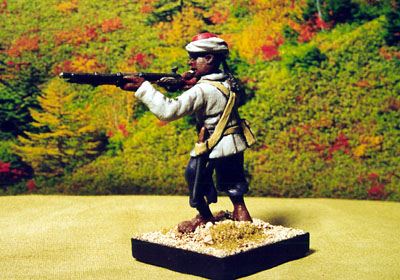


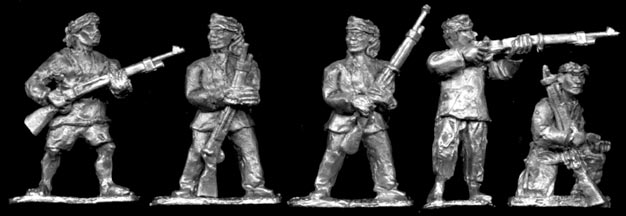


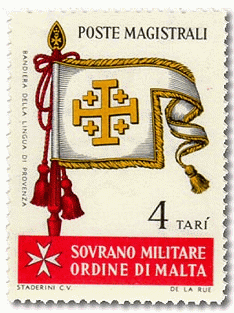




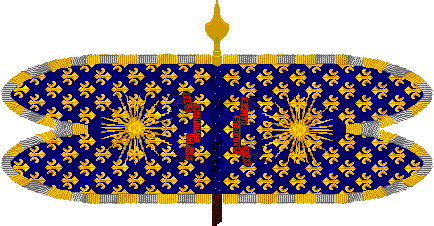







23 comments:
Let’s see… with ‘judicious’ cut & paste, the lower half of the Russian Pandour can be combined with the upper half of the Highlander (but restrict the feathers to the officers? Gorgets?) -perhaps with bits of the Croat with similar cuffs (for the privates?)… Now, to ‘capture’ Fitz-Badger’s tartan, then ‘reverse’ it using the green / red symmetry of GraphicConverter ; then rotate the pattern 45°: that’s the easy part. Discover how to ‘paint’ the trousers with it…
And, here you have those descendants of Highlanders mercenaries settled for three generations somewhere in the Balkans: too many thorny bushs to keep on wearing the kilt!
But they religiously preserve the ‘Cult of the Bagpipe’, alas…
The ‘composite / synthetic’ flag is an old pet idea: I believe to have ‘published’ it first on the ‘Countess Sandra’ Chronofus forum in april 2006! Glad to discover that, as far as understand them, the Guidons of the Wittenberger Cavalry are ‘built along this same principe?
Though, as I understand it, ‘Tidders’ reversed the sides & placed the ‘Leib’ Colour ‘on the left’; yet in my ignorance of the historical Palatinate standards I can’t be sure.
Well, great minds think (almost) alike!
P.S.: Then maybe the historical guidons of Palatinate cavalry did have two very different sides? I’ve just be reminded (by a post on the SYW Yahoo group) of an article about French ‘‘ Dragons du Languedoc’ on J.L. Vial’s NPI site: their guidon, like the one on Tidder’s site, has the obverse very decorated and the reverse with a plain field.
May be some unconscious memory of such ‘historically composite’ guidon implemented the basic idea in my mind?
POLDEVIAN LEGIONS
For the origin of the name ‘Poldevia’ see O1.06.08 comment
These 2 mixed Legions of Light Troops stemmed from an informal discussion on the OSW Group about possible uniforms for a fictitious Frei Korps. A Tarleton helmet and a black uniform were suggested, I then endvisaged 2 variants, based on different ‘exotic’ historical uniforms. They were named with reference to Henry ‘Battlegames’ Hyde.
Numbered references are to illustrations in Preben Kannik’s «Military Uniforms of the World» (1971 -!!-).
PREMIERE LEGION D’HENRI
A few ‘Ancient Roman’ features, following de Saxe…
Uniform basis: cut:_Fusiliers: Spanish Regimiento ligero de Cataluña, 1806-1808: Kannik 239 = link ‘LA DIVISÓN ESPAÑOLA DE LA ROMANA EN HAMBURGO. 1807-1808’ *but* as legwear Obiele foot wraps with Opinci sandals instead of stocks and alpargatas (Hungarian shoes for officers). Buttonholes braiding on the waistcoat (‘basic’ drivers excepted) varying with rank. At the waistbelt, two pistols and the bayonet in a common holder, early ‘Croats’/Grenzers fashion. Note that the cartridge box is worn centrally at the waistbelt. All leathers: black. Metal = brass.
_Grenadiers: all classical distinguishing features: sabre (here *huge* and ‘Eastern-looking’), large grenades-pouch on a large shoulderbelt with fuse-holder, smaller ‘belly’ cartridge box, mustache… White / silver ribbons on the right shoulder.
_Sharpshooters: the pistols and bayonet are carried on a leather flap on the left at the waistbelt, larger ‘belly’ cartridge box, hunting dagger worn on the right, shorter musket.
_Battalion gun crew: no waist holder, no pistols nor bayonet (pistols in saddle holsters), cartridge box on a narrow shoulder belt, Hussar light sabre, French Dragoon laced ‘bottines’, ‘ruby red’ as in the Irish Army in the "30.
_Battalion gun team drivers: no waist holder, no pistols nor bayonet, no cartridge box, waistcoat undecorated, Hussar light sabre, high, heavy riding boots.
_Uhlans: basically as de Saxe’s Uhlans but with an ultra-short waistcoat with pointed ‘Polish’ cuffs worn under the uppercoat with open sleeves; no lace along the leg; + sabretache, no cartridge box. No carbine nor bayonet, 2 pistols at the waist (two in saddle holsters –saddlery as de Saxe’s Uhlans), light lance, mace at the saddle.
_Dragoons: as Fusiliers, shoulder braid / cord on the right, no waist holder but sabretache, hunting dagger-bayonet on the right side, 1 pistol at the waist, cartridge box on a narrow shoulder belt, *huge* heavy cavalry ‘forte epee’, short Hussar carbine, French Dragoon laced ‘bottines’.
_Musicians: as corresponding troop (colors not reversed) + shoulder rolls, false sleeves & lacing British fashion.
Uniform basis: colors:
_(very short) ‘coat’: BLACK
°cuffs (and lining of the Uhlans open sleeves):
-brigadier: purple
-infantry: off-white (cream)
-Uhlans: ‘ventre de biche’
-Dragoons: forester green velvet
-Artillery crew: French ‘ecarlate’
-Drivers: maroon-brown (Napoleonic ‘Train des Equipages’ facing)
_(very short) ‘waistcoat’ ‘blueish iron grey’ / ‘bleu horizon’, except for drivers: (rather dark) buff; always ‘honey’ speckled with greenish ‘old bronze’ for sergeants.
_breeches / trousers: very dark brown, except for officers: ‘Pompei’-red.
Officers: black coat as Grassin, white fur (Uhlans excepted), + buttonholes lacing increasing with rank instead of the very short coat. Under the coat but over the waistcoat a ‘hoqueton’ as worn by the ‘Gardes de la Connetablie’, ‘Pompei’-red and gold. Uhlans: hussar tight trousers and hussar (yellow) boots, coat fur edging: white panther, white panther skin as Austrian Galician Noble Guard.
Helmet: shape: de Saxe’s Uhlans without crest & turban {= ‘Montefino’ Roman helmet without neck pieces & chek pieces} + ‘classical’ ‘Pretorian’ front piece.
_Metal: brass, copper-plated for sergeants, gilded / bright gold for officers
_Crest: shape:
°troops: horsehair as Punic Wars ‘triarii’ / ‘classical’ pre-Marian Roman Legionaries (smaller for drivers),
°sergeants: larger (early Republican Roman cavalryman),
°officers: metallic crest of ‘Assyrian / Ancient Anatolian’ type, effusively befeathered as with *extremities* of ostrich feathers, + a whole ‘horse tail’ hanging behind (Elastolin 40mm Roman Cavalry).
_Crest: color:
°drivers (non-ranking): black
°other troops: fox / squirrel
°sergeants: red
°officers (standard-bearer excepted): white feathers & horsehair
°musicians (and standard-bearer): helmet covered by an animal mask (lower jaw missing), Imperial Roman fashion:
-standard-bearer: lion
-bass drummer, kettledrummer: tiger
-drummers / trumpeters: brown bear (white bear for grenadiers, badger for sharpshooters)
-drum major / trumpet major: panther
-other musicians: wolf, but lynx for grenadiers and she-lion for Uhlans.
_._._._._._
DEUXIEME LEGION D’HENRI
Some early ‘Croats’ in Austrian service wore a peculiar legwear which, as least seen from afar, looks somewhat like the cherivader of late 18th C. Swedish infantry. Hence the idea of this second black-claded LEGION d’HENRI, with the Spanish helmet not used in the 1st Legion; I added facing colors corresponding to the ‘Arm of Service’ following the ACW American model: light blue for Infantry, yellow for Cavalry, red for Artillery.
Uniform basis: cut: Swedish infantry of 1778, BUT in addition a Russian ‘Potemkin’ infantry kurtka (Kannik 147) is worn over the waist-lenghth ‘coat’; kurtka without lapels, decorated as for an officer of Swedish cavalry (= Kannik 146); yet the facing color appears only on the whole (pointed, ‘Polish’) cuffs, as a piping along the collar, and as lace edging the turnbacks. The ‘piping’ on the shoulder rolls, on the breast, along the sleeves, is white ± mixed with bright silver; slightly larger / longer & +buttonholes lace for officers. Officers excepted Carabiniers: a slightly longer waistcoat (Kannik 148). Exception: Carabiniers: shorter coat (Kannik 146), sabretache. BLACK coat and smallclothes. Metal = silver. All leathers black.
°Facings (cuffs, edging of turnbacks, piping along collar):
brigadier purple,
infantry: light blue,
cavalry: yellow,
battalion guns crew: red
(colors as USA during the ACW),
drivers: dark mahogany.
°Legwear and footwear
_Foot: Black ‘cherivader’, edged with white + silver lace; those of lieutenants have a ‘heart-shaped’ cut out like some Prussian Hussars’ (again edged with white + silver piping), those of capitains have their edge serrated. Senior infantry officers are mounted and wear black buckled Dragon ‘bottines’.
While private infantrymen of ‘ordinary’ and ‘sharpshooters’ companies and pack drivers wear all-black ‘Grenzer-like’ footgear, all ranks above from anspessade up, and all grenadiers, wear black ‘sailor’ shoes with very large buckles.
_Horsed: *black* trousers with integral black leather lower part, Potemkin-pattern (Kannik 145, 147) but without vertical lace on the sides; instead the upper limit of the leather part is edged with white + silver lace. Sabre / sword of variable type.
Helmet:: blackened Tarleton, basically, but the crest is raised on the front, de Saxe Uhlan fashion though perhaps less hightly (only the horsehair appearing above the frontplate); the horsehair is extended and ‘hangs’ behind, even more than for the Regimiento ligero de Cataluña, actually as on a ‘Davy Crockett’ fur cap. A low front plate (lower than on early British FIW / AWI helmets, more ‘Roman’ looking) of blackened iron, with tin inlayings. Plain black turban, of black long-haired bearskin for Grenadiers and Carabiniers. Black horsehair except all types of musicians: white (incl. the ‘hanging’ part).
Officers: frontplate and (black) crest as officers of the Napoleonic Greek Light Infantry in British service (blackened metal and bright silver), blach panache.
Troop types & characteristics::
_Fusiliers: basic description for ‘Foot’.
_Grenadiers: all classical distinguishing features: sabre large grenades-pouch on a large shoulderbelt with fuse-holder, *small* ‘belly’ cartridge box, mustache… Shoulder ‘wings’ (# larger shoulder rolls)
_Sharpshooters: *large* (wide, actually) ‘navel’ cartridge box on the waistbelt, thus no shoulder belt at all, hunting dagger worn on the right, shorter musket. Smaller shoulder ‘wings’ than grenadiers.
_Dragoons: basic description for ‘Horsed’, shoulder braid / cord on the right; French Dragoon saddlery, musket (worn hanging muzzle up) and bayonet.
_Carabiniers: shorter ‘Kurtka’ / ‘Kollet’, sabretache; *black* front & backplates + shoulder / upper arms articulated plates as SYW Schaumberg-Lippe Carabiniers; accordingly very *huge* sword / sabre and short rifled carbine (worn suspended muzzle down). Heavy Cavalry / ‘Horse’ saddlery &c… Officers wear a black ‘true’ 3/4 armour, as on the ‘glorified’ portraits of 18th C. Rulers & Marshalls.
_Jägers: lightened equipment, shoulder braid / cord on the left, shorter carbine (worn suspended muzzle down), shorter ‘hussar’ sabre, Hussars saddlery &c…
_Battalion gun crew: as Dragoons, no musket nor bayonet (pistols in saddle holsters), no cartridge box, Hussar light sabre.
_Battalion gun team drivers: as Fusiliers for seated ones and pack drivers, as Dragoons for riding ones, no cartridge box, only a pistol at the waist and an infantry sword.
_Drummers –incl. Bass drummer & Kettledrummer- and Trumpeters: as corresponding troops + swallownests and false sleeves. Additional lace basically white / silver.
_Other musicians: : only swallownests.
RURITANIAN LEGIONS
These 3 mixed Legions of Light Troops are described by ‘poros326’ in the ‘Files’ of the OSW Group, in an annex to his outstanding ‘History of Ruritania’. He kindly gave me additional details in private mails. Thus, these 3 fictitious units are HIS creation and ‘intellectual property’: what follows is merely a 200% personal, unsollicited and unauthorized attempt to ‘visualize’ them.
TARLENHEIM’SCHES LEGIONEN: «Die Grünen Teufels»
ERSTE TARLENHEIM’SCHES LEGION
(officially titled ‘Erste Freiwilligejägerkorps von Tarlenheim’)
Uniform basis: WAS French coat with no collar, no lapels, buttonholes lace on the breast of the ‘justaucorps’, but not on cuffs (yet ‘full’ –front & back– turnbacks). Hunting green coat with dullish madder-red facings, and buttonholes lace edged dull brass-yellow (mixed with gold for officers). Hunting green waistcoat, buff (deerskin) breeches. All leathers: black. Metal = brass.
Musicians follow the Prussian peculiarities .
Troops
-Jäger zu Fuss: basically as French infantrymen, ‘French’ tricorn with small ‘Prussian’ pompoms inside the corners, green cockade; *white* ‘true’ gaiters (I *hate* dark or black gaiters!) . ‘Belly’ cartridge box at the waistbelt, grenadier sabre instead of infantry sword.
-Reitender Jäger: also referred to as ‘Dragoner’; basically as French Dragoons including the black leather buckled ‘bottines’, but with a dashing version of the neo-classical helmet of British Light Dragoons, front plate less ‘peaked’, hunting green turban with dullish madder-red ‘strings’; brass, horsehair ‘mane’ brick red (vermilion for officers, white for musicians).
ZWEITE TARLENHEIM’SCHES LEGION
(also referred to as ‘Neu Freikorps von Tarlenheim’)
Foot: WAS Austrian, coat with lapels (‘full’ –front & back– turnbacks), but *huge* reversed collar. Hunting green coat with dullish madder-red facings. Hunting green waistcoat, buff (deerskin) breeches, *white* gaiters. All leathers: dark (‘natural’) brown. Metal = brass.
_Jäger zu Fuss : ‘Austrian’ tricorn with small ‘Prussian’ pompoms inside the corners, green cockade; ‘Belly’ cartridge box at the waistbelt, grenadier sabre instead of infantry sword.
_Jäger-Grenadiere: all classical distinguishing features of Grenadiers: larger sabre, large grenades-pouch on a large shoulder belt with fuse-holder, *small* ‘belly’ cartridge box, mustache… Shoulder ‘wings’ (# large shoulder rolls) as British Grenadiers. Austrian bearskin of the ‘armchair’ type, a brass grenade in front, dullish madder-red bag, a *small* green plume on the right side.
Musicians follow the Austrian Infantry pattern.
Husaren: general cut as WAS French mounted Chasseurs de Fischer (pelisse worn on the shoulder, denser braiding for officers). Hunting green dolman and pelisse, black-braided, lined dullish madder-red, black fur (‘red fox / squirrel’ for officers, white for musicians); buff trousers, black boots (‘ruby red’ for officers). All leathers: black. Metal = brass. Musicians follow the Prussian Hussars pattern.
° The Tarlenheim Helmet: like the Tarleton, a round black leather helmet, wound round with a cloth turban (hunter green with dullish madder-red ‘strings’ for troops, dullish madder-red with hunter green ‘strings’ for sergeants; brown bear fur for junior officers, leopard skin for those of field rank, ‘silver fox’ skin for musicians); *large*, *huge* bearskin raupe = caterpillar crest [at least ≥ 1815 RHA, even larger for officers] (white for officers, red for trumpeters). BUT with, additionally, a large peak (≥ Russian Chevalier-Gardes) and the neckpiece of the Russian helmet-mitre.
° Kettle-drummer: - brass helmet with more voluminous turban (as de Saxe’s Uhlans) fir tree green with crisscrossed scarlet ‘ropes’, white ‘caterpillar’ expanded and hanging behind as for the ‘Deuxieme Legion d’Henri’ above.
- The pelisse (of 'reversed' colors) is worn over the dolman, and features both shoulder rolls & false sleeves (English WAS Cavalry trumpeter) + ‘open’ oversleeves, Napoleonic Cossack (or de Saxe’s Uhlan) fashion. Attached on the back, a pair of eagle wings, Jiltsi-fashion, feathers re-dyed white at the extremities of the wings, natural light brown in the middle, greenish black (wood groose) at the basis of the wings.
_‘Galloper’ battalion guns crews: basically as Austrian ‘Deutsches’ Artillerie-Corps; collar as infantry. Hunting green coat with dullish madder-red facings, early Austrian ‘Wolfsbraun – Wolsfgrau’ waistcoat, buff (deerskin) breeches, Austrian Carabinier black ‘bottines’. All leathers: black. Metal = brass.
° Helmet: late 18th C. Bavarian Infantry type, but without peak; black horsehair (white for the officer, red for the trumpeter).
_Battalion gun team drivers: basically as Austrian Artillerie-Regiment; collar as infantry. Hunting green coat with dullish madder-red facings, early Austrian ‘Wolfsbraun – Wolsfgrau’ waistcoat with single buttonning, buff (deerskin) breeches, Austrian Carabinier black ‘bottines’. No waist pouch, + one pistol at the waistbelt, high, heavy riding boots. ‘Potemkin’ helmet without peak, black transversal ‘caterpillar’. All leathers: natural brown. Metal = brass.
FREIKORPS VON HENTZAU
Its most striking feature is the SKY BLUE of the uniform.
Uniforms are basically ‘WAS back translations’ of those of various 1795 French Emigres in British Service.
Sky blue, (French) scarlet facings, metal: brass / gold; white leathers, black cartridge boxes / pouches; no shoulder pads / straps.
Foot:
° Musketiere: general cut as Damas Infanterie: sky blue coat, waistcoat and breeches, scarlet facings including lapels , collar & turnbacks, yellow / gold lace and piping (around collar, lapels, cuffs, turnbacks…); ‘French’ tricorn, yellow / gold lace. *White* gaiters.
Musicians: coat in ‘reversed’ colors,
-drummers: shoulder rolls & false sleeves as British drummers, but lace on the coat is of French ‘small royal livery’ and WAS French drummer pattern + inverted ‘V’ on the sleeves (‘great livery’ lacing for the drum-major). Ordinary drummers wear an early type of low schapska, scralet & black fur; drum-major a sergeant’s tricorn + white befeathering.
-bass drummer: As the cymbalist of Napoleon’s Guard Grenadiers, but scarlet short coat and sky blue Hungarian thigh trousers; sky blue turban, the cap is lower and barely visible.
-other musicians: re. drummers: tricorn, large swallownests but neither ‘wings’ nor false sleeves, far less lacing.
° Grenadiere: additional lacing and piping as Waldstein, (scarlet) cuffs as Waldstein, shoulder ‘wings’ as British grenadiers, same buttonholes lace on the waistcoat as on Loyal-Emigrant’s coat lapels; bearskin as Latour but the (smaller, red) plume is on the right. All classical distinguishing features: larger sabre, large grenades-pouch on a large shoulder belt with fuse-holder, *small* ‘belly’ cartridge box, mustache…
Musicians (only drummers and fifers): on the corresponding private’s coat in reversed colors, same rules as for the ‘hat’ companies; fur of the cap: white for drummers, black as troop for fifers.
° Jäger: coat: lower sleeves and cuffs as Hardy, waistcoat braiding as Hardy; cap as Hardy, but the (smaller) green plume is on the left; *large* ‘belly’ cartridge box, thus no belt over the left shoulder; shorter musket.
Musicians (only drummers and hornists): on the corresponding private’s coat in reversed colors, same rules as for the ‘hat’ companies; fur of the cap: white for drummers, black as troop for hornists.
Husaren:: basically as Beon-Hussards but yellow instead of silver (= Rohan-Hussards n°1 but sky blue pelisse), and Rohan-type saddlecloth. Prussian mirliton. Officer vermilion boots.
Musicians: coat of ‘WAS French Hussards trumpeter’ general cut, with lapels all along the dress, in ‘reversed’ colors, eged with fur as for Grassin. (Sky blue) waistcoat braided as for the foot Jägers. Tricorn (except for trumpet-major and kettle drummer). Yellow boots.
-trumpeters: shoulder rolls & false sleeves as British drummers, but lace on the coat is of French ‘small royal livery’ and WAS French trumpeter pattern + inverted ‘V’ on the sleeves (‘great livery’ lacing for the trumpet-major). A later type of pelisse (sky blue lined scarlet) is worn over the coat, but more diagonally (covers the left shoulder, but far below the right shoulder blade).
°Trumpet-major: coat colors *not* reversed, no ‘pelisse’, but a scarlet and gold (lined sky blue) ‘hoqueton’ as worn by the ‘Gardes de la Connetablie’ is worn over the coat; Turkish cavalry ‘helmet’ (right) , sky blue plume, scarlet coiff.
-kettle drummer: open sleeves, Napoleonic Cossack / de Saxe Uhlan fashion; ‘Algerian Spahi Officer’ braiding above the (pointed) cuffs of the waistcoat. No ‘pelisse’ but a French Mousquetaire-like ‘casaque’, scarlet and gold, is worn over the coat. Mameluck’s baggy trousers (with oversized ‘Hungarian knots’, and very large ‘caduceus’ embroidery along the legs) and low boots. ‘Janissary’ headgear with sky blue ‘sleeve’ and gigantic scarlet ‘feather / palm’.
-other musicians: re. trumpeters: swallownests but neither ‘wings’ nor false sleeves, far less lacing; no ‘pelisse’.
_‘Galloper’ battalion guns> crews: basically as Rohan Horse Artillery (including the scarlet waistcoat), but no peak and a smaller plume on the helmet. black horsehair, white for the officer, red for the trumpeter.
-trumpeter: same coat as troop, reversed colors, shoulder wings, false sleeves and pattern of lace as British ‘Horse’ trumpeter.
_Battalion gun team drivers: coat cut basically as Rohan-Infanterie (no buttonholes lacing, ‘pointed’ lapels...); no shoulder belts, equipment, weapons as for the drivers of Tarlenheim 2nd Legion, French fatigue cap, French Dragoon ‘bottines’.
ALLIANCE ARMIES
Alliance is «a federation of imaginary country web sites». Some of them have their army described, several with interesting features. Since I quote my source and only take inspiration: a peculiarity of the background and some uniforms colors patterns, I don’t feel at all guilty of ‘theft of intellectual property’! Then, if the respective *original creators* resent these posts as some form of ‘© infringement’ I’ll of course delete them.
I - ILLYRIE-CARTHAGE
The Kingdom of Mauretanie fields an army with the original peculiarity of combining European and Maghrebian troop types. In an ‘alternate’ 18th C. world, one may imagine that, sometime during or just after the Wars of Religion or TYW, the ruler of a *Reformed* principality (on the Adriatic Sea Eastern Shore, somewhere in the area corresponding in ‘our’ present world to Southern Slovenia / Northern Croatia?), isolated among Roman Catholics and at odds with the Emperor, signed a treaty (secretly at first) with Turkey. In exchange to the promise of somehow hindering the Austrian resistance to the Ottomans, a settlement on the historical site of Carthage was authorized. By the mid-18th C., not only is the colony prosperous but, in that Age of Enlightenment, it is seen as one of the 2 ‘Provinces’ of the Principality, all its inhabitants, regardless of their origin and religion, having the same rights (for what it may really mean) and duties, all equal subjects of the Prince.
A peculiarity of the military system is that a large part of the army is made of part-time soldiers (± as for the Swedish "allotted" {indelta} regiments): in this type of unit only one company in each battalion or Cavalry regiment is fully ‘professionalized’. The members of this «Traditionsstandarte» are referred to as ‘Veteranen’ and proudly display a few uniform particularities.
The national banner shows 4 (slightly deformed, since the flag is not an exact square) *gold* tangent moon crescents facing the 4 corners, on a dark blue field; over the center a large ‘Croix du Sud’ (= ‘Croix d’Agades’) in black, the details and contour outlined in sky blue (white where against the dark blue field).
A sketchy description of the uniforms, following the format of my ‘standardized Army List’.
Drummers, trumpeters, musicians… follow (Hussars and Maghrebian units excepted) the *FRENCH* pattern by WAS times (many Mauretanian uniforms look Napoleonic French).
No dismounting Dragoons brigade, instead the «Army» regiment of Veteran Line Infantry is (like the 2 «Corps» ones always are) able to fight in loose order.
Exceptionally the very light battalion gun is attached *not* to the ‘Irregular Skirmishing Infantry’ unit but to one of the ‘Veteran Regular Line Foot –loose order capable’ regiments (the Marines); keeps its special mobility ability (moves, evades and crosses most terrains as the infantry it is attached to).
UNIFORMS: the pic linked to gives only the *colors pattern and repartition*; the cut of the uniform is as for the equivalent troop type of the quoted nationality by WAS times.
Generally ° WHITE ‘normal’ gaiters° for Foot.
INFANTRY
Most often coat with lapels of the main color, the facing color appearing there only as a piping edging the lapels.
_° Line:
-2 battalions of ‘Elite Regular Line Foot’: colors pattern as images, metal: gold, all peculiarities of Grenadiers including ‘belly’ cartridges box and mustache; bearskin with plate but without cord, the plume very shorter. Cut of the uniform as Spanish ‘Wallon Guards’, but lapels as shown and no buttonholes lace; NO shoulder pads / straps; collar.
°1: as Royal Carabiniers;
°1: as 1er Grenadiers.
-3 battalions of ‘Veteran Regular Line Foot able to fight in loose order’:
°1: Foreign Volunteers Austrian Infantry cut, collar, no shoulder strap, tricorn, Austrian infantry equipment &c.; metal = brass; all classical Grenadier distinguishing features: sabre, large grenades-pouch on a large shoulderbelt with fuse-holder, smaller ‘belly’ cartridge box, but no mustache.
°1: Swiss Fusiliers: same as above.
-1 Marines: British infantry cut, tricorn; British infantry equipment &c. but huge ‘boarding’ sabre; lapels of the coat color; all lace (including that edging the lapels) and piping of the facing color. No Grenadiers, the whole unit feeling ‘Elite’; metal = brass.
-16 battalions of ‘Trained Regular Line Foot’: Prussian infantry (with lapels and Prussian cuffs + cuff flaps) cut, tricorn, equipment; metal = tin. Of the 18 facing colors offered the 1st (Ouahran) and 18th (Erg Occidental) are reserved for the artillery and pioneers units, respectively: this leaves 16 colors to undividualize these 16 regiments.
° ‘Alloted’ units, the ‘permanent’ company has breeches of the same color as the coat, Swedish cuffs + cuff flaps, double buttoning of the waistcoat (Austrian Artillery fashion), all classical Grenadiers distinguishing features: sabre, large grenades-pouch on a large shoulderbelt with fuse-holder, smaller ‘belly’ cartridge box, but no mustache; tricorn.
-1 battalion of Pionneers (Raw Regular Line Foot): cut &c… as Trained Infantry, metal = tin; off-white gaiters.
° ‘Alloted’ unit, its ‘permanent’ company has lighter breeches, Swedish cuffs + cuff flaps, double buttoning of the waistcoat (Austrian Artillery fashion), white gaiters.
_ Drivers: ‘Alloted’ outfits, the picture depicts a ‘professional’ of a ‘permanent’ company; ‘ordinary’ ones (‘timorous’ Levy Irregulars) have a plain, unadorned ‘Western European’ waistcoat the same grey as the coat. Same cut & tricorn as ‘Trained Infantry’, metal = tin. Natural buckskin gaiters for ‘seated’ and pack drivers, French dragoon black buckled ‘bottines’ for the ‘riding’ ones. No cartridge box, only a pistol at the waist and: an Austrian ‘Artillerie-Regiment’ ‘sword’ for the ‘foot’ and ‘seated’ ones, a light cavalry sabre for the riding ones. The ‘professionals’ (Hungarian waistcoat as depicted) provide the team drivers of the Horse Artillery (Soldier Irregulars): hard, heavy riding boots, twin-barrelled pistol in a waist holster, Heavy Horse ‘forte epee’.
_° Light infantry:
-1 battalion of Velites (‘Veteran Regular Light Foot’): cut &c. as ‘Elite Regular Infantry’, same remarks but a *large* ‘navel’ belly cartridge box and only 1 shoulder belt (no ‘grenades pouch’); shorter musket.
-1 battalion of Jägers (‘Veteran Regular Light Foot’): cut as Hungarian infantry but no buttonholes lace on the coat, lapels edged with the facing color, cuffs (with cuff flaps) as depicted, ‘Hungarian knots’ of the facing color on the trousers, Hussar boots. A single belt on the *right* shoulder holding the sabre + bayonet, a *large* ‘navel’ belly cartridge box. *Mirliton*. Shorter musket.
-1 battalion of Janissaries (‘Fanatic Irregular Charging Infantry’): white ‘sleeve’ and (size & pattern varying with rank)) ‘feather(s)’, purple-pink ‘coat’ with front ‘turnbacks’ (coat lined bright yellow), violet ‘undercoat’, dark orange trousers, light chocolate ‘boots’; golden embroideries on ‘coat’ & ‘undercoat’ varying with rank.
-1 battalion of Tunesisch Schützen (‘Warrior Irregular Skirmishing Infantry’); junior officers (even on foot). Actually each company has its own distinguishing color, appearing in the ‘tombo’ on the jacket and the whole waistsash; make your choice. Musicians: the lace on the jacket is ‘livery’ rather than black.
CAVALRY
_° Line:
-1 regiment of Horse Guards (‘Elite Regular Heavy Horse’): cut, decoration, equipment, saddlery, saddlecloth as (WAS, as always) French Household Gendarmes, color pattern as 2ème Cuirassiers, copper-plated full cuirass over the coat, befeathered tricorn; metal: gold.
-1 regiment of Turcopoles (‘Veteran Regular Heavy Horse’): over the uniform add a long (greenish lemon yellow) kaftan (lined sky blue) with false sleeves; raspberry jacket and headgear, cyan / turquoise trousers, red boots (see here also the officers’ boots and additional lace); metal: gold. Mameluck saddlery + pistols holsters, French Dragoon musket and bayonet.
-4 regiments of Reiters (‘Trained Regular Heavy Cavalry’): Fritzjames in French service incl. blackened breastplate, tricorn, whole uniform of a so slightly violet light grey, velvet facings: ‘crimsom’, light-medium blue, black and white, metal: gold.
-4 regiment of Dragoner (‘Trained Regular Heavy Cavalry’): cut, tricorn, equipment, saddlery, saddlecloth as Prussian Dragoons (Swedish cuffs), green coat and waistcoat;
° ‘Alloted’ units, the ‘permanent’ company has off-white breeches, double buttoning of the waistcoat (Austrian Artillery fashion), all classical distinguishing features of Horse Grenadiers but no mustache; tricorn: ‘ordinary’ companies wear maroon breeches. Additionally the piping of the collar, along the opening of the coat, edging the waistcoat and *also* thr cuffs, is maroon for ordinary companies and white for the ‘professionals’. Facings: yellow, dark blue, light green and buff-orange. Metal: tin.
_° Light cavalry:
-1 regiment of Husaren (‘Veteran Regular Light Horse’): cut, equipment, saddlery, saddlecloth as Russian Hussars (incl. change of boots color with rank), pinkish ‘lavander’ uniform with orange facings and pelisse, black fur, metal: tin. Trumpeters and other musicians follow the Prussian pattern of uniform peculiarities, colors of the dolman and pelisse inversed; kettle drummer white busby, white fur, pelisse worn as a cape.
-1 regiment of Spahis (‘Warrior Irregular Light cavalry’): ‘Alloted’ unit, the ‘permanent’ company wears a black ‘burnous’, a black & white silk waistsash and white trousers. Metal: tin. Each company has its own facing color, appearing on the ‘tombo’ and cuffs of the jacket and the whole waistsash: black for the ‘professionals’, make your own choice for the others. ‘Algerian’ saddlery compleated with pistol holsters: note the typical ‘cutting’ stirrups. Musicians: the lace on the jacket is ‘livery’ rather than black; only the kettledrummer (belonging to the ‘professional’ company) has the colors of his jacket ‘reversed’ (black jacket, white ‘tombo’, livery lace).
-1 regiment of Maurische Pfadfinder (‘Warrior Irregular Light cavalry’); light brown jacket, light violet-grey trousers. The color of the turban, ‘tombo’ and waistsash varies with the company. Musicians: as for Spahis. A ‘professional’ outfit, but initially a constabulary force of para-militarys status.
ARTILLERY
Artillery is characterized by the color of the coat (with few exceptions, where it is the color of the waistcoat): ‘rusted grey’, a light medium neutral grey finely studded / mixed with ‘rust’ thread; and by its facing color, a light, bright red.
*White* gaiters (Horse Artillery excepted)
By default, battalion guns crews have the cut, headgear, metal, color of smallclothes… of the (‘normal’ companies of the) battalions they are attached to.
_° Trained battalion guns: as ‘Trained’ basic Line infantry but Swedish cuffs + cuff flaps, rusted grey coat; the facing color of the infantry battalion appears on the cuff flaps.
_° Veteran Line battalion gun: as ‘1er Grenadiers’ but rusted grey waistcoat, ‘Artillery red’ cuffs.
_° Veteran Light battalion gun: as ‘Marines’ but rusted grey waistcoat, ‘Artillery red’ whole cuffs, and collar piping.
_° Trained ‘position’ batteries: cut &c. as ‘Trained’ basic Line infantry, rusted grey coat with ‘Artillery red’ facings; rather dark brown smallclothes, metal: tin.
_° Elite Heavy: cut &c. as ‘Swiss’ veteran Line Infantry, rusted grey coat with ‘Artillery red’ facings, (orange-) yellow smallclothes, metal: gold.
_° Bombardiers (Veterans crewing Siege Howitzers): as ‘Trained position batteries’ but ‘Artillery red’ Swedish cuffs + cuff flaps, equiped as Grenadiers –including mustache, double buttonning of the waistcoat (Austrian Artillery fashion); black busby, but the plume is entirely red and on the left side actually are the ‘professionals’ of the "allotted"'Position' batteries.
_° Galloping guns (Veterans crewing light Horse Artillery): cut &c. as ‘professional’ drivers (incl. the ‘Hungarian’ waistcoat), rusted grey coat with ‘Artillery red’ facings, ‘Swedish’ cuffs + cuff flaps, deerskin breeches, black French dragoon buckled ‘bottines’, metal: brass.
ALLIANCE ARMIES
I I- THE MERCANTILE REPUBLIC OF ZENICCE
The IMPERIUM GALAVORUM tries to ressurect the mores and glamour of Ancient Rome. In an ‘alternate’ 18th C. world such a ‘cult’ of the past glory of the legendary City suggests that the country not only was founded by Italians, but by *expatriated* ones, cultivating as a mark of ‘national identity’ an exacerbed need to copy their embellished vision of the Italy of Old. A likely location is on the Eastern shore of the Adriatic Sea, perhaps over a (mainly coastal) part of ‘our’ modern Albania (e.g. Venice has interests there earlier in our, and then probably there, History).
The Gavalonian Army is of ECW technological level, with some archaisms (horse archers), and entirely organized in ± mixed units mimicking Late Imperial Roman / Early Byzantine practices. To fit both in a Lace Wars setting and in my ‘Standardized Army List’ I just kept a few ideas of uniforms. Yet, if its *original creator* resents this posts as some form of ‘© infringement’ I’ll of course delete it.
The very simple national banner as shown would greatly be improved with elements from the ‘Exarchat de l'Empire Besanthynian’ heraldry: maybe a Bysanthenian banner with purple instead of red as the ‘State’ flag (or ‘State’ obverse of a ‘combined’ flag), the Gavalonian one (with a brighter purple) as the basis of the ‘regimental’ one.
Exxceptionally the very light battalion gun is attached *not* to the ‘Irregular Skirmishing Infantry’ unit but to one of the ‘Veteran Regular Line Foot –loose order capable’ regiments (the Guard Antecursores); keeps its special mobility ability (moves, evades and crosses most terrains as the infantry it is attached to).
A sketchy description of the uniforms, units corresponding to my ‘standardized Army List’, but presented by nature (Guard, ‘National’, ‘Cantonal’ and ‘Parochial’) to avoid repetitions.
Drummers, trumpeters, musicians… follow the *Savoyard* patterns by WSS / WAS times (Zeniccians being of Italian extraction...), but in some units wear in addition a ‘hoqueton’ or ‘tabard’ over their livery coat (this last of course without false sleeves, then).
To reflect the traditionalist (backwaters?) nature of these nostalgic emigrants, the uniforms may look rather old-fashioned by WAS times: 1725-1732 fashion, even WSS fashion for the Guard. Yet, according to my ‘visual rule of thumb’, at least the <‘Trained’ units must display full (front & back) turnbacks and, for those on foot, true (generally ° WHITE°) gaiters.
1 - GUARD UNITS: PRAETORIANI
Common features: Very decorated uniforms of 1705-1720 Spanish, Roman, Papal Guards. Black coat and breeches, waistcoat (and saddlecloth) of the facing color {unless stated otherwise}; metal: gold. Standard-bearers and all musicians: over the decorated coat, a purple and gold ‘hoqueton’ variable in design (open below the waist, and with additional false sleeves, edged with embroidery along the whole periphery, for the Cavalry), with a few details of the facing color.
In the official title of the units, ‘Praetoriani’ follows the unit designation.
Cavalry: 5 units:
-1 regiment of Armigeri (‘Elite Regular Heavy Horse’): facing color: purple [silk]; shining white 3/4 armour with abundant gold inlays (a few jewelry for officers), profusiously laced and befeathered tricorn; white leathers; early 16th C. *knighly* lance with triangular flame black above purple; short carbin, yet bayonet. ‘Vexillum’ standard.
-1 regiment of Protectores (‘Veteran Regular Heavy Horse’): facing color: ‘old gold’ / honey [velvet]; copper-plated cuirass (breast & back plates) over the coat (golden / gilded for officers); white leathers; Polish ‘palasce’ forte-epee instead of sword and koncerz [at the saddle](equipment, other weapons: equivalent to Gardes du Corps, Gendarmes…). Standard fastened to a ‘draco’ by its upper edge.
-1 regiment of Caballarii (‘Trained Regular Heavy Cavalry’): facing color: Murrey, buff waistcoat dyed Murrey (& edged with lace, *obviously*); blackened breastplate worn under the coat; natural leathers.
-1 regiment of Dracones (‘Trained Regular Heavy Cavalry’): facing color: black (velvet); Horse Grenadiers with corresponding additional distinguishing features (no mustache), yellow aiguillette / fourragere (shoulder braid / cord) on the right shoulder; black buckled ‘bottines’; natural leathers; French Dragoon late 17th C. cap, black fur with purple bag. Dragoon musket, long, huge bayonet.
-1 regiment of Speculatores (‘Veteran Regular Light Horse’): facing color: forester green, suede waistcoat dyed forester green; black semi-soft boots; black leathers; short (Hussar) carbin (yet bayonet), Hussar /Light Dragoon saddlecloth, lightened saddlery and equipment.
Infantry: 3 units:
-2 battalions of Pedites (‘Elite Regular Line Foot’): Foot Guards: facing color: purple; white leathers. By ‘traditionalism’, front turnbacks only and wear, instead of ‘true’ gaiters, white stocks raising over the knee (as Swedish infantry still did by 1750). Standard: large vexillum (3rd Reich SA-like).
° Each battalion has a company of Extraordinarii with the double function of *Honor Bodyguards* (as ‘Alabarderos’ or ‘Archers’ in other countries, with the corresponding overlacing of the upper garnments –lining all edges, pockets, over all sewings…–, luxuous ‘grenades pouch’ bandolier…) and *Grenadiers*, with all the corresponding additional distinguishing features (but no ‘belly’ cartridges pouch and no mustache); purple ribbons on both shoulders, copper-plated cuirass (breast & back plates) over the coat (golden / gilded for officers); cap: as early French ‘bombardiers de Marine’ (the type with ‘white panther’ fur), purple and black fur. Sword with a ≥ 3 feet blade, attached to the waistbelt, long (≥2 feet blade) hunting dagger-bayonet attached to the ‘grenades pouch’ large bandolier; a pistol on the left side .
-1 battalion of Antecursores (‘Veteran Regular Light Foot’): facing color: forester green, forester green ribbons on both shoulders, suede coat dyed black. Additional *large* ‘navel’ cartridge box, boarding sabre instead of infantry sword; natural leathers; shortened musket.
Artillery: Ballistarii
Facing: ‘changing’ «fire» silk (as on the flag of French Royal Artillery)
3 types of gun crew:
_° Veteran Light battalion gun: attached to the Antecursores: same cut &c. as them,
_° Elite Heavy: same cut &c. as ‘ordinary’ Pedites,
_° Galloping guns (Veterans crewing light Horse Artillery): same cut &c. as Speculatores, but French dragoon black ‘bottines’.
Drivers for the Praetorian Artillery teams and Train are provided by the ‘Legionarii’ (see below).
-2- ‘NATIONAL’ UNITS: LEGIONARII
Common features: uniform of ca. 1725-30 Savoyard (& Venitian?) cut, still displaying a fair lacing; <‘Pompei’ red coat and breeches, waistcoat (and saddlecloth) of the facing color, metal: silver.
Standard-bearers and all musicians: over the decorated coat, a yellow and silver tabard, open and with (laced) false sleeves for the Cavalry.
In the official title of the units, ‘Legionarii’ follows the unit designation.
Cavalry: 2 units:
-2 regiments of Equitati (‘Trained Regular Heavy Cavalry’): a brigade of Dragoons able to dismount: facing color: black; white aiguillette / fourragere (shoulder braid / cord) on the right shoulder; natural leathers; tricorn; Savoyard dragoon ‘bottines’. Musket, &c.. as French dragoon.
Infantry: 5 units:
-1 battalion of Electi (‘Veteran Regular Line Infantry’): *Grenadiers*, with all the corresponding additional distinguishing features (but no mustache), white ribbons on both shoulders; tricorn; facings: white.
-4 battalions of Milites (‘Trained Regular Line Foot’): ordinary ‘musketiers’, no ‘flank’ companies; facing: ‘bleu horizon’.
Drivers for the Praetorian Artillery teams and Train: all clothes reddish maroon, kakhi facings. (‘Soldier Irregulars’).
Natural buckskin gaiters for ‘seated’ and pack drivers, French dragoon black buckled ‘bottines’ for the ‘riding’ ones. No cartridge box, only a pistol at the waist and: an Austrian ‘Artillerie-Regiment’ ‘sabre’ for the ‘foot’ and ‘seated’ ones, a light cavalry sabre for the riding ones.
- Those (‘Soldier Irregulars’) attached to the Horse Artillery show several differences: scarlet facings, a scarlet shoulder braid / cord on the right, larger lace, double buttoning of the waistcoat; two pistols in a ‘Mameluck’ breast holster, ‘palasce’ forte-epee; heavy cavalry boots.
Artillery: Ballistarii
Facing: ‘ventre de biche’ (yellow orange) 4 types of gun crew:
_° Trained battalion gun crews: attached to the 4 battalions of Milites same cut &c. as them,
_° Veteran battalion gun crew: attached to the Electi: same as above, but double buttoning (Austrian Artillery fashion) and more lace on the waistcoat, ‘ventre de biche’ ribbons on both shoulders,
_° Position batteries: same as Trained battalion gun crews, but double buttoning (Austrian Artillery fashion) on the waistcoat and ‘Dutch’ (Austrian) Artillery cuffs.
_° Bombardiers (Veterans crewing light Horse Artillery): as Position batteries, but equivalent of *Grenadiers*, with all the corresponding additional distinguishing features (but no mustache), deep purple ribbons on both shoulders; tricorn.
Drivers for the Legionary Artillery teams and Train are provided by the ‘Auxiliarii’ (see below).
-3- ‘CANTONAL’ UNITS: AUXILIARII
Common features: relatively simple uniforms of ca. 1745-45 Naepolitan (& Portuguese?) cut; ‘off white’ (so slighly ‘cream’ / ‘ivory’ – dazzling white for officers) coat and breeches, waistcoat (and saddlecloth) of the facing color, metal: silver. Natural leathers unless staded otherwise.
Musicians of units in ‘Western European’ dress: follow the Savoyad pattern for such.
In the official title of the units, ‘Auxiliarii’ follows the unit designation.
Cavalry: 6 units:
-4 regiments of Equitates (‘Trained Regular Heavy Cavalry’): typical ‘Horse’ / ‘Cavalleria’ / ‘Cavalaria’; no cuirass, 3 regiments with blackened breastplate, 1 without; strong, heavy riding boots (actually rather old-fashioned Heavy Cavalry ones); facings: sulphur yellow for the units with breastplate, otherwise straw yellow .
-2 regiments of ‘Foreigners’ (‘Warrior Irregular Light cavalry’): non-European dress, black embroideries (musicians: black vest / jacket with white embroidery):
-1 regiment of (Sagittarii) Foederati: (off-white): plain baggy trousers, open coat, vest with a *lot* of black embroidery but edged with white / silver embroideries and with *open* sleeves, decoration varying with rank; black cap, black, relatively high, soft boots. Hussars-like saddlery (with pistol holsters).
-1 regiment of (Lanciarii) Gentiles: no open coat under the *sleeveless* vest / jacket, tight embroidered trousers, black soft low boots. Officers with black ± feather ‘cap’ with long white ‘bag’, overdecorated belt and vest, the senior ones wear in addition a sleeved (oversized pelisse-like) cape. A short carbin, a light lance with a tuff of black horsehair. Western Turkish ‘Deli’ saddlery, without pistol holsters (except for officers) but with a strapped blunderbuss. Kettledrummer with ‘wings’ on the coiff and in the back, Renaissance Deli-fashion.
Infantry: 17 units:
-2 battalions of Promoti (‘Veteran Regular Line Foot able to fight in loose order’): *Grenadiers*, with all the corresponding additional distinguishing features (but no mustache), British Grenadier ‘wings’, the ‘belly’ cartridge bow is *wide*; tricorn; facings: RAF blue.
-12 battalions of Soldiarii (‘Trained Regular Line Foot’): ordinary ‘musketiers’, no ‘flank’ companies; facing: USAF blue.
-1 battalion of Velites (‘Veteran Regular Light Foot’): facing color: fir tree green. Additional *large* ‘navel’ cartridge box; hanger instead of infantry sword, black leathers; shortened musket, lo,g hunting daggerdoubling as bayonet. Sergeants with double-barrled musket / rifle and half-pike doubling as musket rest (as WBS Grenzer sharpshooters).
-2 regiments of ‘Foreigners’ (‘Irregular Light Infantry’): non-European dress, black embroideries (musicians: black vest / jacket with white embroidery):
-1 battalion of Gladiatores (Foederati) (‘Fanatic Irregular Charging Infantry’): tight white trousers, fustanela, the sleeveless vest / jacket is white with black embroideries, colored glass inserts and false sleeves; shoes with black pompon (red for musicians); black cap of the higher shape. Officers with high black ‘cap’ ± feathered and white bag, and with large open sleeves with serrated or doll-laced edge. Musicians with modern ‘Evzon’ heagear, black with huge red pompon. Weaponry (and waistsash) as on the pics illustating the ‘Foreigners’ light cavalry. Junior officers add a quarter-pike doubling as musket rest.
-1 battalion of Venatores (Gentiles) (‘Warrior Irregular Skirmishing Infantry’): tight trousers with black embroideries, sleeveless vest / jacket with black embroideries, pointed shoes. Black ‘Sardinian’ cap (red for musicians). Weaponry (and waistsash) as on the pics illustating the ‘Foreigners’ light cavalry.
Drivers for the Legionary Artillery teams and Train: all clothes of a darker reddish-brown than for the Legionary ones, facings dark pumpkin. Black gaiters for ‘seated’ and pack drivers, French dragoon black buckled ‘bottines’ for the ‘riding’ ones. No cartridge box, only a pistol at the waist and: an Austrian ‘Artillerie-Regiment’ ‘sabre’ for the ‘foot’ and ‘seated’ ones, a light cavalry sabre for the riding ones.
Artillery: Ballistarii: Facing: violet _° Trained battalion gun crews: attached to 4 battalions of Soldiarii.
Drivers for the Auxilliary Artillery teams and Train are provided by the ‘Symmachiarii’ (see below).
-4- ‘PAROCHIAL’ UNITS: SYMMACHIARII
Common features: very simple uniform (Swedish cut, without lapels); ‘light grey’ (early 18th C. French Infantry), metal: tin.
-1 battalion of Vigiles (‘Raw Regular Line Foot’) [local militia used as Army pioneers]: facings: mustard.
Drivers for the Auxilliary Artillery teams & Train and Army Train: facings mahogany. Black gaiters for ‘seated’ and pack drivers, French dragoon black buckled ‘bottines’ for the ‘riding’ ones. No cartridge box, only a pistol at the waist and: an Austrian ‘Artillerie-Regiment’ ‘sabre’ for the ‘foot’ and ‘seated’ ones, a light cavalry sabre for the riding ones.
ADDITIONAL NOTES
«Pelisse-cap »: an oversized pelisse is worn (very assymmetrically) by the trumpeters of the Freikorps Von Hentzau ‘Husaren’ among the Ruritanian Legions (01.21) and (as a cape) by the ‘Husaren’ kettle drummer of Illyrie-Carthage (01.23).
Black horses: the Carabiniers of the 2eme Legion d’Henri among the Poldevian Legions (01.21) and the Armigeri of Zennice (01.24) ride black horses, while the Zennician Protectores ride grey ones.
In the 3 units trumpeters ride *white* horses, as is by default the rule when an unit is uniformally mounted on black or dark horses.
Kettle-drummers *always* on white horses, unless explictely stated otherwise (‘Gardes de l’Etrier’ in Monte-Cristo, e.g.).
Once Ioannis has closed his ‘wargames&c…’ site, for the cap of ZENICCE (Lanciarii) Gentiles, the quarter-pike of Gladiatores (Foederati) junior officers, see Light troops.
LIMITS OF THE 'LACE WARS' PERIOD?
While Guerre en dentelle is a centuries-old French designation of mid-18th C. warfare in Continental Western Europe, 'Lace Wars' appeared in English only with the translation of Funcken's book. With a slight misunderstanding: Anglophone readers generally interpret 'lace' as 'tape / ribbon' (tricorne lace, buttonholes lace...) ['galon' in French], French 'dentelle' refers to the 'frilly' lace / 'Dutch' / 'doll' lace (as in lingerie lace) worn by officers at the collar and cuffs of their shirts: its delicacy, rather incongruous for a piece of military field attire, associating itself well with the (reputedly) chivalrous / gentlemanly behavior -almost ludicrous during a bloodbath- of the same officers ('By all means shoot first, Gentlemen, I pray you'). Thus the archetype of the Lace Wars is the War of Austrian Succession, the LW era is the period during which, in western Europe, typical uniforms and tactics were those of the WAS.
Beginning? During the Great Northern War ([1700) and the War of Spanish Succession ([1701) the essential details of uniforms were already similar to those of the WAS; the main difference being that infantry was not yet wearing gaiters. And, while Russian and Swedish infantries still included a low proportion of pikemen, the linear tactics typical of mid-18th C. Europe were already used.
End? I'd set it ca. 1770.
- Uniforms-wise, lace was disappearing, by the mid-1770 reformations had removed it from coat and hat in France, Sweden... Uniforms, following the Prussian trend, were more and more skimpy, already similar in cut to those of Revolutionary / early Napoleonic times; tricorne was turning into a bicorne, was replaced with a flat-topped 'postillon' hat in Sweden, by a helmet in Russia, announcing the 19th C. when each major power had its own peculiar military hat -flowerpot, frying pan, stovepipe...
- With the AWI appear a new type of recruits, and thus of tactics: one side was made of volunteers / militia mostly lacking training and discipline (at first): heralding the mass drafted armies of the Revolutionary / Napoleonic times, with the consequences of the 'lack of professionalism' on tactics. Infantry had no longer the discipline / nerve to hold motionless exchanging fire with an enemy line, hence the charges at the fastest possible speed (in columns) screened by swarms of barely controlled skirmishers; lack of confidence facing cavalry prompted the generalization of the square, &c...
But chiefly with the Revolutionary Wars the 'feel' and 'ethics' of war were totally changed. The 'professionals' of the Lace Wars were like football / soccer players to-day: they played for money and pride, they played rough but with 'nothing personal', individual 'transfers' of 'players' (soldiers) and 'coaches' (generals) from a 'team' (army) to another were not frown upon, the men you 'play against' to-day may be on your side next season. And it was enjoyable to esteem and honor the 'adversary'. On the opposite, Revolutionary Wars are *political* and thus as passionate, vicious -and cruel- as Wars of Religion; to put it bluntly, to keep fighting, drafted civilians have to be motivated by *hatred*. A totally different type of war, where no one bothers for niceties...
.
IMAGINARY UNIFORMS AND FLAGS
discussed -based on the 'real' heraldic tradition of their supposed location- and described on 'Emperor vs Elector' for two 'Occitan' Imagi-Nations: Poictesme and Trypheme.
Poictesme:
12 infantry regiments, with their flags (actually at least 2 sets each, according to the diplomatic situation / political status of the country / army the unit is serving in.
Trypheme:
Gardes (dragoons)
Guet (dragoons)
Piquet Soldé of the Militia (foot)
.
'TRANSLATION' OF LATER UNIFORMS: USING DETAILS OF FIELD DRESS
N°1/parade uniforms are easier to 'translate' to the mid-18th C. since they generally keep archaic details and thus are the 'normal' basis of such 'translations'; yet (details of) field dresses are sometimes interesting enough to be used.
Some early 18th C. cuirassiers had 2 uniforms, a colorful 'peace' one and a 'war dress' with buff coat under a cuirass: both deserve translation. Similarly late Napoleonic French Carabiniers had, beside their white uniform, a 'field' ine with light blue coat: this can be used e.g. for the hastily reconstructed army of the 100 Days.
IIIrd Republic French Légion Etrangère, Infanterie Légère d'Afrique and Infanterie Territoriale had uniforms quite similar to that of the infantry, except for a few details which can easily be 'translated'. Yet to give them a more 'different' look the 'translation' may include details from the field dress.
Légionnaires and Joyeux in the field wore white rather than garance trousers and a wide waist sash (blue for the Legion, red otherwise) under the waistbelt (buckled above the waistcoat in a 18th C. translation); besides, campaigning Légionnaires generally carried a very large 'belly' cartridge box instead of the 'regulation' type of the Metropolitan army.
Normally the 'translated 'uniform is the n°1 one and French infantry then did not wear the capote field coat: coat and waistcoat should be of the blue of the jacket (darker for officers, in practice). Terrible Toriaux grandpas (who would count as garrison infantry or militia) for a change would have their coat the grey of the field capote; being aged reservists their officers would wear their obsolete uniform with 'dolman' buttonhole braiding.
[Note that when 'translating' post WW1 armies, for army pioneers, civic guards, garrison infantry, militia... types that generally no longer exist, non-military uniforms (police, jailers, customs, foresters, game keepers...) or even civilian ones (firemen, postmen, train inspectors...).]
.
FRENCH ALPS TROOPS 1888-1988
From their creation the uniform of the French Troupes Alpines had some interesting peculiarities:
-the large (almost black and common to all types) beret (of Pyrenean origin) which can be kept almost as such (but with a national cockade rather than a wool or metal badge): officers wore it angled opposite to the men;
- no field capote coat but a large cloak, over a short jacket with a large reversed collar: the capote is 'normally' ignored in the translation, but some types (officers? Drummers and hornists?) can wear the cloak 'for the look', the jacket can be translated by a jacket (but with the large reversed collar added) over a waistcoat à la Andreas Hofer's Tyroleans;
- puttees: I generally suggest (e.g. for the British Camel Corps) to translate them as 18th C. dragoon bottines but mostly of heavy canvas / baize (light blue here) instead of leather.
Pre-1914 French Troupes Alpines can be translated as Irreg Sk Light infantry (Chasseurs Alpins) with a Vl gun attached (Artillerie Alpine) and Irreg Fanatic Charging Infantry (Infanterie Alpine).
After WW2 the French Chasseurs ('Alpins' included) grey trousers became blue, providing a variant uniform (the same for firemen and Infanterie Coloniale, btw). Mountain troops also received a new field dress with short corduroy breeches and high white stocks: these can be combined by giving these alternate Chasseurs Alpins short Tyrolean hosen (or slightly shorter as in modern Tyrolean costume, to look more 'exotic') of blue corduroy over off-white stockings/ hose worn under white stocks; and perhaps the jacket is now white, as a reference to the 'all snow white' winter field dress.
.
TRANSLATING THE KEPI TO THE MID-18th C.
The képi appeared in France as a 'fatigue cap with peak [visor], the 'bag' with time became smaller and is now the flat top of the cap. Now for translated 'line' troops in 'Western European' uniform the standard head dress is the *tricorne* (transpositions of other hats, bearskin, busby, helmet, mitre..., being restricted to elite or specialized units or 'flank companies'), so when part of the 'normal' uniform the kepi is generally replaced by a tricorne at least in the 'center' companies. But for light troops and militia, it can be translated by a fatigue cap, or even a mirliton {*}.
Then I suggest a different 'translation' for French officers of 'native' troops wearing a 'local' uniform: the variant of the 'mamluk' head dress worn by the French Régiment des Dromadaires in Egypt, i.e. a white turban (the 'couvre-képi' protecting the head from burning sun was always white) around a caouk (an ancestor of the fez) with the colors -and decorations of the top- of the kepi, but with the sides of the turban slightly higher than the top of the caouk. This would apply to French officers of zouaves, méharistes (camel corps, reanslated as light infantry), gendarmes indigènes, spahis, tirailleurs and goumiers from the Maghreb and (during the Interwar) the Levant; also of spahis sénégalais. I'm less sure about the officers of the Black 'native' troops (tirailleurs sénégalais and the like), since they were Troupes de Marine and their officers kept their uniforms of the infanterie de Marine. But it would also apply to the French gendarmes in Saharian uniform and to the compagnies sahariennes of the Foreign Legion, and later some types in ex-colonies.
Now in the mid-"60 a short lived (still worn by the EMIA) medium blue n°1 uniform was introduced for officers of the French army . It could provide the general uniform color for 'post 1914 Foreign Legion' (several characteristics appeared or were formalized during the Interwar), specially for the units appeared after WW1: cavalry (dragoons, but since they were at first mostly White Russians, maybe with moujik trousers and boots, and perhaps a lance), paras (Irreg fanatical charging inf.): then the caouk would be white for troops, black for sergeants, dark blue with garance top for officers. Collar according to the collar (later sleeve) badge? Cuff according to interwar officers n°1 dress with green cuffslap pipped red. Green tie, large blue waist sash.
[Navies and French oversea troops had a 'summer / tropical' white uniform: it could be used to translate the khaki or sand of native / oversea troops who never had a 'colorful' uniform, such as the Arab Legion -but the band, with bagpipes, is in traditional British red coat blue trousers.]
--
{*}: the shako was basically a mirliton with peak: I suggest to give 'center' companies of Napoleonic Infanterie Légère a mirliton -with cockade and [short] plume on the side, not in front- instead of a tricorne, to make them more 'different' (plateless bearskin for the Carabiniers, busby -historical in some regiments- for the Voltigeurs; white gaiters of 'normal' hight but with the top heart-shaped and decorated as the original half-gaiters).
.
TRANSLATING UNITS APPEARED POST-1914
A few such as the Dutch Fusiliers Prinses Irene (with Monaco Carabiniers feathers, as always with helmets of British Victorian infantry type), Nixon's White House Guard, Sarkozy's SSMI, French Gendarmerie Cadets, British 'recombined' regiments... have a 'parade dress' of pre-1914 type, so are easily translated following 'normal' "rules". But most, while interesting and deserving 'translation', received only 'modern' uniforms, requiring more... creativity. Some 'oversea' types were mentioned above, German ones in the main text.
During the interwar French tanks were (for a part) attached to the infantry. The pre-1914 type n°1 uniform of the officers give the basic colors and details for the Chasseurs des Chars (Irreg fanat. charging infantry?), but other peculiarities deserve to be added. The men and sergeants wore a smallish black beret; the waistcoat of the men can be of black leather, in remembrance of the black leather jacket worn aboard tanks; a bizarre peculiarity of 1939 French army was the general use of short, baggy 'golf trousers': these could be worn with half-gaiters by privates (but neither by sergeants nor officers, with normal breeches under black dragoon bottines).
Post-1914 uniforms generally lacked details, suggesting to combine at least 2; they also lacked pleasant colors, but the Air Forces (without direct 18th C. translation) were / are generally in some shade of blue, which could be used as the basic color for other types of translated new units.
After WW1 Belgium created the Chasseurs Ardennais: translated with uniforms of French infantry cut, colors of the Force Aérienne Belge and the large green beret -but with instead of a badge a national cockade; such were generally were of a single color, so yellow, of the 3 Belgian colors the only one common to the Flemish and Wallon flags.
The uniform of French paras could be of # British light infantry type, perhaps with Late Renaissance close-fitting very high boots, colors of pre-WW2 French Armée de l'Air (different for officers) for Chasseurs parachutistes, post WW2 blue for the Parachutistes coloniaux; both with the red 'Highlander bonnet' generalized in Indochina.
Russian parachutists provide an opportunity to translate the old green and blue 'moujik' uniform of the Red Army Choirs, with trousers of the light blue sometimes associated with the Russian Air Force; the green coat partly of the RCW Red Army cut over a 'moujik' jacket stripped white and dark blue (the Russian paras adopted the Navy T-shirt in Afghanistan); cap of the RCW Red Army type (upraised peak) but of the Russian paras beret light blue.
TRANSLATING POST-1914 FRENCH FUSILIERS MARINS AND SAILORS LANDING PARTIES
They received after WW1 an interesting 'field' uniform combining Army and Navy features.
A distinguishing feature was the high white gaiters -still part of the French Navy parade dress.
Translated to the mid-18th C., the uniform of the men would look like this (I advocate the general use of the 'Britton' round hat to translate the various tarred felt hats -including the Restoration one with a caterpillar, but with the plate on the upraised side- straw hats and bonnets used by the French Navy [almost all navies -and some Marines- actually] from 1770 to the present, because they are too 'chronologically tagged') -the red sash rendering the red pompon of the modern bonnet- but with a 'modern' sailor shirt collar, a blue and white horizontally stripped very short waistcoat and white specially high gaiters of mid-18th C. English infantry type. NCO / petty officers / warrant officers would have a tricorne and 'normal' shirt & tie, Navy blue waistcoat and coat, officers in full 'normal' Navy blue officer uniform with white stockings.
This uniform could be used to 'translate' post-1914 units of Fusiliers Marins and Cannoniers Marins (two WW and Indochina).
[Same uniform aboard but without gaiters, thus the trousers of the 'rates' and NCO are fully visible]
The Commandos Marine could wear the same uniform but with the green beret? And, to put them more apart, a 'summer' white uniform instead of the blue 'winter' one?
Speaking of berets, British paratroops would basically wear a 'translation' of the interwar RAF uniform including a 'transposition' of its very peculiar cap, but in amaranth in remembrance of the beret -though the 'elite of elite' SAS could indeed have a red Highlander bonnet?
Sailors landing parties were mostly used oversea, thus about colonial troops, colorful 'Guard' units of ex-colonies could be added to the post-1914 'imperial' troops of the respective colonial powers.
French (North) Africa troops
Spahis French officers (in 'European' uniform) are in waistcoat and wear a burnous cloak instead of a coat. 'French' spahis have a (white) turban around a chéchia, zouave-fashion; this probably applies also to native spahis Sénégalais and the few French NCO of Goumiers (with a turban assorted to that -or to the khiout / rezza, chèche- of the troops; those of foot Goums wear a green ech-chaouniya short djellaba, those of mounted Goums a burnous).
Chasseurs d'Afrique, as soon as they drop their initial wide 'coat', appear in a kind of dolman with a wide red waist sash / cumberbund; after a 18th C. low transposition (with a puggaree) of their initial shapska wear a white chèche wrapped around a garance [& sky blue ] fatigue cap / chéchia (perhaps a crimsom one of the 20th C. 'Italian fez' type with same sky blue pipping as the képi and the huge sky blue pompon visible?) and -alone in 'translated' French cavalry from this period- have baggy trousers with leather lower part (no side stripes, or a single, wide, serrated one?); the officers are in more 'European' uniform.
French Troupes Alpines: the wide beret, initially (1891) dark blue, became black after WW2.
French sepoys received in the late 19th C. a 'zouave' uniform, but once 'transposed' for 'local color' at least the NCO would wear a white 'Sikh' turban.
18th C. 'TRANSPOSITIONS': AFTERTHOUGHTS 1
International: Native troops originally with sandals, slippers or bare feet could generally receive 'typical' sailor / 'pirate' shoes.
International: since such 'transpositions to the Lace Wars' are fictitious, don't forget the 'test uniforms' tried, often submitted to public appreciation, but never realized: some are interesting.
International: political uniforms used for militia / home guard types: the colored shirt gives the color of the waistcoat; coat same color as breeches (if regulated) or more saturated / darker shade of the original shirt hue. Tricorne as default headdress, but preferably a 'typical' local cap such as the 'fez' of Italian Black Shirts, a 'Carlist' beret in Spain, maybe a Montero cap (peak upraised under the raised sides) for the BPF...
International: remember that: -in the mid-18th C. plumes, if any, were far shorter than later and, like feathers and cockades, were as a rule worn on the side of the busby / cap / mirliton, not on the front;
- rounded-topped hats look far more 'Lace Wars' than flat-topped ones;
- typical mid-18th C. head dresses (re. the helmet devised by Marshal de Saxe for his uhlans) had neither peak / visor nor neck piece, the lower rim was perfectly horizontal.
18th C. 'TRANSPOSITIONS': AFTERTHOUGHTS 2
To look more 'different' the French Commandos Marine ('Eclaireurs Marins'?) receive the all-white summer uniform, all ranks wear the green Highlander bonnet (tilted opposite to the paras). Additionally the cut of the 'rating' sailors / seamen uniform is based on the traditional Britton costume with baggy bragoù bras trousers and white half-gaiters, wide black waist sash / cumberbund, but the jacket has sailor cuffs, the double-breasted doublet is stripped horizontally blue and white, and the 'blue collar' is of course worn.
(International) Common to all sailors / seamen: seamen jacket would have 'sailor' cuffs; leading / able rates maybe wear a slightly longer coat with the large cuffs of the initial reference image in previous comment?
The 'blue collar' is worn in combination with a black tie; the color of the cumberbund, if any, varies with country.
For military types sailor trousers (blue, off-white or stripped according to country and time?) are far more elegant than slops!
Typical warrant / petty officer coat / frock [no 'blue collar']; maybe warrant officers class 1 wear Venetians rather than trousers?
18th C. UNIFORMS OF THE TEUTONIC ORDER
Someone asked on the Alternate History forum about the possible 18th C. uniforms of a surviving 'active' Teutonic Order. I suggested, following the historical precedent of the Knights of Malta, that the Ritter would wear a cassock similar to that of the French Mousquetaires but white (edged black) with the complex Teutonic black cross (± as on the arms of the Hochmeister), any additional embroideries in silver not to distract from the black-&-white scheme; over an all-white uniform with black facings, buttons / lace 'gold' to emphasize the 'noble' status. In campaign a full cuirass (blackened and undecorated) worn under the cassock. So all in all the 'knights' would look very much like contemporary Mousquetaires in different colors, but being of 'knightly' rather than 'mounted infantry' origin the corps would have heavy cavalry boots rather than dragoon buckled bottines, and trumpets rather than drums.
One could argue they would look more impressive / threatening and 'Germanic' if entirely clad in black with only the white cassock / soubreveste of the Order, but I suspect the idea would come from references to far more recent German types (Panzer, SS) and thus is not historically justified? Unless it characterizes a subunit of specially fanatical knights volunteers to any suicidal mission -forlorn hope, last stand &c? In the 18th C. - 19th C. no lepers as the Knights of Saint Lazarus, but 'penitent knights' in penance for having contracted a venereal disease?
Now the Military Orders fielded sergeants in addition to knights: in the 18th C. sergeants would have simpler uniforms, basically grey instead of white (still with black facings, but tin buttons / white lace), the (simplified) Teutonic cross appearing only on cartridge boxes, and would provide infantry and artillery (this last with black smallclothes, black powder is dirty) in addition to chevau-légers/ dragoons.
Then in the Holy Land the Military Orders had locally recruited Turcopoles: following the tradition in the 18th C. the Teutonic Order may have Turkopolen i.e. Uhlanen -or if when in decline it moved southward to survive as a nominally independent Banat, Husaren (anyway in grey and black).
.
LES CARABINIERES DE LA REINE
Posted on the Alternate History Forum as an answer to the challenge "Female Soldiers in the 1700's".
.
IS THERE A MARKET FOR ORIGINAL IMAGI-NATION MINIATURES?
Interesting debate on TMP; related threads about Imagi-Nations and ethical 'Lace Wars'.
.
Post a Comment